Billings County Transfer on Death Revocation Form
Last validated November 20, 2026 by our Forms Development TeamFormatted for recording in Billings County, for property anywhere in the county: rural and unincorporated areas as well as Fairfield, Medora.
- 3 documents included
- Immediate PDF download
- Formatting guarantee
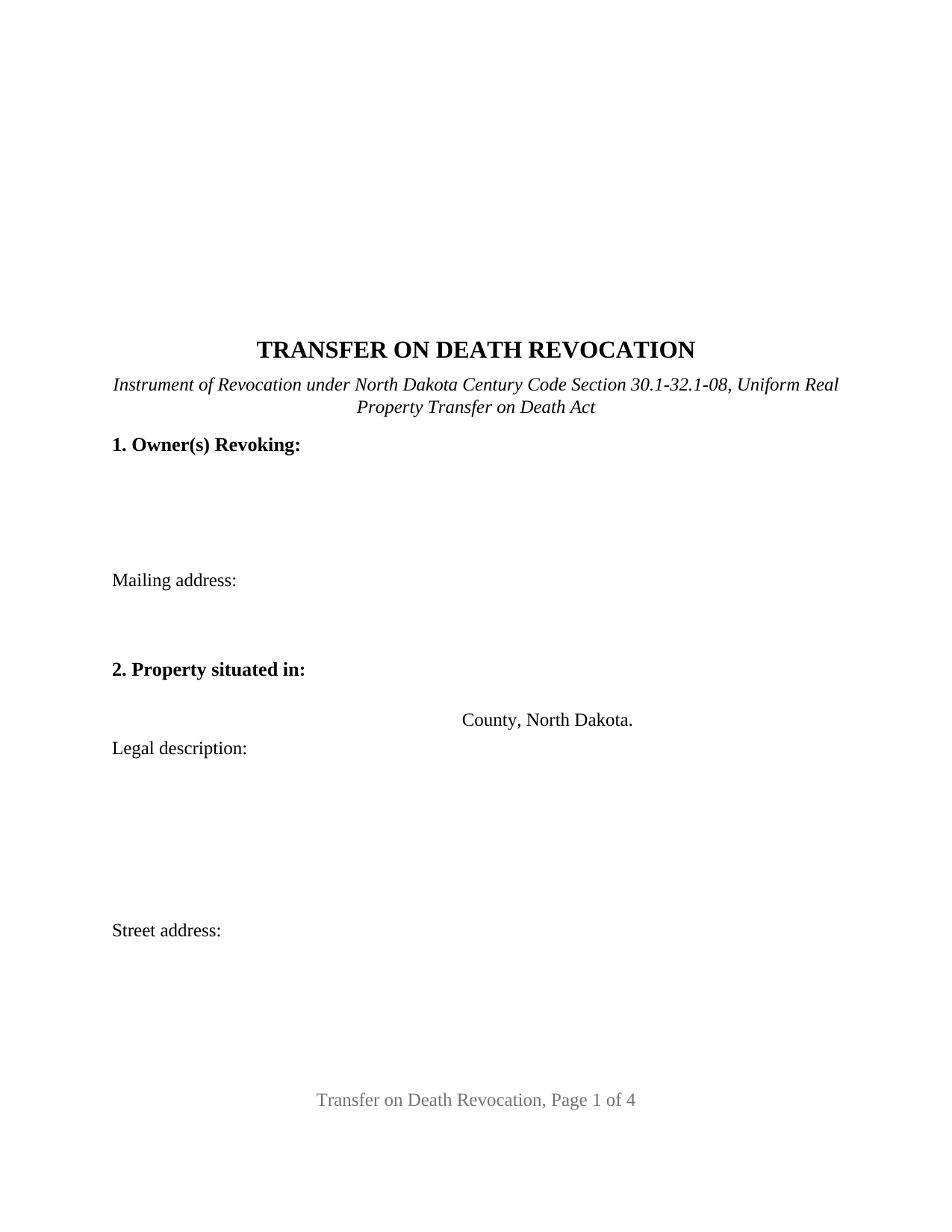
Billings County Transfer on Death Revocation Form
Fill in the blank Transfer on Death Revocation form formatted to comply with all North Dakota recording and content requirements.
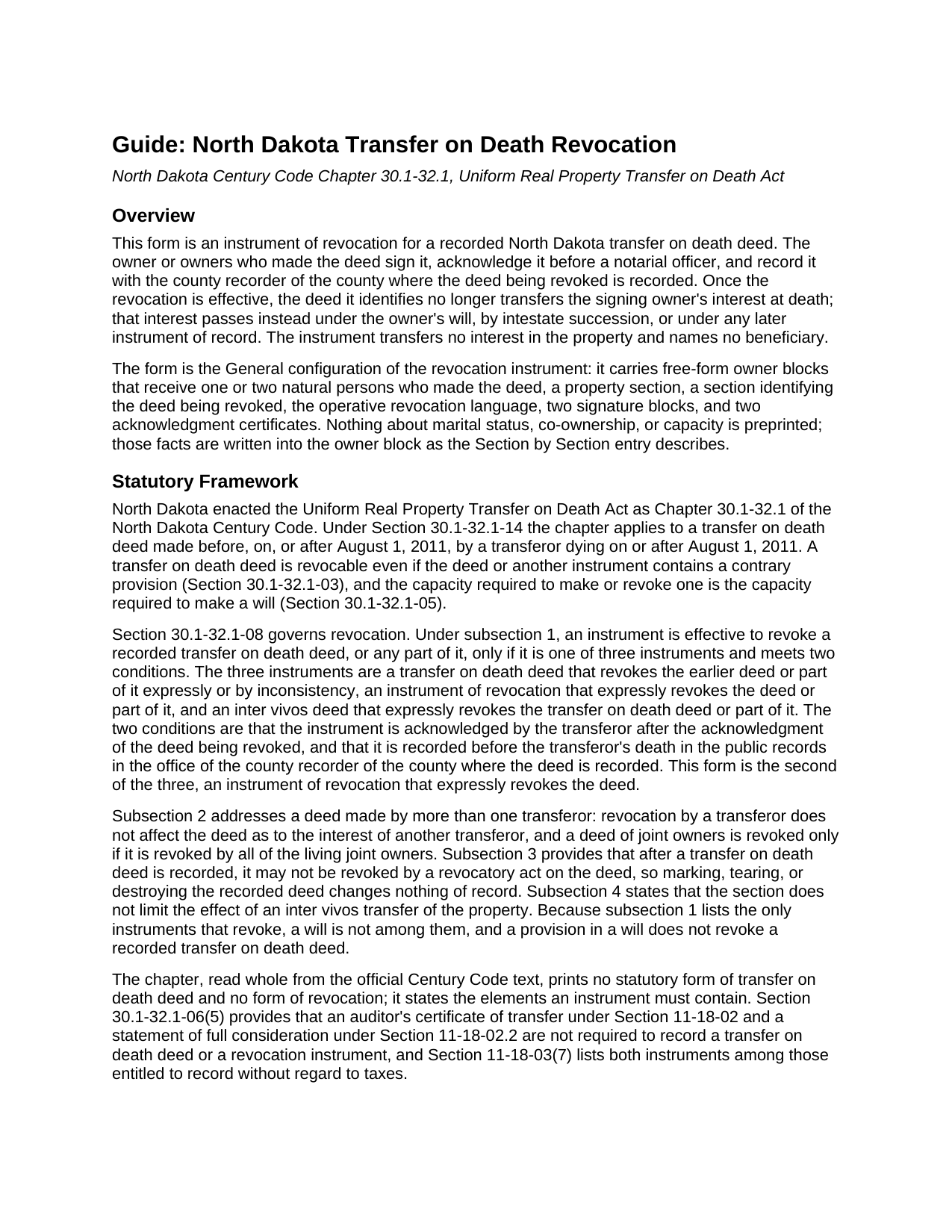
Billings County Transfer on Death Revocation Guide
Line by line guide explaining every blank on the Transfer on Death Revocation form.
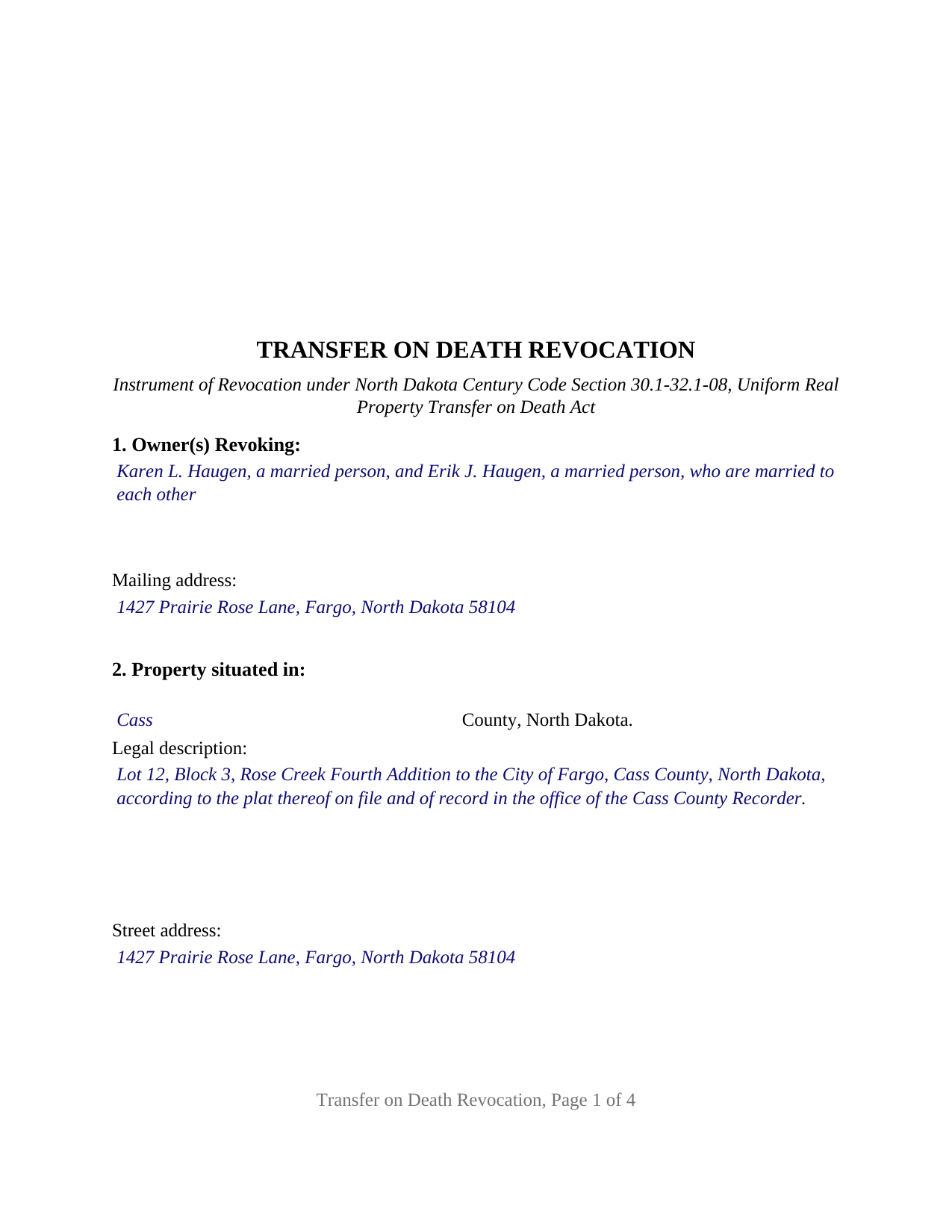
Billings County Completed Example of the Transfer on Death Revocation Document
Example of a properly completed North Dakota Transfer on Death Revocation document for reference.
All 3 documents above included • One-time purchase • No recurring fees
Immediate Download • Secure Checkout
Additional North Dakota and Billings County documents included at no extra charge:
Where to Record Your Documents
Billings County Recorder/Clerk of Court
Medora, North Dakota 58645
Hours: 8:00 to 4:00 Mo-Fr; Summer: 7:00 to 4:00 Mo-Th, 8:00 to 12:00 Fr
Phone: (701) 623-4491
Recording Tips for Billings County:
- Bring your driver's license or state-issued photo ID
- Ensure all signatures are in blue or black ink
- White-out or correction fluid may cause rejection
- Ask about their eRecording option for future transactions
- Avoid the last business day of the month when possible
Cities and Jurisdictions in Billings County
Properties in any of these areas use Billings County forms:
- Fairfield
- Medora
Hours, fees, requirements, and more for Billings County
How do I get my forms?
Forms are available for immediate download after payment. The Billings County forms will be in your account ready to download to your computer. An account is created for you during checkout if you don't have one. Forms are NOT emailed.
Are these forms guaranteed to be recordable in Billings County?
Yes. Our form blanks are guaranteed to meet or exceed the applicable formatting requirements used for recording in Billings County, including margin requirements, font requirements, and other layout standards. This guarantee applies to formatting, not to the legal sufficiency of information entered by the user or the suitability of a form for a particular transaction.
Can I reuse these forms?
Yes. You can reuse the forms for your personal use. For example, if you have multiple properties in Billings County you only need to order once.
What do I need to use these forms?
The forms are PDFs that you fill out on your computer. The free Adobe Acrobat Reader is recommended, and most PDF apps also work. You do NOT enter your property information online - you download the blank forms and complete them privately on your own computer.
Are there any recurring fees?
No. This is a one-time purchase. Nothing to cancel, no memberships, no recurring fees.
How much does it cost to record in Billings County?
Recording fees in Billings County vary. Contact the recorder's office at (701) 623-4491 for current fees.
Questions answered? Let's get started!
A North Dakota transfer on death deed stays revocable for the owner's whole life, but the revocation takes a recorded instrument. This form prepares the instrument of revocation that Section 30.1-32.1-08 of the North Dakota Century Code names: a document the owner or owners who made the deed sign, acknowledge, and record with the county recorder where the deed is on file. It revokes a recorded transfer on death deed in its entirety as to each signing owner's interest, transfers nothing, and names no beneficiary.
Revocation happens on the record, not on the deed
North Dakota adopted the Uniform Real Property Transfer on Death Act as Chapter 30.1-32.1, and the chapter is strict about how a TOD deed, sometimes searched for as a beneficiary deed, comes out of effect. Section 30.1-32.1-08(1) lists three instruments that revoke a recorded deed: a later transfer on death deed that revokes it expressly or by inconsistency, an instrument of revocation that expressly revokes it, and an inter vivos deed that expressly revokes it. Nothing else does. Subsection 3 states that once a transfer on death deed is recorded it may not be revoked by a revocatory act on the deed, so crossing out the beneficiary, tearing up the owner's copy, or writing a contrary instruction in a will leaves the recorded deed exactly where it was. This instrument is the second item on the statute's list, written to revoke the deed expressly and with no other purpose.
Acknowledged after, recorded before
The same section attaches two timing conditions, and the form is built around both. The instrument is effective only if it is acknowledged by the transferor after the acknowledgment of the deed being revoked, and only if it is recorded before the transferor's death in the office of the county recorder of the county where the deed is recorded. Section 3 of the form therefore collects the date the original deed was acknowledged, taken from the notarial certificate on the recorded deed, beside its recording date, document number, and recording county, so the record shows the sequence the statute requires. A capital letter statement in Section 4 restates the two conditions in the statute's words on the instrument itself, because an unrecorded revocation at the owner's death revokes nothing and the deed then operates as written.
The capacity to revoke is the capacity to make a will under Section 30.1-32.1-05, and the operative paragraph recites it. The revocation leaves the property where it was during the owner's life: a transfer on death deed creates no interest in the beneficiary while the owner lives under Section 30.1-32.1-09, and revoking it simply removes the designation that would have operated at death. The owner's interest then passes under a will, by intestate succession, or under any later instrument of record.
One owner or two, each as to that owner's interest
The form recites one or two natural persons who made the deed, each signing in that person's own right. The owner block is free-form: it receives one name or two, written as they appear on the recorded deed, with whatever marital status recital the signer writes in, and nothing about status or co-ownership is preprinted. Two signature blocks and two separate acknowledgment certificates follow, so two owners can acknowledge on the same day before one notarial officer, as the completed example shows, or on different days in different places. Where one owner revokes, the second block and its certificate stay blank.
Section 30.1-32.1-08(2) decides what a signature accomplishes when a deed was made by more than one transferor: revocation by one transferor does not affect the deed as to another transferor's interest, and a deed of joint owners is revoked only if all of the living joint owners revoke it. The patterns that present this form are a sole owner revoking a deed made alone, two owners revoking a deed they made together, one of two tenants in common revoking as to that owner's share, and the last surviving joint owner revoking a deed the joint owners once made. The form is not set up as a revocation by an entity, a trustee, a person signing under a power of attorney, or three or more owners on one instrument. An owner who wants a different beneficiary rather than none records a new transfer on death deed, which is a separate instrument prepared and recorded separately and not included in this package.
No auditor stamp and no consideration statement
A deed presented for recording in North Dakota ordinarily carries the county auditor's certificate of transfer under Section 11-18-02 and a statement of full consideration under Section 11-18-02.2 on its face. Section 30.1-32.1-06(5) provides that neither is required to record a transfer on death deed or a revocation instrument, and Section 11-18-03(7) lists both instruments among those entitled to record without regard to taxes. The revocation goes directly to the recorder with the statewide fee of Section 11-18-05, twenty dollars for an instrument of one to six pages, and it is drawn to the format that section describes: letter size pages, a three inch space across the top of the first page for the recorder's information, one inch margins on every page, and twelve point body type, larger than the ten point Calibri the section names as the minimum for a form not issued by a government agency.
The package includes the fillable instrument of revocation, a completed example filled in for a Cass County fact pattern, and a guide that walks through each section, the statute, and the recording process. The example and the guide describe the form and the governing North Dakota law in general terms; they are not legal advice.
Important: Your property must be located in Billings County to use these forms. Documents should be recorded at the county recording office listed above.
This Transfer on Death Revocation meets all recording requirements specific to Billings County.
Our Promise
The documents you receive here are guaranteed to meet or exceed the applicable Billings County recording format requirements. If there is a rejection caused by our formatting, we will correct the issue or refund your payment. This guarantee applies to document formatting only and does not extend to information entered by the user, the selection of the form, or the legal effect of the completed document.
Save Time and Money
Get your Billings County Transfer on Death Revocation form done right the first time with Deeds.com Uniform Conveyancing Blanks. At Deeds.com, we understand that your time and money are valuable resources, and we don't want you to face a penalty fee or rejection imposed by a county recorder for submitting nonstandard documents. We constantly review and update our forms to meet rapidly changing state and county recording requirements for roughly 3,500 counties and local jurisdictions.
4.8 out of 5 - ( 4,862 Reviews )
Charles S. 5 out of 5 stars
very happy with guidance and responses - thank you - not finished yet but confident
We are sincerely grateful for your feedback and are committed to providing the highest quality service. Thank you for your trust in us.
PAMELA D. 5 out of 5 stars
great response!! Thank you
Thank you!
QINGXIONG L. 2 out of 5 stars
The major problem is too expensive, particularly sometime, only few words need to file correction deed which cost 20 dollars!!
Thank you for your feedback. We really appreciate it. Have a great day!
Evelyn R. 5 out of 5 stars
Filing my deed through your service was great. All directions were clear and specific; it was very easy to upload the documents and most of all feedback from your office was professional and very timely. You service was excellent. Thank you!! Thank you so very much!!
Thank you for your feedback. We really appreciate it. Have a great day!
Kimberly G. 3 out of 5 stars
It would be helpful if there were a specific example of putting a deed into a trust. Also, the limitation of characters on the description of the property was not enough.
Thank you for your feedback. We really appreciate it. Have a great day!
Bonnie A. 5 out of 5 stars
I wish you could send copy in mail
Thank you for your feedback. We really appreciate it. Have a great day!
Kirstie W. 3 out of 5 stars
In California, the recorder charges a $75 fee for EVERY PAGE of any document related to real estate, with a $225 maximum. So the easement deed this company made is 3 pages, when it could easily have fit in 2 pages (including the notary page). So they just cost me an extra $75. Do better!
Thanks for the feedback. One correction, because it matters for anyone reading this: California's $75 fee (SB 2, Government Code 27388.1) is charged per document title, not per page, and the $225 cap applies to transactions with multiple documents or titles. Page count only affects the base recording fee, which is $3 per additional page. A three-page easement deed carries the same $75 as a two-page one would. Recording fees are set and collected by the county, not by Deeds.com, and the county recorder's published fee schedule is the place to confirm what you were charged.
Rocio G. 5 out of 5 stars
Better than in person service, I recommend this service 100%.
We appreciate your business and value your feedback. Thank you. Have a wonderful day!
Rhoads H. 5 out of 5 stars
Excellent, thank you.
Thank you!
Michael L. 5 out of 5 stars
Thumbs up. Very pleased with service. Easy process.
Thank you!
Arthur L. 5 out of 5 stars
The directions were clear, I typed the deed out and it was successfully recorded and mailed back to me in less than a week.
Thank you for your feedback. We really appreciate it. Have a great day!
Renata L. 3 out of 5 stars
Was a bit difficult to navigate. I feel a fee to access the site and a fee to print is a bit much. I am in the real estate business and find the deeds very useful
Thank you for your feedback. We really appreciate it. Have a great day!
Pamela L. 5 out of 5 stars
The packet was very comprehensive and easy to use (I had just one question that wasn't clearly explained). II appreciate that the forms are kept up to date.
We appreciate your business and value your feedback. Thank you. Have a wonderful day!
Bruce L. 5 out of 5 stars
Fantastic. The forms were easy to read and complete. Came with a guide and examples of how it looked completed Thanks!
We appreciate your business and value your feedback. Thank you. Have a wonderful day!
randy j. 1 out of 5 stars
the deed format and fill-in language are very specific to one type of easement and are not generally applicable to any other type; in other words it is not useful in a majority of situations and i would recommend against purchase unless you are creating an easement for an appurtenant landowner ONLY
Thank you for your feedback. We really appreciate it. Have a great day!