Ohio Affidavit of Confirmation (Beneficiary of Last Surviving Owner)
County Specific Legal Forms Validated as recently as October 23, 2026 by our Forms Development Team
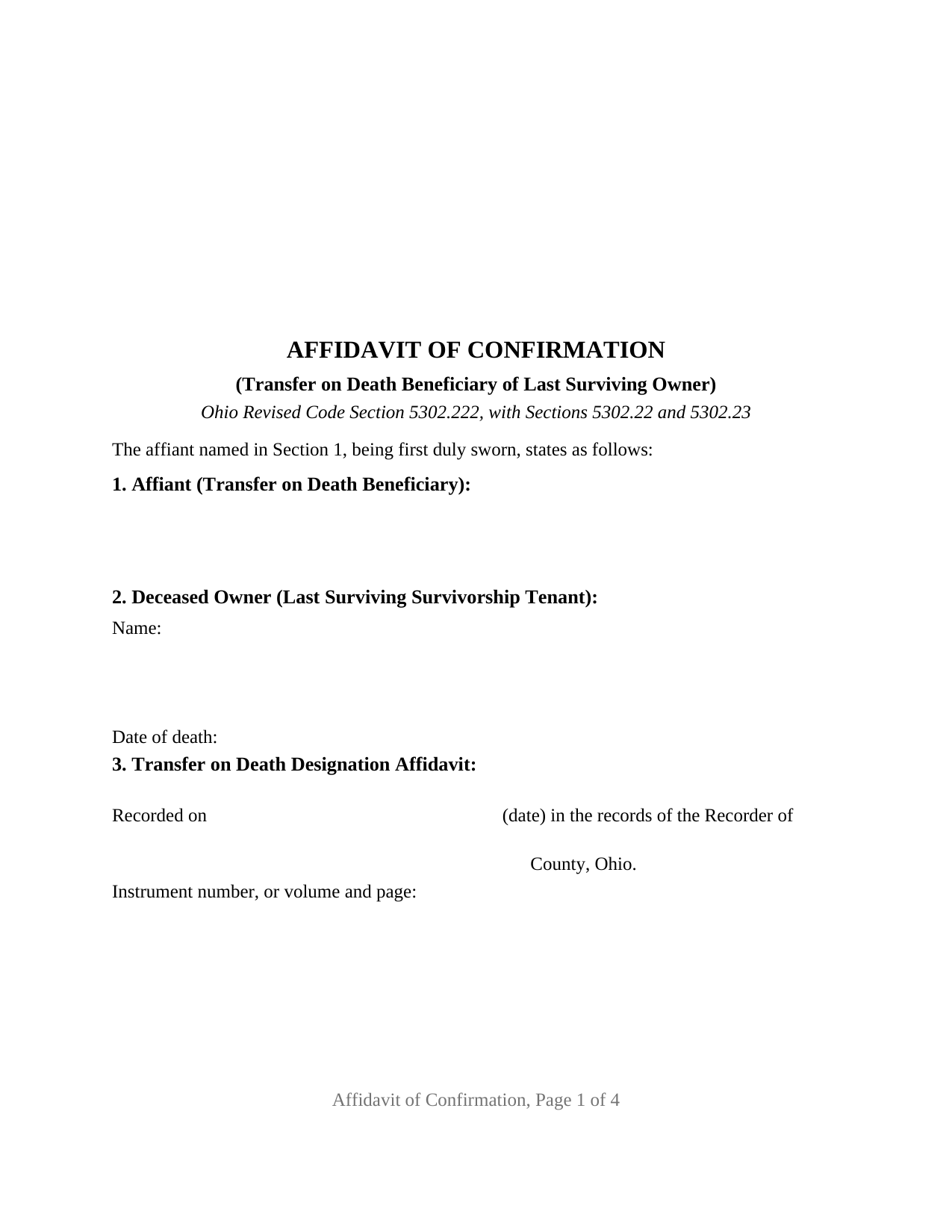
About the Ohio Affidavit of Confirmation (Beneficiary of Last Surviving Owner)
How to Use This Form
- Select your county from the list
- Download the county-specific form
- Fill in the required information
- Have the document notarized if required
- Record with your county recorder's office
What Others Like You Are Saying
"Awesome, so far. Thanks"
"Very good. The right forms and instructions . Thanks"
"The transaction was easy and the download was immediately, What a great service to provide for a rea…"
"Very Pleased. Was so easy and No hidden cost. Second time I have used their services. Would not use …"
"I used the Affidavit of Death form provided by Deeds.com. The form and directions were easy to follo…"
4.8/5 from 4,830 reviews. Read all
When the last of two or more Ohio survivorship owners dies, a recorded transfer on death designation affidavit finally does its work: under Ohio Revised Code Section 5302.22(C)(2), title vests in the named transfer on death beneficiaries at that last death, and nothing passed to them while any survivorship tenant was alive. This Ohio Affidavit of Confirmation is the sworn instrument written for that moment, prepared for a beneficiary of the last surviving survivorship tenant to present to the county auditor and file with the county recorder under Section 5302.222.
A designation that waits for the last death
A survivorship deed under Section 5302.17 carries the property to the surviving owner at each death. When survivorship tenants also record a transfer on death designation affidavit, the TOD affidavit that replaced Ohio's transfer on death deed in 2009, Section 5302.22(C)(2) layers the two: at one tenant's death, title vests in the surviving tenants; at the death of the last surviving survivorship tenant, title vests in the transfer on death beneficiaries. Section 5302.23(B)(7)(b) makes the last death the one that matters. A designation made solely by a tenant who died earlier, without joinder by the tenant who became the last survivor, was nullified at that earlier death. This affidavit states, under oath, the facts of the surviving path: the deceased owner was the last surviving survivorship tenant, executed the designation affidavit, and that affidavit was recorded before the death.
What the sworn statements place of record
Section 5302.222 prescribes no form, so this affidavit tracks the statute's list of contents: the name and address of each transfer on death beneficiary who survived the deceased owner or that was in existence on the date of death, the date of death, a description of the real property with its parcel number and prior instrument reference, and the name of each designated beneficiary who did not survive. Certified death certificates for the deceased owner and for each beneficiary who did not survive accompany it. The operative sentence makes the affidavit of confirmation under Section 5302.222 to record the transfer to the surviving beneficiaries. A knowingly false statement is falsification under Section 2921.13(A)(6), which is why the instrument is sworn rather than merely signed.
One affiant, one jurat
This configuration carries exactly one signature block and one jurat certificate. Section 5302.222(A) is satisfied by an affidavit executed by any transfer on death beneficiary to whom the transfer is made, so one beneficiary swears to the affidavit and the other surviving beneficiaries are named without signing. The certificate is a jurat in the words Section 147.542(C)(3)(b) accepts, Sworn to and subscribed before me, with the venue, date, signature, printed name, seal, and commission expiration that Section 147.542(F) requires. A deceased owner who held alone, as a tenant in common, or as a tenant by the entireties under a 1972 to 1985 deed presents a different pattern, as does the earlier death of a tenant who was not the last survivor, which Section 5302.17 records by its own affidavit or certificate of transfer, a separate instrument not included in this package. Children taking a parent's home after the second parent's death, and siblings or partners who held as survivorship tenants and named the next generation, present the pattern this affidavit states.
Auditor first, then recorder
The statute sends the affidavit to the county auditor of the county where the property lies before the county recorder files it. The Section 319.202 conveyance fee statement, DTE 100 or DTE 100EX, travels with it, and the auditor transfers the property on the tax list to the named beneficiaries, which is why their mailing addresses and the prior instrument reference appear on its face. The form is built to Section 317.114: a three inch blank top margin on the first page, one inch side and bottom margins, a one and one half inch top margin on later pages, and 12 point body text over the 10 point floor. Recording fees under Sections 317.32 and 317.36 are $34 for the first two pages and $8 for each page after, before any county document preservation surcharge of up to $5.
The package contains the fillable affidavit of confirmation with its non-recorded instructions page, a completed example filled in for a Franklin County fact pattern, and a guide that walks through each section, the jurat, and the auditor and recorder steps. The description and the guide describe the form and the governing Ohio statutes in general terms; they are not legal advice.
Important: County-Specific Forms
Our affidavit of confirmation (beneficiary of last surviving owner) forms are specifically formatted for each of the 88 counties in Ohio.
After selecting your county, you'll receive forms that meet all local recording requirements, ensuring your documents will be accepted without delays or rejection fees.