Ohio Affidavit of Confirmation (Trustee Beneficiary)
County Specific Legal Forms Validated as recently as October 23, 2026 by our Forms Development Team
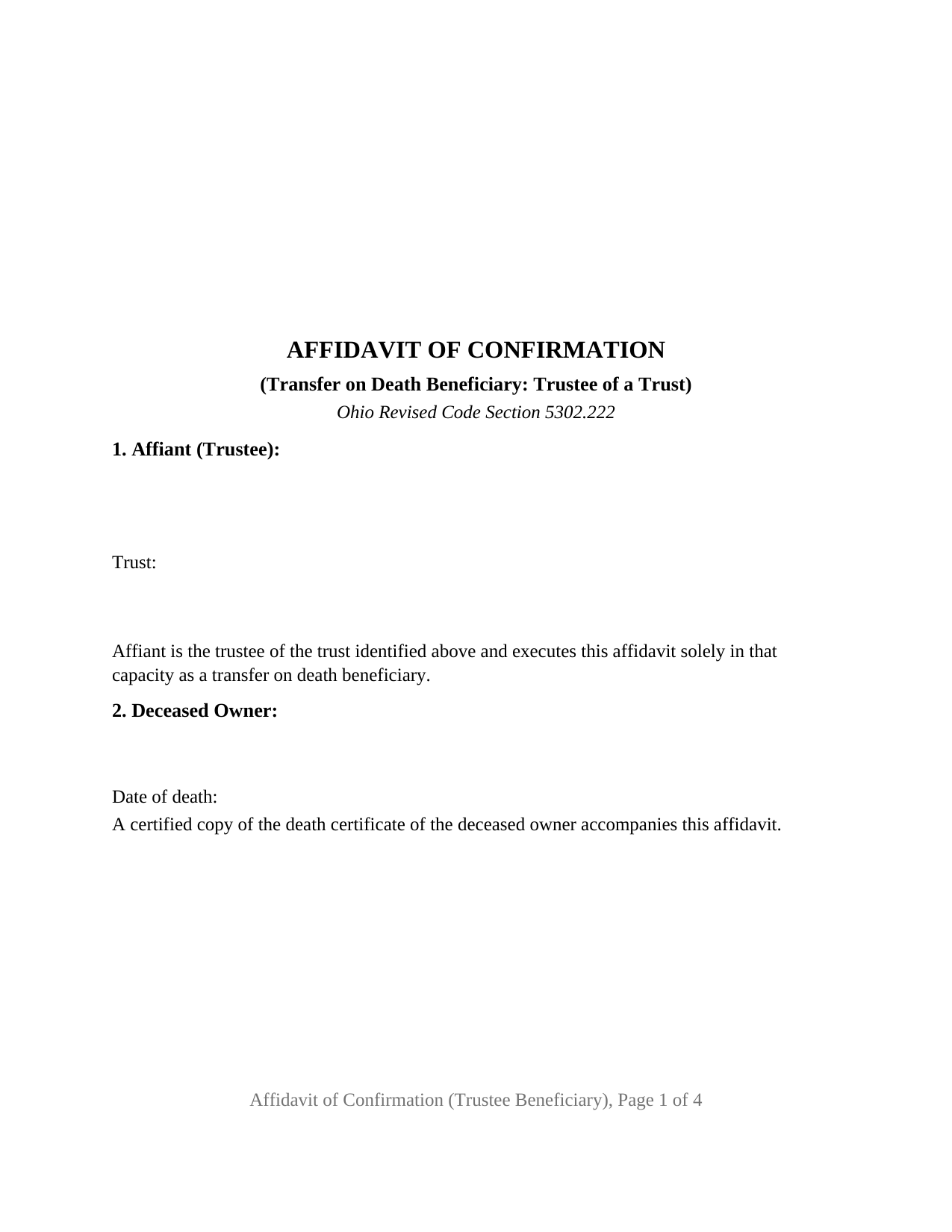
About the Ohio Affidavit of Confirmation (Trustee Beneficiary)
How to Use This Form
- Select your county from the list
- Download the county-specific form
- Fill in the required information
- Have the document notarized if required
- Record with your county recorder's office
What Others Like You Are Saying
"Easy to fill-in forms, easy instructions, worth purchasing"
"I was pleasantly surprised as I didn't even know you can record a quit claim deed digitally. I am in…"
"we are hoping this is what we need. Thanks"
"Great service, well worth the $15 fee. Especially helpful was the review of my documentation and the…"
"So very easy to use and we're so glad we could do everything from our home office."
4.8/5 from 4,831 reviews. Read all
When an Ohio property owner names a trust as the transfer on death beneficiary of real estate and later dies, the trustee holds title the moment the owner dies, but the county records still show the owner's name. This Ohio Affidavit of Confirmation (Trustee Beneficiary) is the sworn instrument under Ohio Revised Code Section 5302.222 that a trustee presents to the county auditor and files with the county recorder to place that transfer on the public record. One affiant signs it: the trustee of the designated trust.
A beneficiary that exists rather than survives
Section 5302.22(G) transfers the deceased owner's interest to the beneficiaries named in the designation affidavit who survive the owner or that are in existence on the date of death, and Section 5302.23(B)(3) permits a beneficiary to be any natural or legal person, including a bank as trustee of a trust. A trust does not survive anyone; it exists or it does not. The affidavit of confirmation therefore states that the trust was in existence on the date of the owner's death and identifies the trust by name and date beside the trustee who signs.
When the trustee named in the designation has changed
Where the trustee named in the designation affidavit has died, resigned, or been replaced by the owner's death, Section 5302.22(G) treats the successor trustee as the beneficiary in existence on the date of death even though the designation never named the successor, and Section 5302.222(A)(1) then adds two requirements to the affidavit of confirmation: the name and address of the successor trustee and a copy of the recorded successor trustee affidavit described in Section 5302.171. The form carries a block for the trustee as originally named and a block for the recorded successor trustee affidavit; a trustee who has served from the start enters None, as in the completed example.
What the trustee swears to
Section 5302.222 lists the contents of the affidavit, and the form follows the list: the deceased owner and the date of death, the recorded designation affidavit by recording date, instrument number, and county, the property by legal description, parcel number, and street address, the interest the designation covered, every other transfer on death beneficiary who survived the owner or that was in existence at death, with a mailing address for each, and every beneficiary who did not. Certified death certificates accompany it for the owner and for each deceased beneficiary named. The confirmation section states that the transfer covers only the interest the deceased owner held on the date of death, subject to all encumbrances, reservations, and exceptions, the limit Section 5302.23(B)(7)(a) places on every transfer on death beneficiary. A knowingly false statement in the affidavit is falsification under Section 2921.13(A)(6), a point Section 5302.222(E) makes expressly.
The trustee configuration
The form carries one signature block, captioned for the affiant as trustee, and one jurat certificate rather than an acknowledgment, because Section 5302.222 requires the affidavit to be verified before a person authorized to administer oaths. A trust whose trustee has served without change, one whose named trustee has been succeeded, and a bank serving as trustee each present the pattern this affidavit describes. The form is not set up as an affidavit by a beneficiary signing in that person's own right, by an entity taking in its own name, or by two or more beneficiaries signing together; any one beneficiary to whom the transfer is made may execute the affidavit, and the trustee's affidavit lists the others.
Auditor first, then recorder
The affidavit goes first to the county auditor of the county where the property is located, with the auditor's conveyance fee statement, form DTE 100EX where an exemption under Section 319.54(G)(3) is claimed, and the certified death certificate; the auditor endorses it and moves the parcel into the trustee's name for tax purposes. It is then filed with the county recorder, who records it under Section 5302.222(C). The form follows the Section 317.114 recording standard, including the 3 inch blank top margin on the first page that Ohio reserves for the auditor's and recorder's endorsements, and carries the preparer block Section 317.111 requires.
The package includes the fillable affidavit, a completed example filled in for a Franklin County trust beneficiary, and the guide that walks through every numbered section, the jurat, and the auditor and recorder steps. This description and the guide describe the form and the governing Ohio statutes in general terms; they are not legal advice.
Important: County-Specific Forms
Our affidavit of confirmation (trustee beneficiary) forms are specifically formatted for each of the 88 counties in Ohio.
After selecting your county, you'll receive forms that meet all local recording requirements, ensuring your documents will be accepted without delays or rejection fees.