Ohio Affidavit of Confirmation (Married Beneficiaries)
County Specific Legal Forms Validated as recently as October 23, 2026 by our Forms Development Team
About the Ohio Affidavit of Confirmation (Married Beneficiaries)
How to Use This Form
- Select your county from the list
- Download the county-specific form
- Fill in the required information
- Have the document notarized if required
- Record with your county recorder's office
What Others Like You Are Saying
"Great website, efficient and informational. Very helpful!"
"I found exactly the perfect forms that I needed with Deeds, and much more. I definitely will be usin…"
"Excellent service. Easy to use"
"Thank you for the thorough assortment of forms!"
"I found the documents I needed and so many more that I will utilize for business, personal and famil…"
4.8/5 from 4,830 reviews. Read all
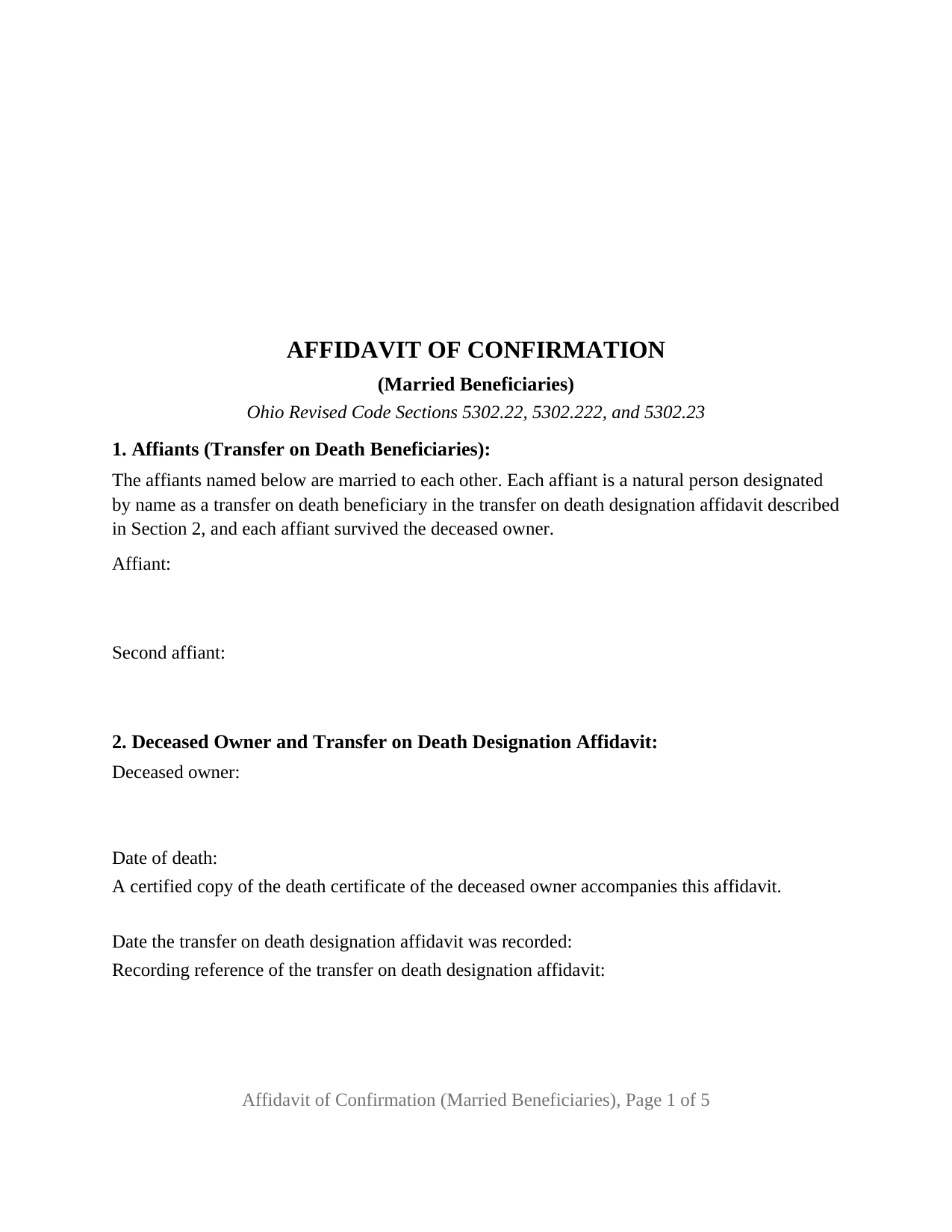
Two spouses named together as the transfer on death beneficiaries of Ohio real estate can place the transfer of record with one sworn instrument that both of them sign. This Ohio Affidavit of Confirmation (Married Beneficiaries) is that instrument under Ohio Revised Code Section 5302.222: an affidavit by two affiants who are married to each other, each named in the recorded transfer on death designation affidavit, presented to the county auditor and filed with the county recorder after the owner's death.
Two beneficiaries, one affidavit, two oaths
Section 5302.222(A) has the transfer recorded by an affidavit of confirmation executed by any transfer on death beneficiary to whom the transfer is made, verified before a person authorized to administer oaths. This form has both spouses swear. Its first section prints the configuration as fixed text: the affiants are married to each other, each is designated by name in the designation affidavit, and each survived the deceased owner. Both names and mailing addresses go on the face of the instrument for the auditor's tax list under Section 319.20. The form carries two signature blocks, headed AFFIANT and SECOND AFFIANT, and two jurat certificates, one for each spouse, so the oaths may be taken on different days or before different officers.
How the spouses hold title afterward
The affidavit of confirmation does not decide how the couple owns the property; the deceased owner's designation affidavit already did. Under Section 5302.23(B)(1), two or more transfer on death beneficiaries take title in equal shares as tenants in common unless the owner designated other than equal shares or designated the beneficiaries as survivorship tenants. The form's confirmation section states that the beneficiaries take title in the shares and in the manner stated in the designation affidavit: a survivorship designation carries the home to the surviving spouse at the first of their deaths, while one without survivorship language leaves each spouse an undivided half. No tenancy by the entireties results, since Section 5302.22(A)(4) recognizes that estate only under deeds recorded between 1972 and 1985, and dower under Section 2103.02 attaches to each spouse's share.
What the sworn statements carry
Section 5302.222 lists the affidavit's contents rather than printing a form, and the form follows the list. The deceased owner and the recorded designation affidavit are identified by name, date of death, and recording reference, with fixed text stating that the designation was recorded before the death and that no later affidavit revoked or changed it. The property section carries the legal description, parcel number, street address, and prior instrument reference; a fourth section lists any other beneficiaries, who do not sign. The operative section has no blanks: the affiants, each first duly sworn, make the affidavit of confirmation under Section 5302.222 to record the transfer on death of the deceased owner's interest, subject to all encumbrances, reservations, and exceptions. A knowingly false statement is falsification under Section 5302.222(E).
The couples this configuration describes
A parent who named a son and daughter-in-law as the beneficiaries of the family home, and an aunt who named a niece and the niece's husband as the beneficiaries of a rental duplex, present the two-affiant pattern the form states. The form is not set up as an affidavit by one beneficiary signing alone, by a trustee or an entity, by a contingent beneficiary taking the place of one who died first, or for a transfer that waited for the last death among survivorship tenants. In practice the instrument is also called a TOD affidavit of confirmation.
Auditor, then recorder
The affidavit goes first to the county auditor of the county where the property lies, with a certified copy of the owner's death certificate and the Section 319.202 conveyance fee statement, and then to the county recorder, who provides the Medicaid estate recovery form Section 5302.221 prescribes and records the affidavit under Section 5302.222(C). The form follows the Section 317.114 standard, with twelve point body text and the three inch blank top margin on the first page, and carries the preparer statement Section 317.111 requires. Its five pages record for $58 at the statewide fee under Sections 317.32 and 317.36, before any county surcharge.
The package includes the fillable affidavit of confirmation, a completed example filled in for a Franklin County couple, and the guide that describes every section, both jurats, and the path through the auditor's and recorder's offices. This description and the guide treat the form and the Ohio statutes that govern it in general terms only; neither is legal advice.
Important: County-Specific Forms
Our affidavit of confirmation (married beneficiaries) forms are specifically formatted for each of the 88 counties in Ohio.
After selecting your county, you'll receive forms that meet all local recording requirements, ensuring your documents will be accepted without delays or rejection fees.