Ohio Limited Warranty Deed (Corporation Grantor)
County Specific Legal Forms Validated as recently as October 21, 2026 by our Forms Development Team
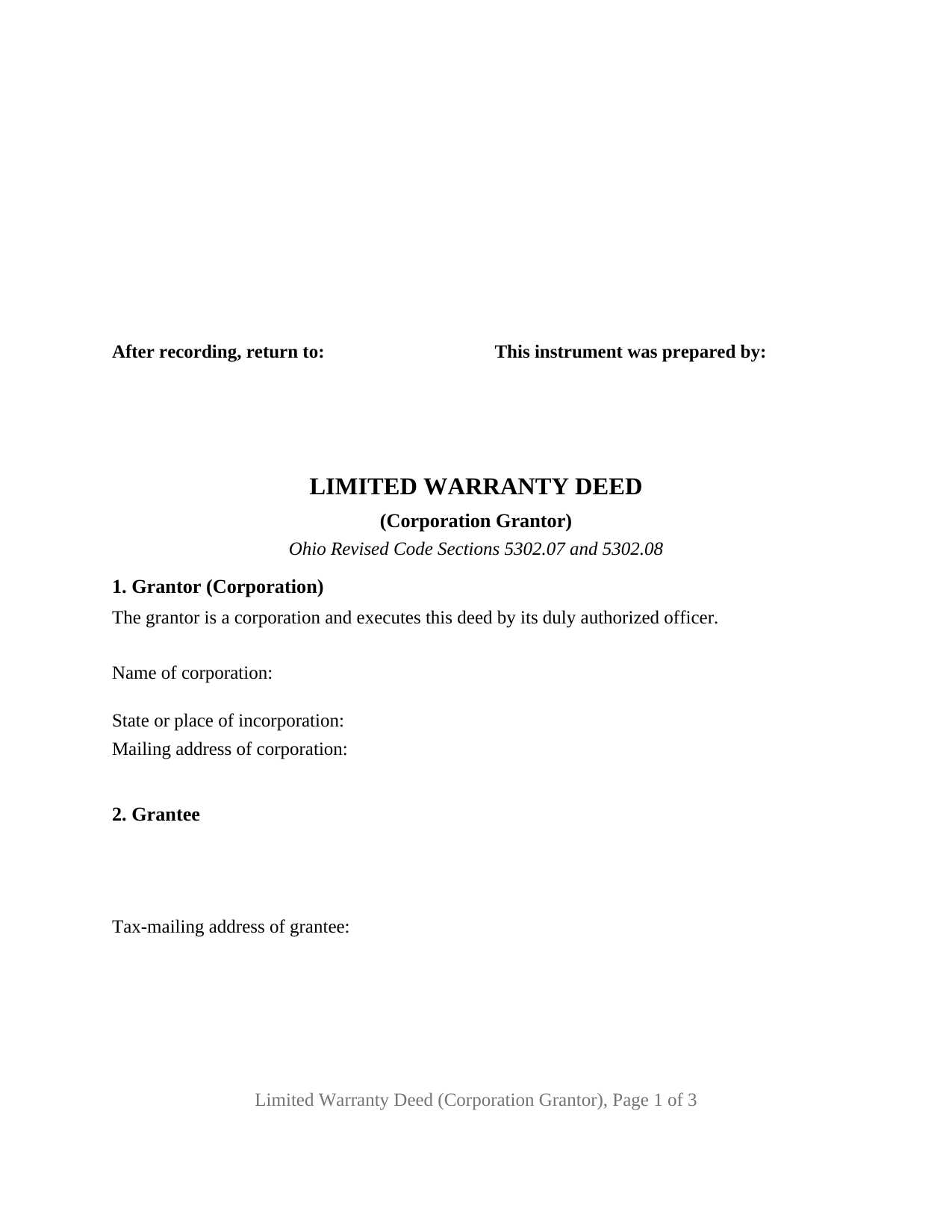
About the Ohio Limited Warranty Deed (Corporation Grantor)
How to Use This Form
- Select your county from the list
- Download the county-specific form
- Fill in the required information
- Have the document notarized if required
- Record with your county recorder's office
What Others Like You Are Saying
"The service provided was exactly what I needed. The downloadable deed and supporting documents allow…"
"Great product and service. So convenient."
"The site is a good idea, however, I couldn't find what I needed with just the address alone. I was l…"
"Gave me exactly what i needed"
"Process was easy... paperwork was on point... process took less then one day..."
4.8/5 from 4,829 reviews. Read all
When an Ohio corporation sells real property, the deed is signed by a person who owns none of it. This fillable form prepares an Ohio limited warranty deed for exactly that signing: one corporation as grantor, one officer signing on its behalf, and one acknowledgment certificate in the corporate short form of Ohio Revised Code Section 147.55(B). The deed conveys in fee simple in the words of the Section 5302.07 statutory form, with the Section 5302.08 covenant against the corporation's own encumbrances and against claims by, through, or under it, but against none other.
One officer, one certificate, no dower
Section 1701.64 gives a corporation's officers the authority the directors determine, and Section 1701.13 provides that a missing corporate seal does not affect the validity of an instrument. The deed therefore carries a single signature block headed GRANTOR CORPORATION, BY ITS AUTHORIZED OFFICER, with the officer's printed name, the date, and the officer's title beneath the signature, and no seal line and no attesting secretary, neither of which Section 5301.01 requires. The notary's certificate names the officer and title, the corporation, and its state or place of incorporation, and recites that the acknowledgment was made on behalf of the corporation. Dower under Section 2103.02 is a spouse's interest in the other spouse's land; a corporation has no spouse, so the dower release sentence of the statutory form is omitted under the authority Section 5302.01 gives to alter the forms as circumstances require, and no spouse signs.
What the corporation promises
Limited warranty covenants are the middle of Ohio's three statutory covenant sets. The corporation warrants that it made no encumbrance that remains on the land beyond those the deed excepts, and it defends against anyone claiming through its own period of ownership. A judgment lien that attached while the corporation held title, a mortgage it gave and never released, an easement it granted: the covenant answers for these. A defect that predates the corporation's own deed is outside the promise, which is why the limited warranty set appears so often where the seller is a company.
Corporate authority behind the signature
The deed recites that the corporation executes it by its duly authorized officer, and the authority itself lives in the corporate record: a resolution of the directors, and, where the sale is of all or substantially all of the corporation's assets outside the usual and regular course of its business, the shareholder authorization Section 1701.76 requires, by two thirds of the voting power unless the articles set a different proportion not less than a majority. Section 1701.76(D) bars an action to set aside such a conveyance for noncompliance unless it is brought within ninety days. Title insurers commonly ask for the resolution and an incumbency certificate; neither is recorded with the deed.
The configuration this deed recites
The form recites exactly one grantor, a corporation, domestic or foreign, identified by name, state or place of incorporation, and mailing address, conveying to one or two grantees who may take with any designation of title Ohio recognizes, including the survivorship designation of Section 5302.17. A builder conveying a finished lot, a company selling the parcel it operated from, a corporate landlord disposing of a rental house, and a corporation distributing land to a shareholder present the pattern this deed recites. The form is not set up as a conveyance by a limited liability company, a partnership, a trustee, an attorney-in-fact, or a natural person, and not for a second signing officer or an attesting officer.
Auditor first, then recorder
The deed is built for Ohio's two-office path. It carries the grantee's tax-mailing address and a Prior Instrument Reference, the two items Section 319.20 requires before the county auditor transfers the parcel, together with the preparer's name under Section 317.111 and the survey-maker statement of Section 5301.25(B). The grantor pays the conveyance fee under Section 319.54 on the DTE 100 statement filed with the auditor, the auditor stamps and endorses the deed, and only then does Section 317.22 let the recorder accept it. The three-page instrument follows the Section 317.114 format.
The package includes the fillable corporation grantor deed, a completed example filled in for a Hamilton County conveyance by an Ohio corporation to two individual grantees, and a guide covering each section, the corporate signing pattern, and recording. This description and the guide describe the form and the Ohio statutes in general terms and are not legal advice.
Important: County-Specific Forms
Our limited warranty deed (corporation grantor) forms are specifically formatted for each of the 88 counties in Ohio.
After selecting your county, you'll receive forms that meet all local recording requirements, ensuring your documents will be accepted without delays or rejection fees.