Ohio Limited Warranty Deed (Individual Grantor by Attorney-in-Fact)
County Specific Legal Forms Validated as recently as October 21, 2026 by our Forms Development Team
About the Ohio Limited Warranty Deed (Individual Grantor by Attorney-in-Fact)
How to Use This Form
- Select your county from the list
- Download the county-specific form
- Fill in the required information
- Have the document notarized if required
- Record with your county recorder's office
What Others Like You Are Saying
"Your website worked but I am waiting for answers for two questions."
"Although I did not use the forms yet, it appears very easy to understand and navigate."
"Quick and complete. Thanks!"
"Thank you everything was as expected very good service"
"Thank you for offering this service. We were getting several different answers on how to solve our p…"
4.8/5 from 4,829 reviews. Read all
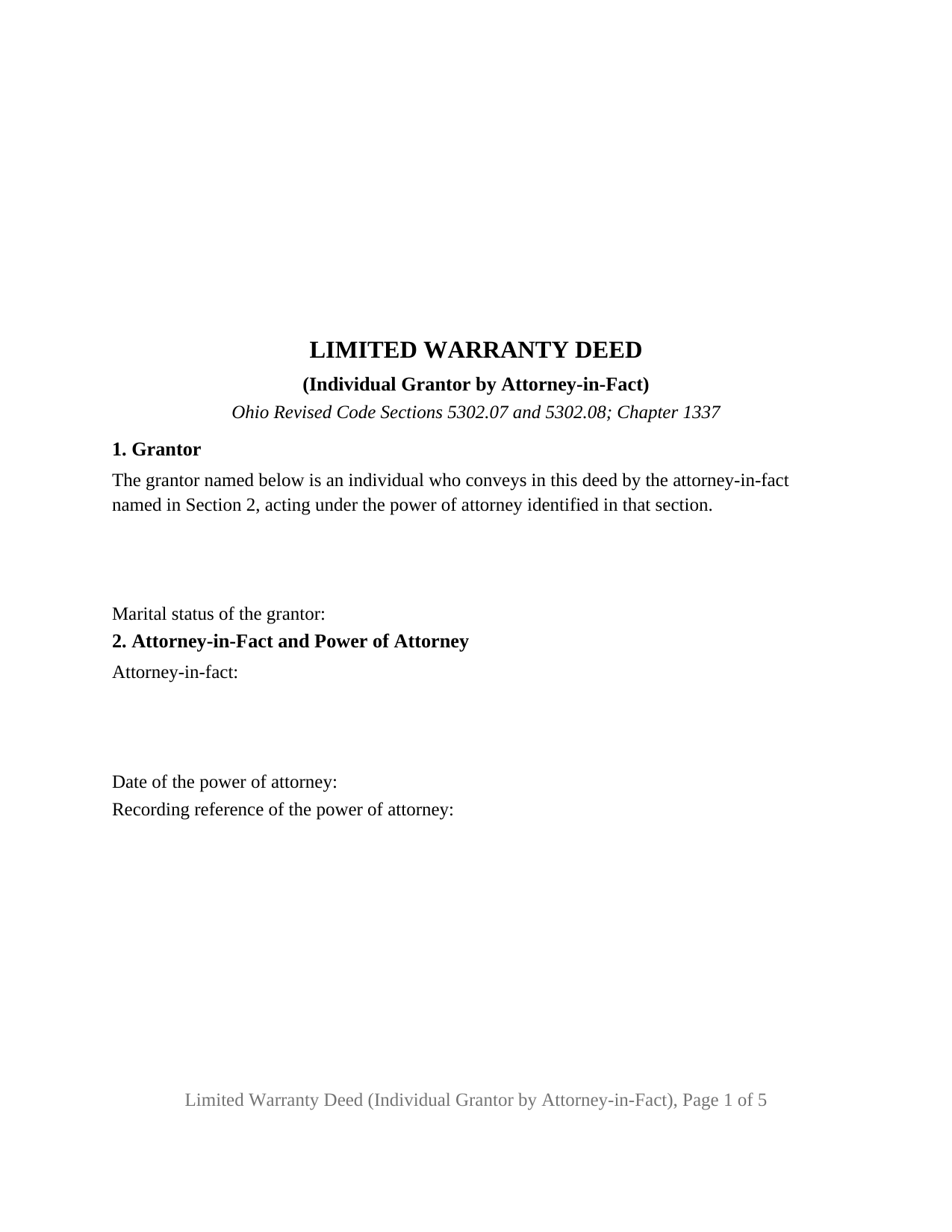
An Ohio limited warranty deed signed by an attorney-in-fact puts the grantor's name on the deed and another person's hand on the signature line. This fillable form prepares that deed for one individual grantor whose agent, acting under a recorded power of attorney, conveys Ohio real property with limited warranty covenants under Ohio Revised Code Sections 5302.07 and 5302.08. The grantor is named in Section 1 and does not sign; the attorney-in-fact is named in Section 2, signs the deed, and acknowledges it in a certificate written for that act.
A deed the grantor never signs
Section 1337.02 requires a deed made by virtue of a power of attorney to contain the name of the grantor, and provides that it conveys the grantor's interest as fully as if the grantor had signed in person. The form's Section 1 identifies the grantor as an individual who conveys through the attorney-in-fact named in Section 2, and its operative paragraph has the grantor, acting by and through that attorney-in-fact, grant with limited warranty covenants in the words of the statutory form. The Section 5302.08 definition of those covenants prints beneath it, so the limit of the promise reads on the face of the deed.
The power of attorney goes on record first
Section 1337.04, rewritten by Senate Bill 94 effective October 24, 2024, sets two sequence rules: the power of attorney is executed and acknowledged by the principal before the deed is, and it is recorded with the county recorder of the county where the land lies before the deed is recorded, a power of attorney recorded the same day but after the deed counting as recorded first. Section 2 of the form therefore collects the date and recording reference of the power of attorney beside the attorney-in-fact's name, so the deed points to the instrument that authorizes it. Where a power of attorney was never recorded ahead of the deed, the amended statute supplies an affidavit path for placing it of record later.
A certificate written for an agent
Section 147.55(E) publishes the statutory short form of acknowledgment for an individual acting as principal by an attorney in fact, and the first certificate on this form prints it, with blanks for the attorney-in-fact and for the grantor as principal, so the notary records the capacity in which the signer appeared. Section 5301.071(D) stands behind it: a recorded conveyance is not defective because an attorney in fact signed or acknowledged individually instead of in a representative capacity.
Dower stays with the spouse in person
Under Section 2103.02 the spouse of an Ohio property owner holds a dower interest in real property the owner held during the marriage until that interest is released or barred. The form fixes no marital status; a line in Section 1 records it. A second signature block, SPOUSE OF GRANTOR (if applicable), with its own Section 147.55(A) certificate for an individual acting in the individual's own right, receives the spouse's signature in person, and the sentence in Section 7 releases dower to the grantee when the spouse signs. An unmarried grantor leaves that block blank; a spouse who is also the attorney-in-fact signs twice and acknowledges in each capacity.
What this configuration recites
The form recites one grantor, a natural person, conveying through one attorney-in-fact under one power of attorney, and carries two acknowledgment certificates. An owner in a care facility whose adult child holds a durable power of attorney and sells the family home, an owner abroad or on military deployment whose agent closes the sale, and a seller who cannot attend a closing present the pattern this deed recites. The form is not set up as a conveyance by two or more grantors, by a grantor signing personally, or by an entity, trustee, or court-appointed fiduciary.
Auditor first, then recorder
The deed carries the grantee's tax-mailing address and a prior instrument reference, the two items Section 319.20 puts in front of the county auditor's transfer, and Section 317.22 keeps the recorder from accepting it until the auditor's endorsement appears. The pages keep the Section 317.114 margins, so the deed records at the base fee.
The package includes the fillable deed form, a completed example filled in for a Hamilton County fact pattern, and a guide that walks through the power of attorney statutes, every section of the form, the dower release, and the recording sequence. This description and the guide describe the form and the governing Ohio statutes in general terms; they are not legal advice.
Important: County-Specific Forms
Our limited warranty deed (individual grantor by attorney-in-fact) forms are specifically formatted for each of the 88 counties in Ohio.
After selecting your county, you'll receive forms that meet all local recording requirements, ensuring your documents will be accepted without delays or rejection fees.