Ohio Limited Warranty Deed (Trustee Grantee)
County Specific Legal Forms Validated as recently as October 21, 2026 by our Forms Development Team
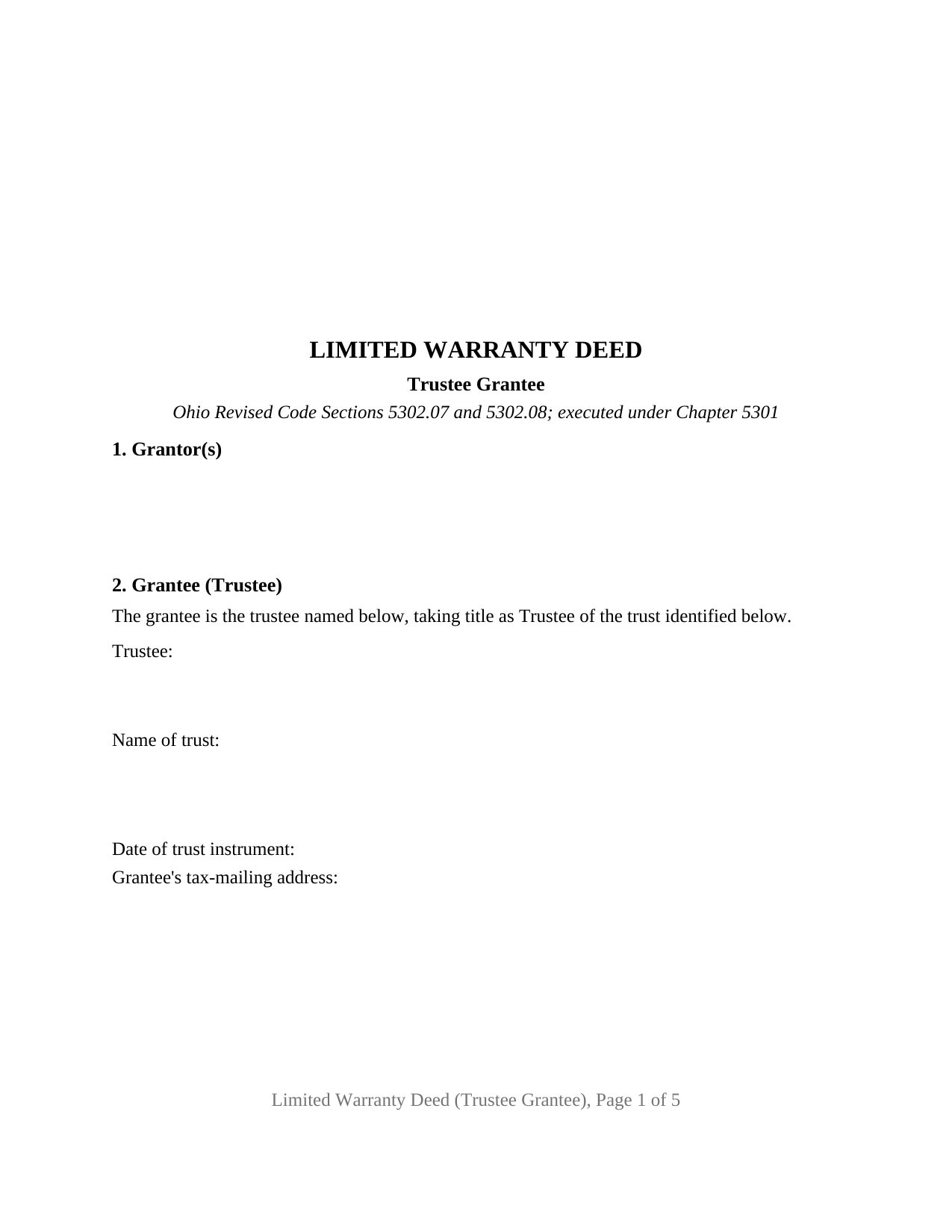
About the Ohio Limited Warranty Deed (Trustee Grantee)
How to Use This Form
- Select your county from the list
- Download the county-specific form
- Fill in the required information
- Have the document notarized if required
- Record with your county recorder's office
What Others Like You Are Saying
"Very easy forms to fill out and convenient since my county does not carry these forms , great servic…"
"Quick and easy, but the 2MB file limit ended up causing some big headaches. Had I known the limit co…"
"Happy with the forms and the service, would recommend to others."
"I have only used the service on one occasion but so far it has been great. Extremely simple to use."
"Very fast and efficient. Easy to fill out but was upset the latest tax exemptions ruled in 2014 did …"
4.8/5 from 4,829 reviews. Read all
An Ohio limited warranty deed with a trustee grantee moves real property into a trust: one or two individual owners convey to the trustee of a named trust, and the deed fixes that capacity on its face. The grantee section names the trustee, the trust, and the date of the trust instrument, and the conveyance states that the grantee takes and holds title as Trustee of that trust and not individually. The operative words are those of Ohio Revised Code Section 5302.07, grant(s), with limited warranty covenants, and the covenant is the one Section 5302.08 defines.
A deed to the trustee, not to the trust
Ohio title practice names the trustee as grantee. Section 5301.071(E) treats a recorded deed that named only the trust as a conveyance to its trustees, but only once a memorandum of trust describing the property is of record, a detour this form avoids: the trustee is named, the trust is identified by name and date, and co-trustees are entered together on the trustee line. When a couple funds their own revocable living trust, the same names appear on both sides of the deed, once as grantors and once as Trustees, and the deed says which capacity is which.
Why the limited covenant still matters
A conveyance to one's own trustee is not a sale, yet the choice of covenant is not idle. The limited warranty of Section 5302.08 promises that the premises are free from encumbrances made by the grantor and defends against claims by, through, or under the grantor, but against none other: a promise confined to the grantor's own acts, which Section 5302.07 extends to the grantee's heirs, assigns, and successors. A quitclaim carries no covenant at all; a general warranty reaches back through every prior owner. The form prints the Section 5302.08 definition in the statute's own words.
The memorandum of trust and the next conveyance
Recording this deed does not record the trust. Since June 16, 2026, Section 5301.255 requires a memorandum of trust, executed and acknowledged by the trustee and stating the trustee's name and address, the trust date, and the trustee's powers over real property, to be of record whenever the trustee of a disclosed trust conveys an interest in real property. The guide describes that memorandum, which is prepared and recorded separately and is not included in this package, and the certification of trust under Section 5810.13 that a bank or title company may accept in place of the trust instrument.
Exempt from the conveyance fee, still through the auditor
Every Ohio deed stops at the county auditor before the recorder. Section 319.54(G)(3)(t) exempts a transfer to a trustee of a trust when the grantor of the trust has reserved an unlimited power to revoke it, the ordinary revocable living trust, and the exemption is claimed on form DTE 100EX rather than paid. The auditor still looks for the trustee's tax-mailing address and the prior instrument reference under Section 319.20, both of which the form carries, and stamps the deed before the recorder takes it under Section 317.22. The guide covers the other trust-related exemptions, the county transfer tax, and the recorder's format and fee rules.
One or two grantors, one trust
The form recites exactly one trustee grantee, a single trustee or two co-trustees of one trust, and receives one or two natural-person grantors signing in their own right. It carries two signature blocks, GRANTOR and SECOND GRANTOR (if applicable), each followed by its own Section 147.55(A) acknowledgment certificate, and a release of dower under Section 2103.02 by each grantor who signs and the spouse of each grantor who signs. A married couple deeding their home to themselves as co-trustees of a joint revocable trust, a sole owner funding a personal trust with a spouse signing to release dower, and a parent conveying to the trustee of an irrevocable trust for children present the pattern this deed recites. The form is not set up as a conveyance by a trustee, by a corporation or limited liability company, by an executor, or by an attorney-in-fact, and not for three or more grantors.
The package includes the fillable deed, a completed example filled in for a Summit County fact pattern in which a married couple conveys to themselves as co-trustees, and a guide covering every section, the dower release, the memorandum of trust, and recording. The description and the guide describe the form and the Ohio statutes in general terms; they are not legal advice.
Important: County-Specific Forms
Our limited warranty deed (trustee grantee) forms are specifically formatted for each of the 88 counties in Ohio.
After selecting your county, you'll receive forms that meet all local recording requirements, ensuring your documents will be accepted without delays or rejection fees.