Oregon Bargain and Sale Deed (Simple Estate Affiant Distribution)
County Specific Legal Forms Validated as recently as October 9, 2026 by our Forms Development Team
About the Oregon Bargain and Sale Deed (Simple Estate Affiant Distribution)
How to Use This Form
- Select your county from the list
- Download the county-specific form
- Fill in the required information
- Have the document notarized if required
- Record with your county recorder's office
What Others Like You Are Saying
"Satisfactory. I was confused and somwhat lost on what to do and what I was getting."
"They deliver!"
"I wasn't sure what I was looking for initially so I printed out the wrong thing. Had to pay again to…"
"The product I purchased looks great and I added Adobe to be able to copy it, but for some reason I c…"
"Very fast, efficient, and convenient - thanks Deeds.com! I would recommend this service to everyone …"
4.8/5 from 4,828 reviews. Read all
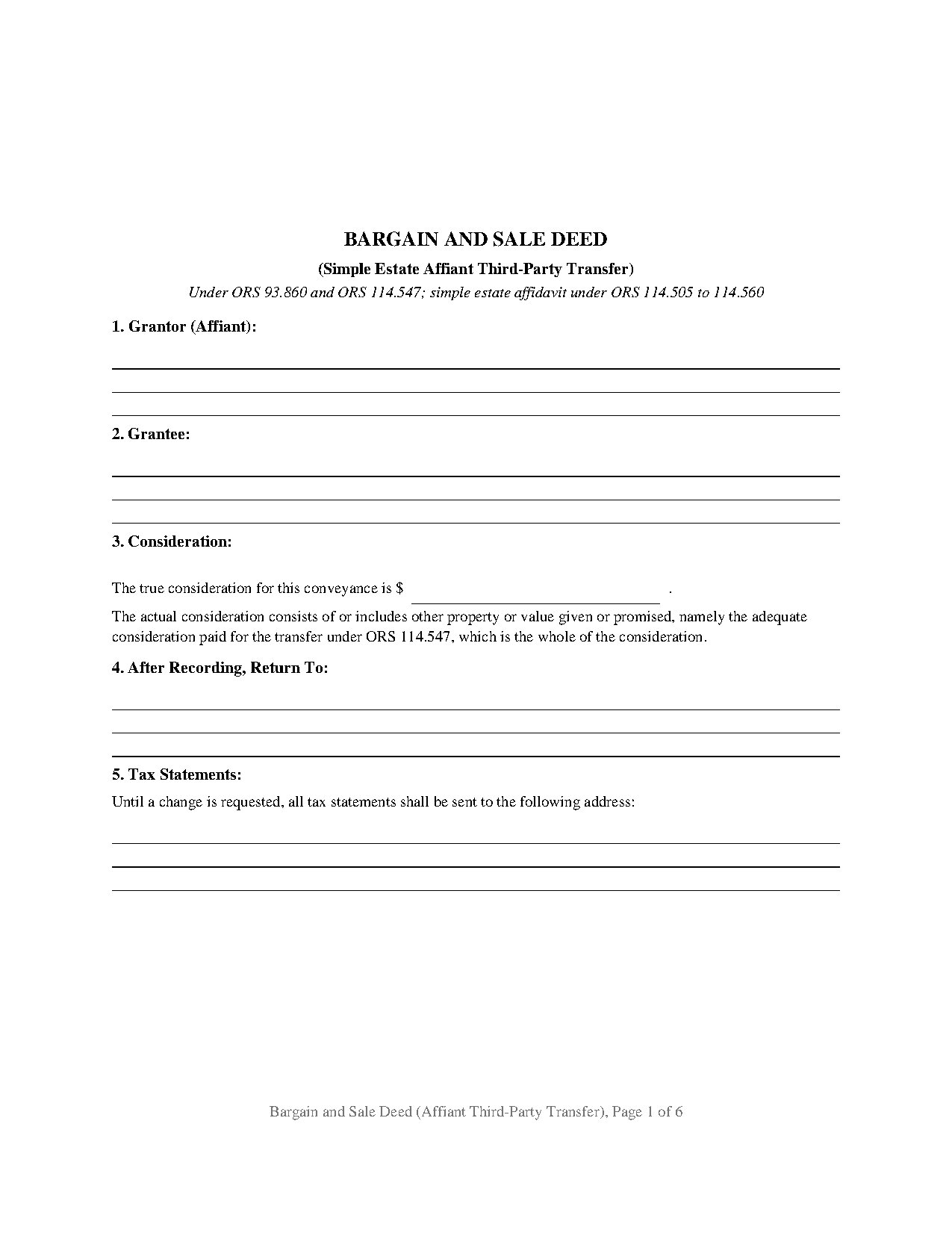
When an Oregon simple estate reaches the end of its claim period, the real property still standing in the decedent's name has to move onto the record in the names of the people who inherit it. ORS 114.555(3) names the instrument that does it: a bargain and sale deed from the affiant to the person entitled to the property, executed under ORS chapter 93 and recorded in the county where the land lies. This form prepares that deed, the Oregon Bargain and Sale Deed (Simple Estate Affiant Distribution), for an affiant conveying to one or two heirs or devisees.
The conditions the deed recites
ORS 114.555(1)(a) does not let the affiant distribute on any day the affiant chooses. The transfer follows the four-month period described in ORS 114.540 with no petition to appoint a personal representative on file, follows payment of the unsecured creditors to the extent of the estate's property, and precedes the close of the two-year review period of ORS 114.550. The conveyance paragraph of this deed recites each of those facts beside the grant, so a later title examiner sees a distribution that met the section's terms, with the affidavit identified by decedent, court, case number and filing date.
What the heirs take
The grantee receives the decedent's interest and nothing more. ORS 114.555(2) keeps the property subject to liens and encumbrances against the decedent or the estate, so a recorded trust deed or judgment lien travels with the land, and it keeps the property open to the claims of the decedent's creditors until the ORS 114.550 two-year period runs out. A capitalized statement in the deed carries both rules onto its face, together with the plain sentence that the deed conveys without any covenant or warranty of title. The bar on other claims in ORS 114.555(1)(a) carries statutory exceptions, among them a surviving spouse's elective share, which the guide walks through.
Under ORS 93.860 the words conveys to pass the entire interest the deed purports to convey and carry after-acquired title, while giving no title covenant at all; an affiant distributing an inheritance has no reason to warrant the decedent's title, and the statute asks for none.
One signer, no joinder
The deed carries exactly one signature block and one acknowledgment certificate, both for the affiant, who signs solely as affiant under the affidavit and not individually. The heirs and devisees who take under the deed do not sign it; ORS 114.555 asks for no joinder. The grantee section holds one or two heirs or devisees with their mailing addresses, followed by any words that fix how two of them hold title. Under ORS 93.180 two grantees who are not spouses take as tenants in common unless the deed clearly and expressly declares a right of survivorship, and two grantees who are spouses married to each other take by the entirety unless the deed declares otherwise; the completed example conveys to two siblings as tenants in common in equal undivided shares. Where the affiant is also an heir, the name appears in the grantor section as affiant and in the grantee section as an heir.
Two adult children receiving the family residence in equal shares after the claim window has closed, and a single devisee named in the will taking record title to a rental the decedent owned alone, present the distribution pattern this deed recites. The form recites one or two grantees who take as individuals; an estate with three or more heirs entitled to one parcel, a devisee that is a trust or an entity, and a conveyance by a court-appointed personal representative follow different patterns.
Built for the Oregon recording counter
The first page carries the items ORS 205.234 places there, the parties, the ORS 93.030 consideration statement adapted for a transfer whose value is the grantee's entitlement rather than a price, the return address, and the ORS 93.260 tax statement sentence, with two inches reserved above for the clerk's recording label. The ORS 93.040 land use statement appears in its current text, the body type sits at 12 point above the 10 point minimum of ORS 205.232, and the deed runs five recordable pages.
The package includes the blank deed as a fillable PDF with a removable instructions page, a completed example filled in for a Lane County estate, and a guide that explains every section and the recording steps. The materials describe Oregon law in general terms; they are informational and are not legal advice.
Important: County-Specific Forms
Our bargain and sale deed (simple estate affiant distribution) forms are specifically formatted for each of the 36 counties in Oregon.
After selecting your county, you'll receive forms that meet all local recording requirements, ensuring your documents will be accepted without delays or rejection fees.