Oregon Bargain and Sale Deed (Simple Estate Affiant Third-Party Transfer)
County Specific Legal Forms Validated as recently as October 9, 2026 by our Forms Development Team
About the Oregon Bargain and Sale Deed (Simple Estate Affiant Third-Party Transfer)
How to Use This Form
- Select your county from the list
- Download the county-specific form
- Fill in the required information
- Have the document notarized if required
- Record with your county recorder's office
What Others Like You Are Saying
"Great online tool to get your deeds recorded without having to go downtown! Will be using deeds.com …"
"Would be better if you could save the forms to word for easier use on your computer."
"Easy, quick and very proficient. I am glad I used Deeds."
"I used Deeds.com to record two judgments with the County Recorder's Office. The site was very easy t…"
"Easy to use and download. Will use in the future, if ever needed."
4.8/5 from 4,830 reviews. Read all
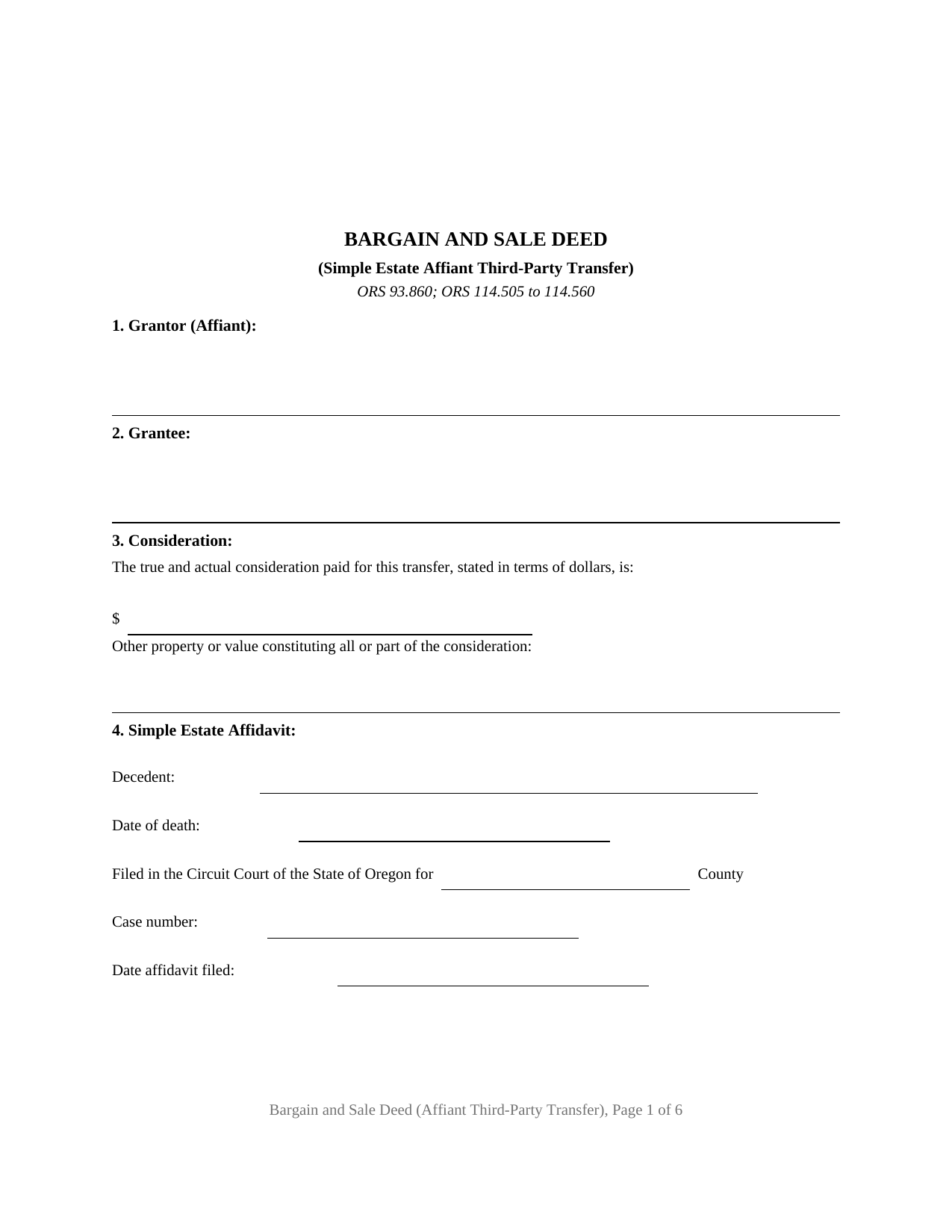
Three signature lines on one Oregon deed: the affiant who filed the simple estate affidavit, and the two heirs or devisees who would have inherited the land, all conveying to the same buyer in a single instrument. That is the shape of this form, an Oregon bargain and sale deed drawn for the mid-administration sale that ORS 114.547 permits,.
Three grantors, one fiduciary
Only one of the three signers conveys as a fiduciary. The affiant holds the estate under ORS 114.545, which places the person who signed the affidavit under a general duty to administer, preserve, settle and distribute it, and this deed names the affiant as grantor in that stated capacity, with the affidavit identified by decedent, circuit court, case number and filing date so the authority can be checked against the probate file. The other two blocks belong to the heirs or devisees who would succeed to the interest conveyed. Each of them conveys whatever right, title and interest that signer holds, if any, in the same sentence that carries the affiant's conveyance. Where the affiant is also an heir, the deed's Section 5 recital reaches that capacity too, and the affiant signs once.
The two joining blocks are a design limit as much as a feature. The deed recites exactly two joining successors; an estate with three or more heirs or devisees who would take the parcel presents a different signature inventory than this form carries.
What ORS 114.547 asks a sale deed to show
The statute conditions an affiant's sale of real property on three things, and the deed recites all three in its conveyance section. The consideration is adequate, and the first page states the true and actual dollar figure as ORS 93.030 requires. The conveyance is made before the two-year summary review period of ORS 114.550 has run from the affidavit's filing date. And the net proceeds, after the reasonable expenses of sale and any debt secured at death by a perfected lien, become part of the estate under ORS 114.547(3). What the buyer receives in return is the protection of ORS 114.547(6): a purchaser in good faith and for valuable consideration takes the interest stated free of any interest of the claiming successors and owes no duty to watch where the money goes.
Why the deed carries no warranty
The operative words are conveys to, the statutory bargain and sale language of ORS 93.860, and the deed says in terms that it conveys without covenant or warranty of title. A fiduciary selling a decedent's property does not personally stand behind the decedent's title, and the bargain and sale form matches that posture: ORS 93.860 gives the deed estoppel and after-acquired-title effect but none of the covenants a warranty deed carries. The deed also states what rides with the land under ORS 114.545(3), liens and encumbrances against the decedent or the estate, and gives the parties a place to list the matters of record the sale is subject to, with a sentence making clear that the listing creates no covenant.
An Oregon first page, as the recorder reads it
Oregon's ORS 205.234 places five items on the first page of a recorded instrument, and this deed is laid out around them: the return address, the tax statement line of ORS 93.260, the title, the affiant and the buyer, and the consideration statement all sit on page one below the space the county's recording label occupies. The affidavit details, the joining signers, the legal description and the operative conveyance follow in numbered sections, and the ORS 93.040 land use statement appears in capital letters where that statute places it in the body. Each signer has an acknowledgment certificate in the ORS 194.285 short form wording, with room for the affiant's representative capacity, so the three signers may acknowledge in different counties and on different days. Oregon imposes no statewide transfer tax on the sale; Washington County's local tax is the exception a buyer there encounters at recording.
What the package holds
The download contains the fillable deed with its removable instructions page, a completed example set in a Deschutes County estate sale with one joining heir, and the guide that walks through the statute and every numbered section. These materials describe Oregon law in general terms and are not legal advice.
Important: County-Specific Forms
Our bargain and sale deed (simple estate affiant third-party transfer) forms are specifically formatted for each of the 36 counties in Oregon.
After selecting your county, you'll receive forms that meet all local recording requirements, ensuring your documents will be accepted without delays or rejection fees.