Oregon Quitclaim Deed
County Specific Legal Forms Validated as recently as October 9, 2026 by our Forms Development Team
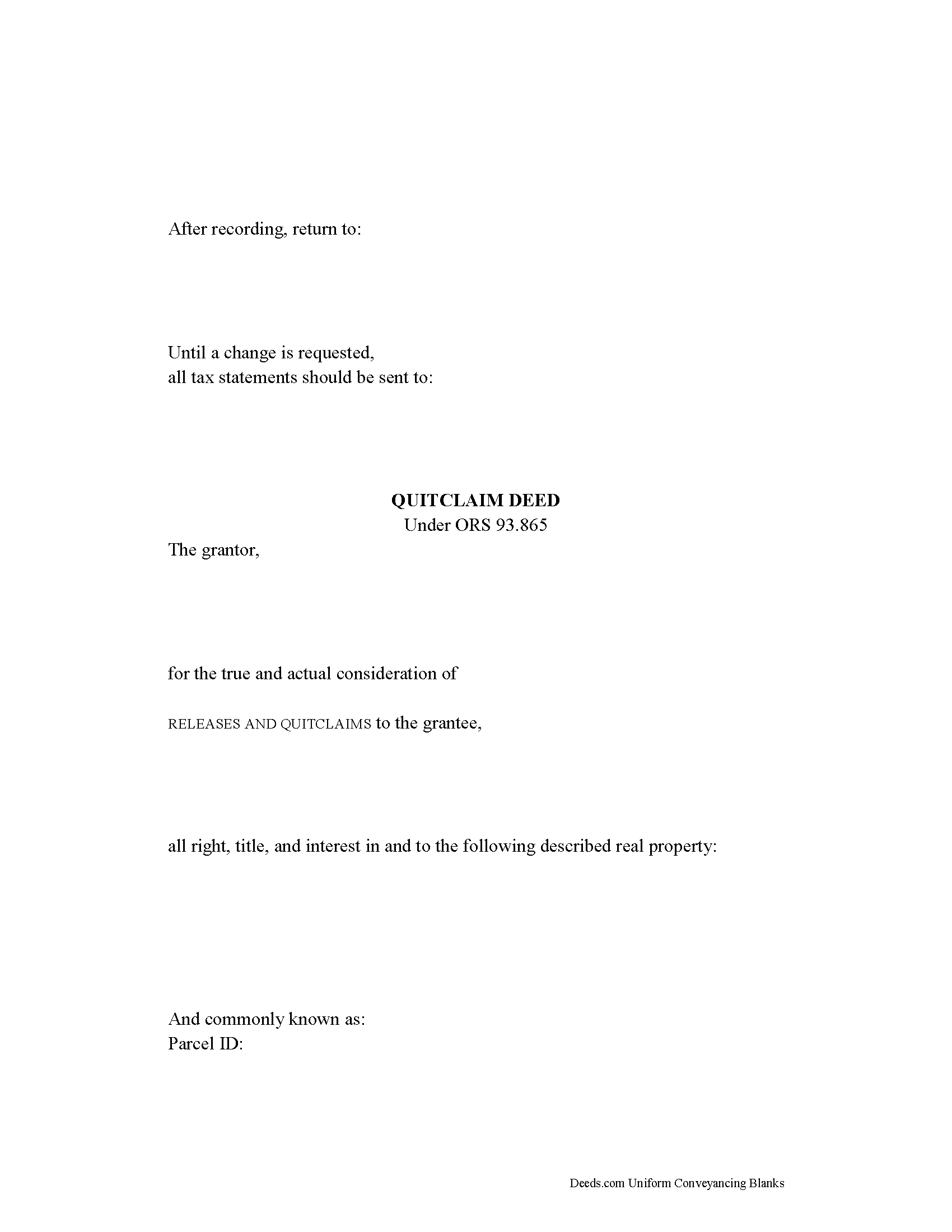
About the Oregon Quitclaim Deed
How to Use This Form
- Select your county from the list
- Download the county-specific form
- Fill in the required information
- Have the document notarized if required
- Record with your county recorder's office
What Others Like You Are Saying
"Great forms. Just what I needed."
"Deeds.com is very helpful when filling a Deed. I appreciate that. Thank you."
"Package downloaded without any problems. Help sheet was fair. Maybe they could cross reference the h…"
"Happy with the forms and the service, would recommend to others."
"Im an out of state realtor, but couldnt believe how quick and easy the process was. Recieved my deed…"
4.8/5 from 4,836 reviews. Read all
Elsewhere a quitclaim is treated as a warning label on the title itself, read as a sign that the buyer knew something was wrong with it. Oregon wrote the answer into the section: under ORS 93.865(3), a grantee is not denied the standing of a good faith purchaser for value merely because title arrived by or through this kind of deed. The instrument says little about the interest it moves, and Oregon declines to hold that silence against the person who takes it. This is the base Oregon quitclaim deed, indexed in some counties as a quit claim deed, drawn for individual owners releasing to individual takers.
A measure, not a promise
Every Oregon deed form is defined by the verbs it uses, and this one uses the pair ORS 93.865 supplies. What follows from them is a measurement rather than an assurance: the interest that exists in the grantor's hands on the date written on the deed is the interest the grantee ends up with, whether that is the whole fee, an undivided fraction, or a claim too doubtful for anyone to price. Land the grantor acquires next year stays with the grantor, no estoppel runs, and no covenant of title backs any of it. ORS 93.110 runs the other direction, letting the words pass every estate a grantor could lawfully convey.
The base configuration
The architecture of this form is deliberately unfixed. Section 1 is an open block for one or two natural persons conveying in their own capacity, with room for the status wording the record calls for. Section 2 is the same shape for one or two takers, and it holds the co-ownership designation the grantees select, since ORS 93.180(1)(a) reads a deed to two people as a tenancy in common unless a right of survivorship is clearly and expressly declared, while ORS 93.180(1)(b) hands two grantees married to each other a tenancy by the entirety unless the deed says otherwise. Nothing about marriage, capacity, or vesting is preprinted anywhere on the sheet; those words belong to the person completing it, and the guide covers them. Signing follows the same logic: two grantor blocks, headed GRANTOR and SECOND GRANTOR, each under its own acknowledgment certificate in the ORS 194.285 individual short form, with the second block and certificate left empty where one owner conveys alone. One grantor to one grantee, one to two, two to one, and two to two are the four counts the blanks absorb. An entity signing through an officer, member, manager, or partner, a fiduciary, an agent under a power of attorney, and any arrangement with three or more owners on a side each recite a capacity or a count this form does not draw.
Where Oregon puts things on the sheet
ORS 205.234 governs the first page, and one of its items decides the layout here: the name and address of the person who receives the instrument back from the clerk. That block sits at the top of page one, above the title, with the party names, the dollar figure ORS 93.030 requires and its companion line for other property or value, and the ORS 93.260 sentence routing the annual tax statement, all on the same sheet beneath a two inch strip kept clear for the county label. The land use and property rights statements of ORS 93.040 print in capitals further down, in the wording that came out of Oregon Laws 2025 chapter 209. A first page missing an item is still recorded under ORS 205.327, at a twenty dollar penalty over the ordinary fees.
Signing, and the trip to the clerk
Oregon asks for little ceremony. Under ORS 93.410 the grantors sign and acknowledge before a qualified officer; no subscribing witness signs, and no seal is called for. Timing then matters more than ceremony: ORS 93.640 is a race notice rule, so a deed left in a drawer loses to a later good faith purchaser for value whose deed reaches the county index first. Fees are county figures, several reset on July 1, 2026 after the legislature freed the Public Land Corner Preservation component from its ceiling, and no transfer tax follows an Oregon deed outside Washington County.
Three files come with the purchase: the fillable deed, a completed example worked out for a Deschutes County release between family members, and a plain language guide covering each numbered section, both certificates, and the recording steps. These materials describe Oregon law in general terms and are not legal advice.
Important: County-Specific Forms
Our quitclaim deed forms are specifically formatted for each of the 36 counties in Oregon.
After selecting your county, you'll receive forms that meet all local recording requirements, ensuring your documents will be accepted without delays or rejection fees.