Pennsylvania Warranty Deed (Two Grantors)
County Specific Legal Forms Validated as recently as September 15, 2026 by our Forms Development Team
About the Pennsylvania Warranty Deed (Two Grantors)
How to Use This Form
- Select your county from the list
- Download the county-specific form
- Fill in the required information
- Have the document notarized if required
- Record with your county recorder's office
What Others Like You Are Saying
"This Service Provider is amazing!! Needed Notice of Commencement recorded in Broward County, FL.. Th…"
"It was easy to access the documents for a minimal fee."
"was fairly easy to work through the forms but needed better information on what goes on a few of the…"
"So far so good"
"The paperwork for our transfer on death deed was easy to fill out and the county has excepted it for…"
4.8/5 from 4,828 reviews. Read all
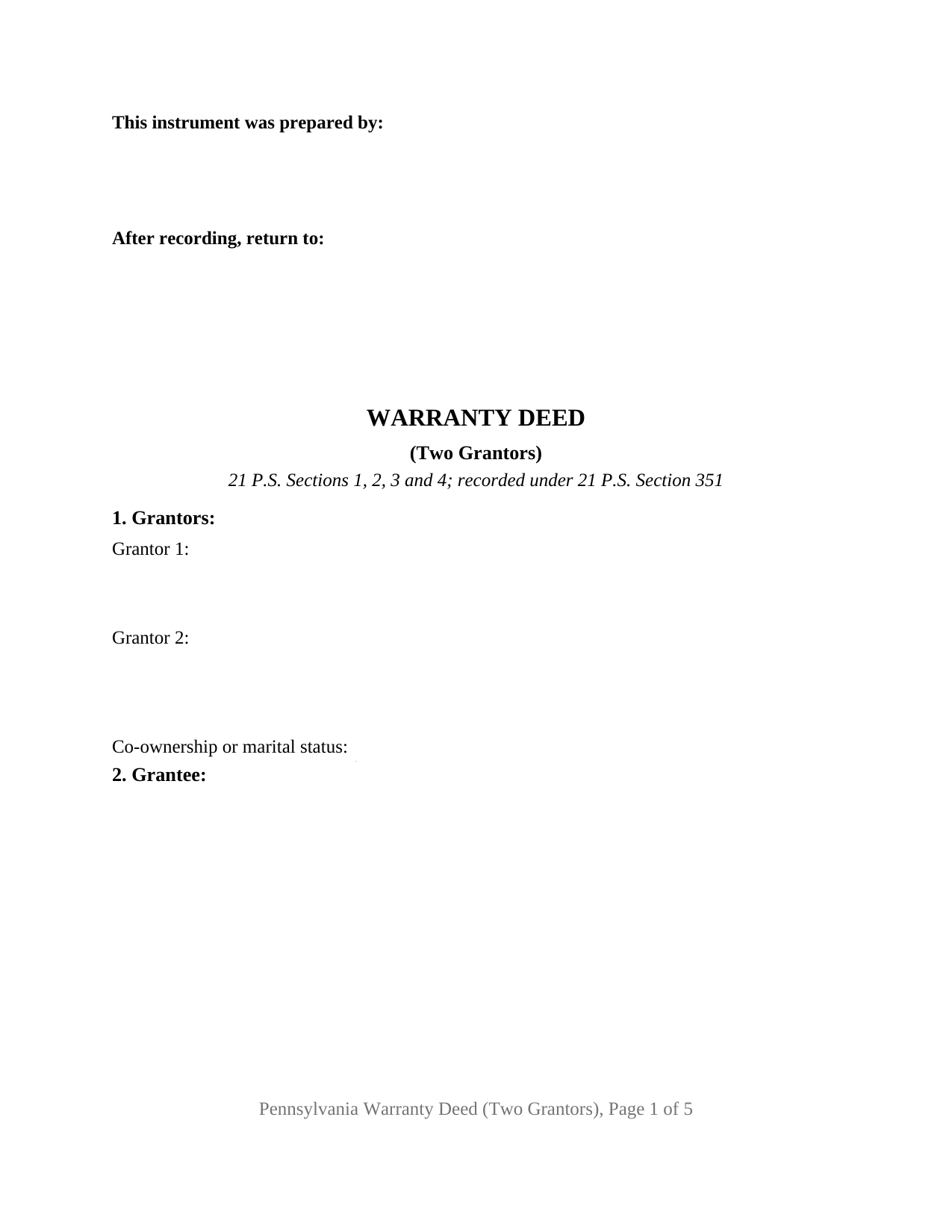
A Pennsylvania warranty deed for two grantors puts co-owned title behind a single conveyance: two grantor blocks, two signature lines, two acknowledgment certificates, and one general warranty made by both owners together. The form is configured for exactly two individuals conveying Pennsylvania real property in their own right, whether they hold as spouses, as tenants in common, or as joint tenants with right of survivorship.
One indivisible estate, two signatures
The two grantor pattern is at its most demanding where the grantors are married to each other. Pennsylvania presumes that a conveyance to spouses creates a tenancy by the entirety, an estate the Pennsylvania Supreme Court has long described as belonging to the marital unit rather than to two separable halves. During the marriage neither spouse alone conveys the whole, so a lifetime deed of entireties property is inherently a two signature instrument: both spouses join in the granting clause, both sign, and both acknowledge. This deed recites that pattern directly, with a co-ownership line in the grantor section carrying the marital or co-tenancy status the record shows.
Unmarried co-owners present the same two grantor architecture with different mechanics. Two tenants in common each convey a fractional interest, and the deed passes the whole property because both fractions leave in one instrument. Two joint tenants with right of survivorship convey together and end the survivorship along with their ownership. Divorced former spouses, whose entireties property converted to equal shares under 23 Pa.C.S. Section 3507, appear in the record as two tenants in common conveying by a single deed.
A general warranty made by both grantors
Pennsylvania attaches deed covenants to statutory phrases rather than to a document's label. This deed carries the words grant and convey, which pass a fee simple under 21 P.S. Section 1, and it adds the promise of 21 P.S. Section 4 that the grantors will warrant generally the property hereby conveyed, the covenant reaching the whole chain of title. On this form both grantors make that covenant, and a construction clause states that the conveyance and the warranty bind both of them. An under and subject section lists the recorded matters the transfer remains subject to, so the covenant is read against the exceptions the deed itself discloses, and the statutory coal and right of support language of the 1957 act appears in capitals within the instrument.
Two acknowledgment certificates
The execution architecture mirrors the grantor count. Each grantor has a signature line with a printed name and date, and each has an acknowledgment certificate in the statutory short form wording of 57 Pa.C.S. Section 316, so the two grantors may appear before different notaries, on different dates, or in different states. Acknowledgment is the gateway to the record: under 21 P.S. Section 351 a deed is acknowledged or proved and then recorded where the land lies, and an unrecorded conveyance yields to a later good faith purchaser or lienholder without notice. Pennsylvania also permits remote online notarization of deed acknowledgments under 57 Pa.C.S. Section 306.1.
Two grantors at the recording counter
The first page reserves the top area recorders stamp, with the prepared by and return to blocks positioned at the top left the way the largest Pennsylvania counties publish. The certificate of residence of 16 P.S. Section 9781 closes the deed: the grantee, or a person acting on the grantee's behalf, signs a certification of the grantee's precise residence and complete post-office address, and a recorder presented with a deed lacking that certificate must refuse it. A blank for the county tax parcel or Uniform Parcel Identifier serves the counties whose ordinances make the number a recording condition. Realty transfer tax is collected when the deed is recorded, one percent for the Commonwealth plus the local rate, and the guide describes the Statement of Value form that accompanies gift transfers and exemption claims.
The package delivers the two grantor warranty deed as a fillable PDF, a completed example showing a Lancaster County sale by a married couple filled in from start to finish, and a plain language guide to each numbered section, the signing formalities, and the county recording steps. These materials describe the law generally and are not legal advice.
Important: County-Specific Forms
Our warranty deed (two grantors) forms are specifically formatted for each of the 67 counties in Pennsylvania.
After selecting your county, you'll receive forms that meet all local recording requirements, ensuring your documents will be accepted without delays or rejection fees.