Pennsylvania Warranty Deed
County Specific Legal Forms Validated as recently as October 7, 2026 by our Forms Development Team
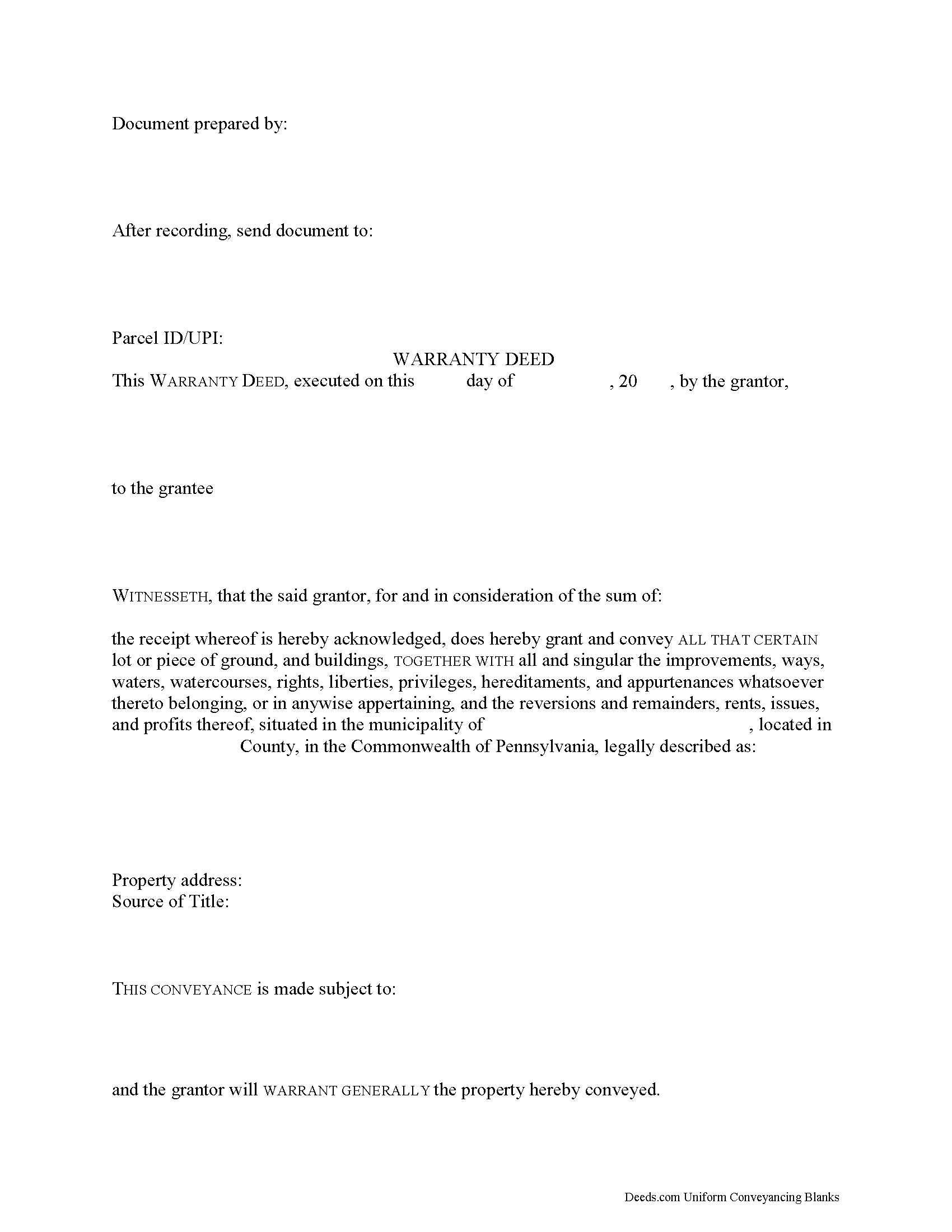
About the Pennsylvania Warranty Deed
How to Use This Form
- Select your county from the list
- Download the county-specific form
- Fill in the required information
- Have the document notarized if required
- Record with your county recorder's office
What Others Like You Are Saying
"I was easy fast and easy to order and download."
"Easy to understand and download!"
"Very Pleased. Was so easy and No hidden cost. Second time I have used their services. Would not use …"
"Five stars rating for sure. All so easy to download and print from your home computer. I live in rur…"
"Thank you. Your service is WONDERFUL and saved me a lot of time getting a deed filed in Schuylkill C…"
4.8/5 from 4,825 reviews. Read all
A Pennsylvania warranty deed conveys land with the general warranty covenant of 21 P.S. Section 4, and this package prepares the general configuration of that deed: grantor and grantee blocks that stay open, taking one or two individuals on either side in the words the parties' own title records use. Two signature blocks and two acknowledgment certificates follow the conveyance, and a conveyance by a single owner leaves the second of each unused.
Blanks the parties fill, not language the form fixes
The party sections of this deed preprint nothing about marital status, capacity, or co-ownership. The grantor block is open space for the name of each person conveying in that person's own right, written as the name appears in the deed that put the land in that person's hands, along with whatever status the record carries. The grantee block does the same work on the receiving side and holds the vesting words after the names.
Four count patterns fit that architecture: one grantor to one grantee, one grantor to two grantees, two grantors to one grantee, and two grantors to two grantees. Everyone named in the grantor block signs, so the second signature block and its certificate are simply left blank on a one-owner conveyance. What the form is not set up to recite is a signature in a representative capacity, an entity acting through an authorized officer, an agent under a power of attorney, or a title standing in three or more names.
The warranty lives in a phrase
Pennsylvania attaches covenants to statutory words, not to the caption at the top of the page. Grant and convey passes a fee simple and brings with it the limited covenants of 21 P.S. Section 3, which reach only encumbrances the grantor did or suffered. Adding the Section 4 phrase, that the grantor will warrant generally the property hereby conveyed, extends the promise to the lawful claims and demands of all persons, the reach Pennsylvania buyers and lenders look for in a general warranty deed. A construction sentence states that two grantors each convey and each warrant.
Under and subject, the deed's own carve-out
Pennsylvania conveyancing has a distinctive habit worth understanding before signing: the under and subject clause. This form devotes a numbered section to it, and both the conveyance and the warranty are made subject to what that section lists, so plan easements, restrictions, coal severances, and current taxes named there sit outside the covenant. An entry of None. leaves the warranty unqualified by the deed's own terms. The coal and right of support notice from the Act of July 17, 1957 prints above the conveyance in capital letters, the treatment that act permits.
The certificate that has to be there
The deed closes with a certificate of residence. Under 16 P.S. Section 9781 the recorder of deeds must refuse a deed unless the grantee, or a person acting for the grantee, has certified the grantee's precise residence and complete post-office address as part of the instrument, a reading the Commonwealth Court confirmed in Campeau v. Bates. The certificate sits at the end of the form with its own signature line, separate from the notary blocks, because it is a party statement rather than a notarial act.
Built for the county counter
Recording happens with the recorder of deeds where the land lies, and priority follows the record: 21 P.S. Section 351 leaves an unrecorded deed void against a later purchaser or lienholder without notice. The first page reserves the area the recorder stamps, with the prepared-by and return-to blocks at its left, and a blank near the property description takes the tax parcel number or Uniform Parcel Identifier that counties with an ordinance under 16 P.S. Section 9781.1 require on the instrument. Realty transfer tax is collected at recording, one percent for the Commonwealth plus the local rate, which runs from another one percent through the higher rates published in Philadelphia and parts of Allegheny County.
Acknowledgment before a notary is the gateway to the record, and Pennsylvania permits it remotely under 57 Pa.C.S. Section 306.1. The package delivers the deed as a fillable PDF, a completed example filled from start to finish for a Chester County sale, and a plain-language guide covering every section, the vesting words the grantee block can carry, the signing formalities, and the county recording steps. These materials describe Pennsylvania law in general terms and are not legal advice.
Important: County-Specific Forms
Our warranty deed forms are specifically formatted for each of the 67 counties in Pennsylvania.
After selecting your county, you'll receive forms that meet all local recording requirements, ensuring your documents will be accepted without delays or rejection fees.