South Dakota Transfer on Death Deed (Single Owner, Multiple Beneficiaries)
County Specific Legal Forms Validated as recently as November 22, 2026 by our Forms Development Team
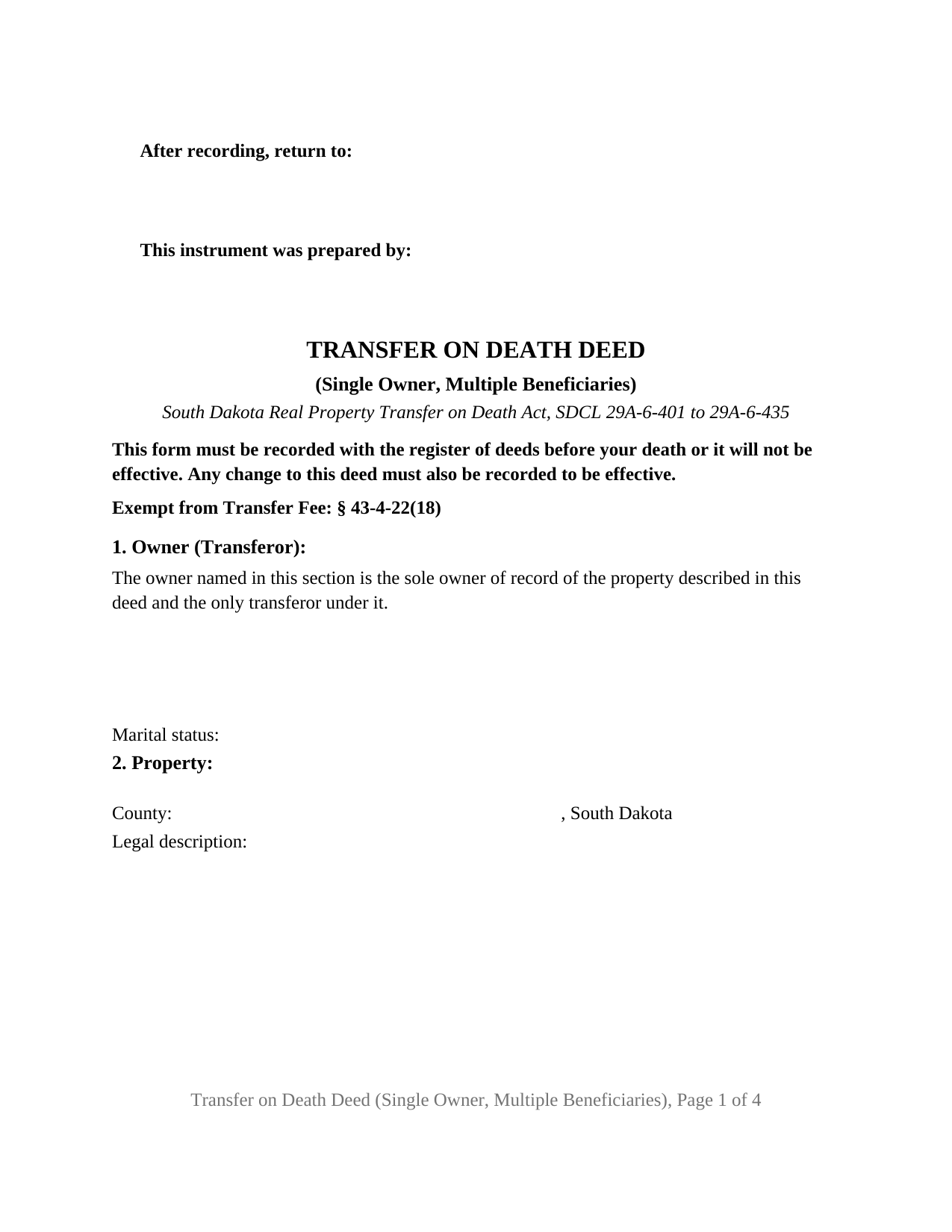
About the South Dakota Transfer on Death Deed (Single Owner, Multiple Beneficiaries)
How to Use This Form
- Select your county from the list
- Download the county-specific form
- Fill in the required information
- Have the document notarized if required
- Record with your county recorder's office
What Others Like You Are Saying
"Very satisfied. In the middle of COVID19 I was able to complete important paperwork even though I wa…"
"It had the info, but when I would type into the document the items I needed in adobe all that would …"
"I like the simplicity of your site and the reasonable charge for your services but for some reason y…"
"Very helpful; information included on the form explanations about Colorado laws in regards to benefi…"
"Love your deed service. Simple and easy."
4.8/5 from 4,863 reviews. Read all
Several names on one deed, each with a share. This fillable transfer on death deed carries a single South Dakota owner of record's designation of two or more beneficiaries who receive the property at the owner's death, in the fractions the deed states or in equal shares where it states none. The owner keeps everything while living, the deed goes on record now, and the beneficiaries take concurrently when the owner dies, outside probate.
How South Dakota divides the property among several beneficiaries
The South Dakota Real Property Transfer on Death Act, SDCL 29A-6-401 to 29A-6-435, writes the arithmetic of a multiple-beneficiary deed into statute. Under SDCL 29A-6-415(3), concurrent interests pass to the beneficiaries in equal and undivided shares with no right of survivorship, and the optional statutory form at SDCL 29A-6-430 says the same in its own words: the beneficiaries take in equal shares, as tenants in common and not as joint tenants with rights of survivorship, unless the owner says otherwise. This deed carries that sentence verbatim and gives the owner the place to say otherwise, a share line beside each of four numbered beneficiary blocks. A share written there is that beneficiary's undivided fraction; share lines left blank leave the equal-share default in force. The beneficiaries hold as tenants in common after the death, so each one's share passes under that beneficiary's own estate plan from then on.
What happens to a share when one beneficiary dies first
A deed naming several people has to answer the question a single-beneficiary deed never faces: what becomes of one person's share if that person dies before the owner. SDCL 29A-6-415(4) answers it for a South Dakota TOD deed. Where two or more designated beneficiaries are named to receive concurrent interests, the share of one that lapses or fails for any reason is transferred to the other, or to the others in proportion to their interests in the remaining property. Three children named in equal shares become two taking one-half each; a one-half and two one-fourth shares, less the deceased one-fourth, redivide in the ratio two to one. The contingent beneficiaries named in Section 5 come into the picture only when no designated beneficiary survives, which is exactly how the statutory form's contingent sentence reads: if no primary beneficiary survives the owner, the contingent beneficiaries take. The section opens by yielding to anything the deed itself provides and to several provisions of the probate code, including the antilapse section, SDCL 29A-2-603, and the rules on revocation by divorce, homicide, survival, and the elective share; the guide walks through each of them.
The one hundred twenty hour box
The statutory form carries one election, and this deed prints it as two boxes: the transfer is, or is not, subject to the requirement that the named beneficiary survive the owner by one hundred twenty hours. SDCL 29A-6-415(2) supplies the rule that applies when neither box is marked, under which the interest of any designated or contingent beneficiary who fails to survive the owner by one hundred twenty hours lapses unless survival is specifically waived or modified as SDCL 29A-2-702 provides; marking the second box is the deed's express statement that no survival period is required. Each designated beneficiary's interest is separately contingent on surviving the owner, so on a deed with three names the rule is applied three times, and a lapsed share follows the redistribution rule above.
One owner, four beneficiary blocks, one certificate
The form recites exactly one owner of record as the sole transferor, with one signature line and one South Dakota certificate of acknowledgment in the SDCL 18-4-12 form. A fixed sentence in Section 1 identifies the owner named there as the sole owner of record and the only transferor; the marital status line from the statutory form is a factual entry, so the deed fixes no marital status. Section 3 carries four designated beneficiary blocks, each with a name and mailing address entry (the grantee address SDCL 7-9-7(1) requires on a recorded deed) and a share line, under a fixed sentence that the deed names two or more designated beneficiaries; blocks three and four are completed only where a third or fourth beneficiary is named. A parent dividing a house among three adult children in stated fractions, and an owner naming two nieces and a longtime friend in equal shares, present the pattern this deed recites. A deed naming one beneficiary, a deed signed by two co-owners, and a deed by an agent or trustee each present a different configuration, and this form does not recite them.
Recorded in life, revocable until death
Recording is the effectiveness condition. SDCL 29A-6-408 requires the deed to be recorded before the owner's death with the register of deeds of the county where the property lies, and the deed's first page carries the statutory form's own warning to that effect. Until death the deed does nothing: it creates no interest in any beneficiary and leaves the owner free to sell, mortgage, or lease (SDCL 29A-6-414), and it is revocable by a later recorded TOD deed, a recorded instrument of revocation, or a recorded inter vivos deed that expressly revokes it, never by tearing up the paper (SDCL 29A-6-410 and 29A-6-412). At the register of deeds counter the document rides lightly: no certificate of real estate value accompanies a transfer on death deed (SDCL 7-9-7(5)), no transfer fee is due on a transfer for which no consideration was given (SDCL 43-4-22(18)), and the first page prints the exempt from transfer fee statement with that subdivision, the marking SDCL 43-4-23 requires of every exempt transfer. The first page also reserves the three inch recording space of SDCL 43-28-23, with the preparer legend of SDCL 7-9-1, name, address, and telephone number, in its left half.
The download contains the blank deed as a fillable PDF, a completed example carrying a Pennington County fact pattern from the owner's entry through three beneficiaries with stated shares and the notary block, and a plain language guide to every numbered section, the signing, and the recording steps. The materials are informational and are not legal advice.
Important: County-Specific Forms
Our transfer on death deed (single owner, multiple beneficiaries) forms are specifically formatted for each of the 66 counties in South Dakota.
After selecting your county, you'll receive forms that meet all local recording requirements, ensuring your documents will be accepted without delays or rejection fees.