South Dakota Transfer on Death Deed (Single Owner, Primary and Contingent Beneficiaries)
County Specific Legal Forms Validated as recently as November 23, 2026 by our Forms Development Team
About the South Dakota Transfer on Death Deed (Single Owner, Primary and Contingent Beneficiaries)
How to Use This Form
- Select your county from the list
- Download the county-specific form
- Fill in the required information
- Have the document notarized if required
- Record with your county recorder's office
What Others Like You Are Saying
"Documents available immediately as advertised. Was easy to understand the guide and complete the dee…"
"Outstanding forms and the recording service made a short day of what I needed to do. Will be back fo…"
"I was easy fast and easy to order and download."
"Super easy and quick. Love the service-"
"I could not be happier with the service. Shortly after I uploaded my documents, my package was prepa…"
4.8/5 from 4,863 reviews. Read all
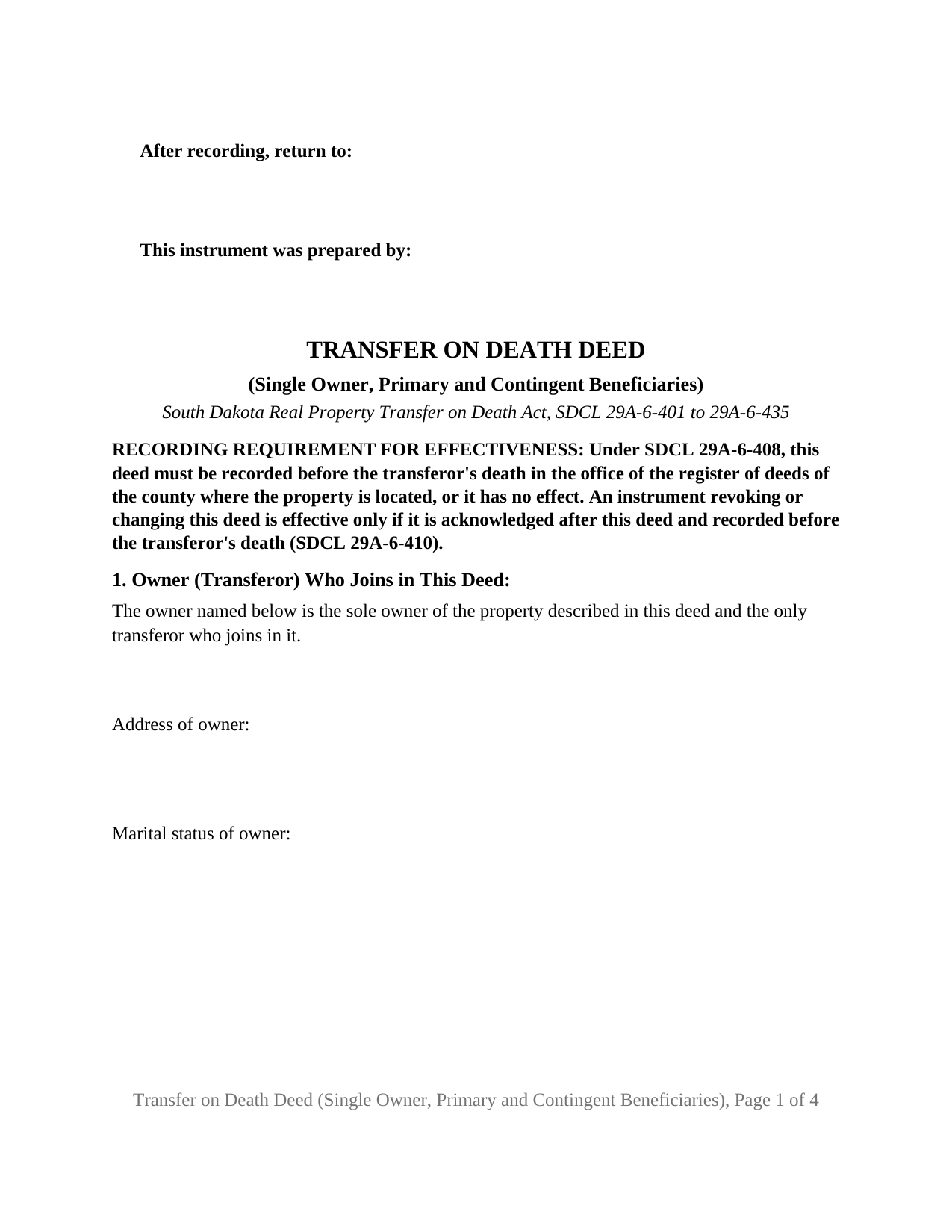
Two tiers of beneficiaries on one recorded page. A sole owner of South Dakota real property completes this fillable transfer on death deed to name the primary designated beneficiaries who take the property at the owner's death and, in a second section the deed treats as required, the contingent designated beneficiaries who take instead if no primary beneficiary survives. Exactly one record owner is recited as the transferor; the deed carries one signature line and one acknowledgment certificate, is acknowledged before a notary, and goes of record with the register of deeds while the owner lives.
A second line of succession written into the deed
The South Dakota Real Property Transfer on Death Act, SDCL 29A-6-401 to 29A-6-435, builds the contingent tier into its own rules. SDCL 29A-6-415(1) transfers the property at the transferor's death to the designated beneficiary or, when necessary, to the contingent beneficiary in accordance with the deed, and SDCL 29A-6-415(2) applies the survival rule to a designated and a contingent beneficiary alike. The optional statutory form in SDCL 29A-6-430 prints a contingent beneficiary section whose sentence operates only if no primary beneficiary survives the owner, and this deed carries that sentence word for word in Section 7, under the sentence in Section 5 that names the primary beneficiaries, revokes all prior transfer on death deeds concerning the property, and sets the default of equal shares as tenants in common and not as joint tenants with rights of survivorship, unless the owner says otherwise. Where two or more primary beneficiaries are named and one of them fails to survive, SDCL 29A-6-415(4) moves that share to the surviving primary beneficiaries in proportion to their interests; the contingent class is reached only when the primary class is empty.
The survival statement and what each box does
Between the two beneficiary sections the deed prints the optional form's survival statement with its two alternatives, each beside a box, so the owner states whether a named beneficiary's taking depends on surviving the owner by one hundred twenty hours, or whether the deed states no survival period. The blank form marks neither box. When the first box is marked the deed states the requirement expressly; when the second is marked the deed waives it in the manner SDCL 29A-6-415(2) and SDCL 29A-2-702 contemplate for a governing instrument; and when no box is marked the statutory rule in SDCL 29A-6-415(2) applies on its own terms, the interest of any designated or contingent beneficiary who fails to survive the transferor by one hundred twenty hours lapsing. The guide describes each of the three outcomes with its citation, and the completed example marks one box as an illustration.
What the single-owner, two-class form recites
A fixed recital in Section 1 identifies the named owner as the sole owner of the property and as the only transferor joining in the deed; the owner's name and mailing address follow it, and the marital status line of the optional form is completed as a fact rather than fixed by the form. The county and legal description, the street address, and the recording reference of the vesting deed each take their own section. Section 8 states that the deed names one or more primary designated beneficiaries in Section 5 and one or more contingent designated beneficiaries in Section 7, then carries the form's sentence of transfer, the statement SDCL 29A-6-408(2) requires that the transfer occurs at the transferor's death, and its revocation sentence. A widowed owner of a Rapid City house naming two adult children as primary beneficiaries, with grandchildren named as the contingent class, is the pattern the completed example carries. The form is not set up as a deed by two or more record owners, as a designation of a lone beneficiary with no contingent class, as a deed signed by an attorney in fact, or as a deed by a trustee or an entity; each of those is a different configuration. SDCL 29A-6-426 bars an attorney in fact, custodian, conservator, or other agent from making, revoking, or changing a beneficiary designation unless the document establishing the agent's right to act, or a court order, expressly authorizes the action and the action complies with the governing instrument, the rulings of the court, and applicable law.
Revocable until death, and only by record
During the owner's life the deed changes nothing: SDCL 29A-6-414 provides that it affects no interest or right of the owner, including the right to transfer or encumber the property, and creates no interest in any beneficiary, primary or contingent. The owner keeps every right to sell, mortgage, or lease the property, and a sale during life leaves the deed with nothing to transfer. Changing either beneficiary class takes an instrument SDCL 29A-6-410 recognizes, a later transfer on death deed, an instrument of revocation, or a lifetime deed with express revoking words, which the owner acknowledges after this deed and records, before death, with the register of deeds where this deed is of record. Burning, tearing, canceling, or obliterating the recorded paper revokes nothing (SDCL 29A-6-412). The instrument of revocation and the affidavit of confirmation a beneficiary records after the death under SDCL 29A-6-427 are each prepared and recorded separately and are not included in this package.
At the register of deeds counter
Recording before the owner's death with the register of deeds of the county where the property lies is a requirement of the deed itself under SDCL 29A-6-408(3), and the deed states that requirement on its face. The first page reserves the three inch blank space of SDCL 43-28-23(4), with the prepared-by legend of SDCL 7-9-1, including the preparer's telephone number, in the left half and the title directly below. No certificate of real estate value accompanies the deed, which SDCL 7-9-7(5) exempts, and the face of the deed prints the transfer fee exemption recital of SDCL 43-4-22(18) the optional form carries, so the register collects only the statewide recording fee of SDCL 7-9-15. Each beneficiary entry takes a mailing address, the grantee address SDCL 7-9-7(1) calls for on every deed presented for record, and the beneficiaries take whatever interest the owner holds at death, subject to mortgages, liens, and other interests then affecting the property (SDCL 29A-6-416) and without covenant or warranty of title (SDCL 29A-6-418). Searched for as a beneficiary deed or TOD deed, the instrument is the same statutory transfer on death deed under either name.
The download contains the blank single-owner deed with both beneficiary classes as a fillable PDF, a completed example carrying a Pennington County fact pattern from the owner recital through the acknowledgment certificate, and a plain language guide to the statute, each numbered section, the signing, and the recording steps. The materials are informational and are not legal advice.
Important: County-Specific Forms
Our transfer on death deed (single owner, primary and contingent beneficiaries) forms are specifically formatted for each of the 66 counties in South Dakota.
After selecting your county, you'll receive forms that meet all local recording requirements, ensuring your documents will be accepted without delays or rejection fees.