South Dakota Transfer on Death Revocation (Individual Transferor)
County Specific Legal Forms Validated as recently as October 26, 2026 by our Forms Development Team
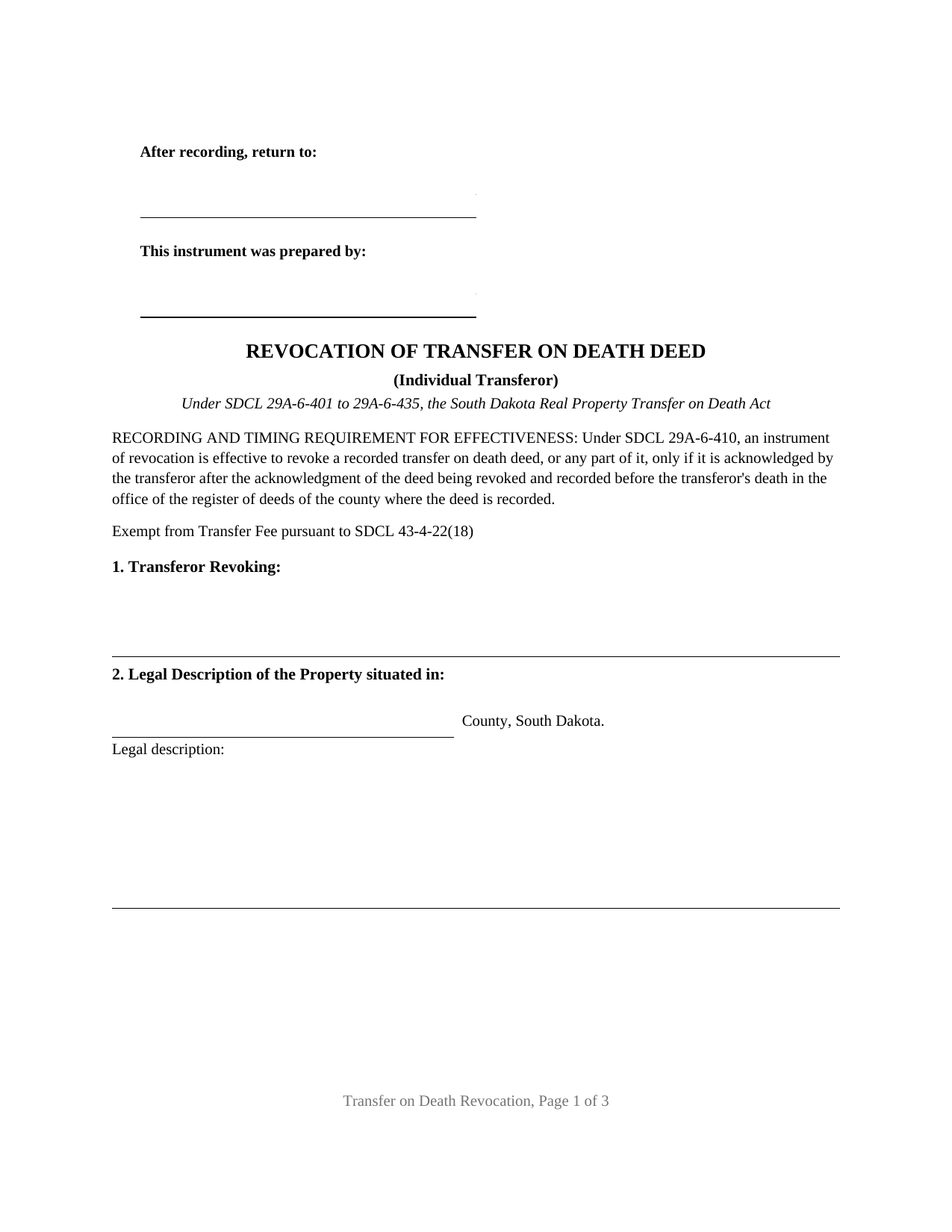
About the South Dakota Transfer on Death Revocation (Individual Transferor)
How to Use This Form
- Select your county from the list
- Download the county-specific form
- Fill in the required information
- Have the document notarized if required
- Record with your county recorder's office
What Others Like You Are Saying
"Forms were top notch, easy to complete, printed beautifully, recorded with no revisions. Highly reco…"
"Easy to use,makes things easier,Thanks! Great Idea!"
"Excellent Service, with quick turnaround times."
"Wonderful experience. Was preapred to wait days, recording was finished in less than an hour."
"My first time using it; very fast service. I am an estate planning attorney (44 years). None of my o…"
4.8/5 from 4,836 reviews. Read all
One South Dakota property owner, one recorded transfer on death deed, one recorded instrument that takes the designation back: that is the configuration this fillable Transfer on Death Revocation prepares. The form is set up for an individual transferor under SDCL 29A-6-410, the revocation provision of the South Dakota Real Property Transfer on Death Act, with a single transferor block, a single signature line, and a single acknowledgment certificate.
A Revocation That Runs Against Two Clocks
South Dakota gives a recorded transfer on death deed, also searched as a TOD deed or beneficiary deed, a deliberately narrow exit. Under SDCL 29A-6-410, a recorded deed is revoked only by another recorded instrument: a later transfer on death deed that revokes it expressly or by inconsistency, a lifetime deed that expressly revokes it, or a standalone instrument of revocation, which is what this form prepares. Marking, tearing, or destroying the recorded deed revokes nothing once the deed is of record (SDCL 29A-6-412), and the statute leaves no room for a will to undo the designation.
The instrument then runs against two clocks. It operates only if it is acknowledged before a notary after the date the transfer on death deed itself was acknowledged, and only if it is filed with the county register of deeds before the transferor dies. The form collects the deed's acknowledgment date on its face and states both timing rules in capital letters above the signature line, so the requirements travel with the document to the signing table and the recording counter.
What the Individual Transferor Form Recites
The form recites exactly one transferor: the owner who made and recorded the transfer on death deed now being revoked. Its five numbered sections carry the transferor's name and mailing address, the county and formal legal description of the property, the identification of the deed being revoked by acknowledgment date, recording date, and document number or book and page, the express revocation with the capacity recital of SDCL 29A-6-407, and the signature block, followed by one notary acknowledgment certificate. The operative section also states that the instrument transfers no interest in real property, which keeps the filing from reading as a conveyance.
An owner whose named beneficiary has died, an owner clearing an outdated designation before making a new estate plan, and an owner returning the property to disposition by will or trust present the single-transferor pattern this instrument recites. The boundary is equally specific: a transfer on death deed recorded by two or more owners follows SDCL 29A-6-411, under which revocation by one transferor reaches only that transferor's interest and a deed of joint owners is revoked only by all living joint owners, a multi-signature pattern this one-signature form is not set up to carry.
Recording at the Register of Deeds
The completed instrument is recorded with the register of deeds of the county where the transfer on death deed is recorded, for the statewide fee of thirty dollars under SDCL 7-9-15. No Certificate of Real Estate Value accompanies it: SDCL sec. 7-9-7 attaches that filing to deeds and contracts for deed used in a purchase, exchange, transfer, or assignment, and a revocation transfers nothing; for the same reason the real estate transfer fee of SDCL 43-4-21 does not apply, and the transfer fee exemption recital citing SDCL 43-4-22(18) appears on the face of the form. The first page reserves the three inch recording space of SDCL 43-28-23 and carries the preparer statement required by SDCL 43-28-23, with the preparer's name and address, in the left half of that space, matching the format standards South Dakota registers apply statewide.
After recording, the property passes at death as if the revoked designation had not been made, under the transferor's will, trust, or the intestacy statutes, or under any later transfer on death deed. A replacement designation, where one is wanted, is made by a new transfer on death deed, prepared and recorded separately and not included here. This download contains the fillable revocation form, a completed example showing a realistic Minnehaha County fact pattern in every blank, and a plain language guide that walks through each section, the signing formalities, and the recording steps. The materials are informational and are not legal advice.
Important: County-Specific Forms
Our transfer on death revocation (individual transferor) forms are specifically formatted for each of the 66 counties in South Dakota.
After selecting your county, you'll receive forms that meet all local recording requirements, ensuring your documents will be accepted without delays or rejection fees.