South Dakota Transfer on Death Revocation (Joint Transferors)
County Specific Legal Forms Validated as recently as October 5, 2026 by our Forms Development Team
About the South Dakota Transfer on Death Revocation (Joint Transferors)
How to Use This Form
- Select your county from the list
- Download the county-specific form
- Fill in the required information
- Have the document notarized if required
- Record with your county recorder's office
What Others Like You Are Saying
"Was successful, I'm happy. Tks"
"It worked well for me."
"Worked great. Count Clerk and Recorder liked them and we got the job done."
"QUICK SERVICE"
"Professional, simple. Very good."
4.8/5 from 4,815 reviews. Read all
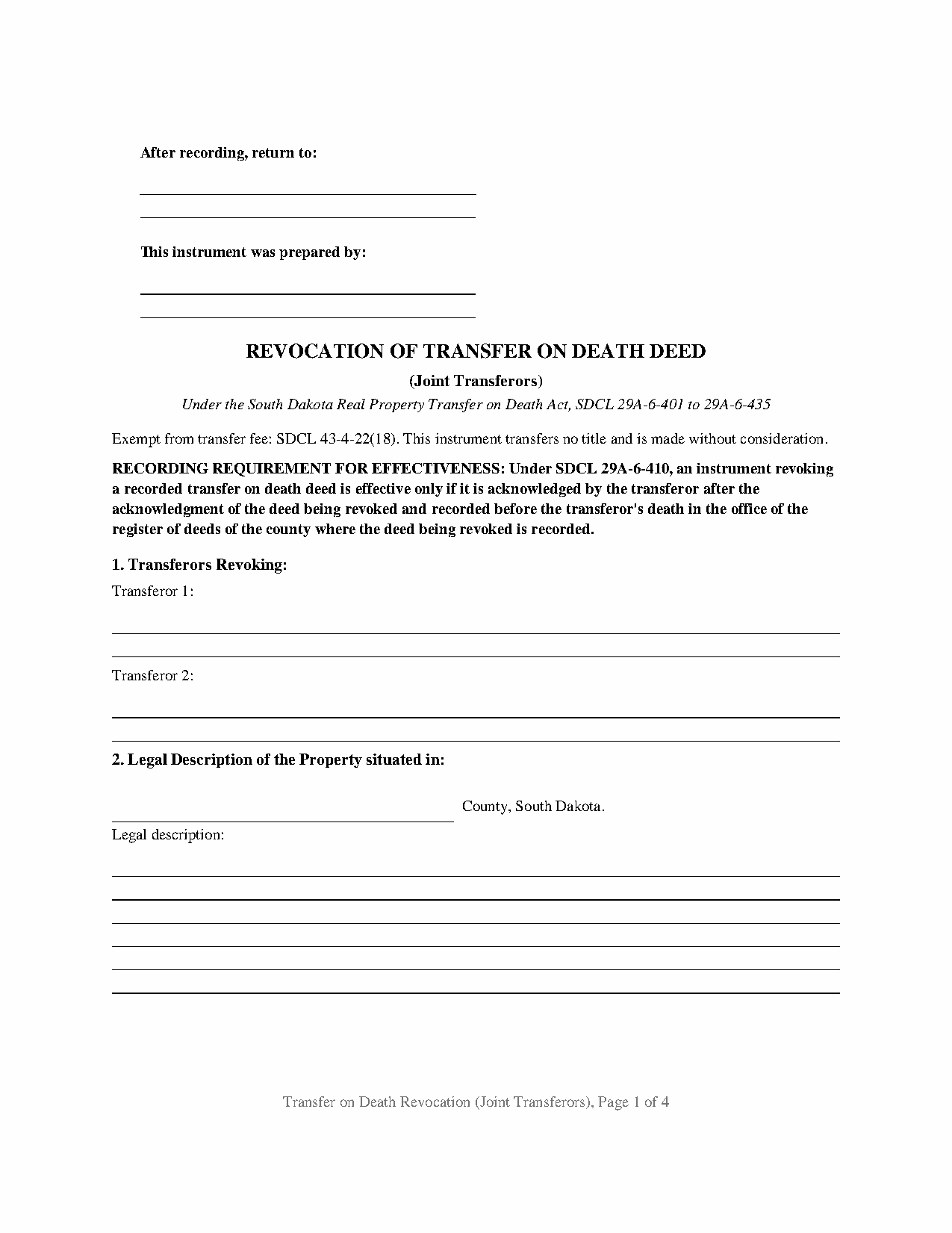
A recorded South Dakota transfer on death deed made by two owners is not undone by one signature. This form prepares the revocation for exactly that configuration: an instrument of revocation under SDCL 29A-6-410 with two transferor signature blocks, a separate acknowledgment certificate for each signer, and the recital that the signers constitute all of the living transferors under the deed being revoked.
Why Every Living Joint Owner Signs
The South Dakota Real Property Transfer on Death Act, SDCL 29A-6-401 to 29A-6-435, splits multi-owner revocation into two rules at SDCL 29A-6-411. Revocation by a transferor does not affect the deed as to the interest of another transferor, so a co-owner holding an undivided share, such as a tenant in common, signing alone removes only that share from the deed. And a deed of joint owners, the act's term for co-owners with a right of survivorship such as South Dakota joint tenants, is revoked only if it is revoked by all of the living joint owners. One of two living joint tenants cannot quietly undo the recorded beneficiary designation.
Both rules converge on the same completed document for a two-transferor deed: both living transferors sign, and the transfer on death deed is revoked in its entirety. After one joint owner has died, the survivor holds the whole property and the act treats the deed as operating at the last surviving joint owner's death; the form's recital covers that sole living transferor, who completes only the first signature block.
Acknowledged After, Recorded Before Death
South Dakota builds two timing conditions into SDCL 29A-6-410. The revocation is effective only if each notary certificate carries a date later than the acknowledgment date of the original TOD deed, and the instrument must reach the register of deeds office of the recording county before the transferor's death. A signed revocation resting in a drawer at death revokes nothing. The statute is equally firm about what does not work: after recording, a transfer on death deed may not be revoked by a revocatory act on the document (SDCL 29A-6-412), and a will is not among the instruments SDCL 29A-6-410 lists as effective to revoke, so tearing up the old deed or signing a new will leaves the recorded designation standing.
What the Form Recites
The form identifies the transferors by the names on the recorded deed, the property by county and formal legal description, and the transfer on death deed being revoked by its acknowledgment date, recording date, document or instrument number, and recording county, all taken from the register's stamp or index. The operative section then recites the SDCL 29A-6-407 capacity standard, states that the signers constitute all living transferors, including all living joint owners, and expressly revokes the deed in its entirety, followed by the statutory warnings in capital letters. The form recites exactly two transferors; a designation made by a sole owner presents a different revocation pattern than the one this instrument recites.
The layout follows South Dakota recording standards: the 3 inch blank space across the top of the first page under SDCL 43-28-23, with the preparer statement placed in the left half of that space, 10 point type on letter size pages, and the transfer fee exemption statement on the face citing SDCL 43-4-22(18). Because a revocation conveys no title, no Certificate of Real Estate Value accompanies it, and the statewide recording fee under SDCL 7-9-15 is thirty dollars for a document of this length.
The download contains three pieces: the revocation as a fillable PDF, a completed example showing a realistic Minnehaha County revocation from start to finish, and a guide that walks through every section, the acknowledgment timing, and the recording steps. The materials describe South Dakota law in general terms and are not legal advice.
Important: County-Specific Forms
Our transfer on death revocation (joint transferors) forms are specifically formatted for each of the 66 counties in South Dakota.
After selecting your county, you'll receive forms that meet all local recording requirements, ensuring your documents will be accepted without delays or rejection fees.