South Dakota Warranty Deed (Individual Grantor)
County Specific Legal Forms Validated as recently as October 2, 2026 by our Forms Development Team
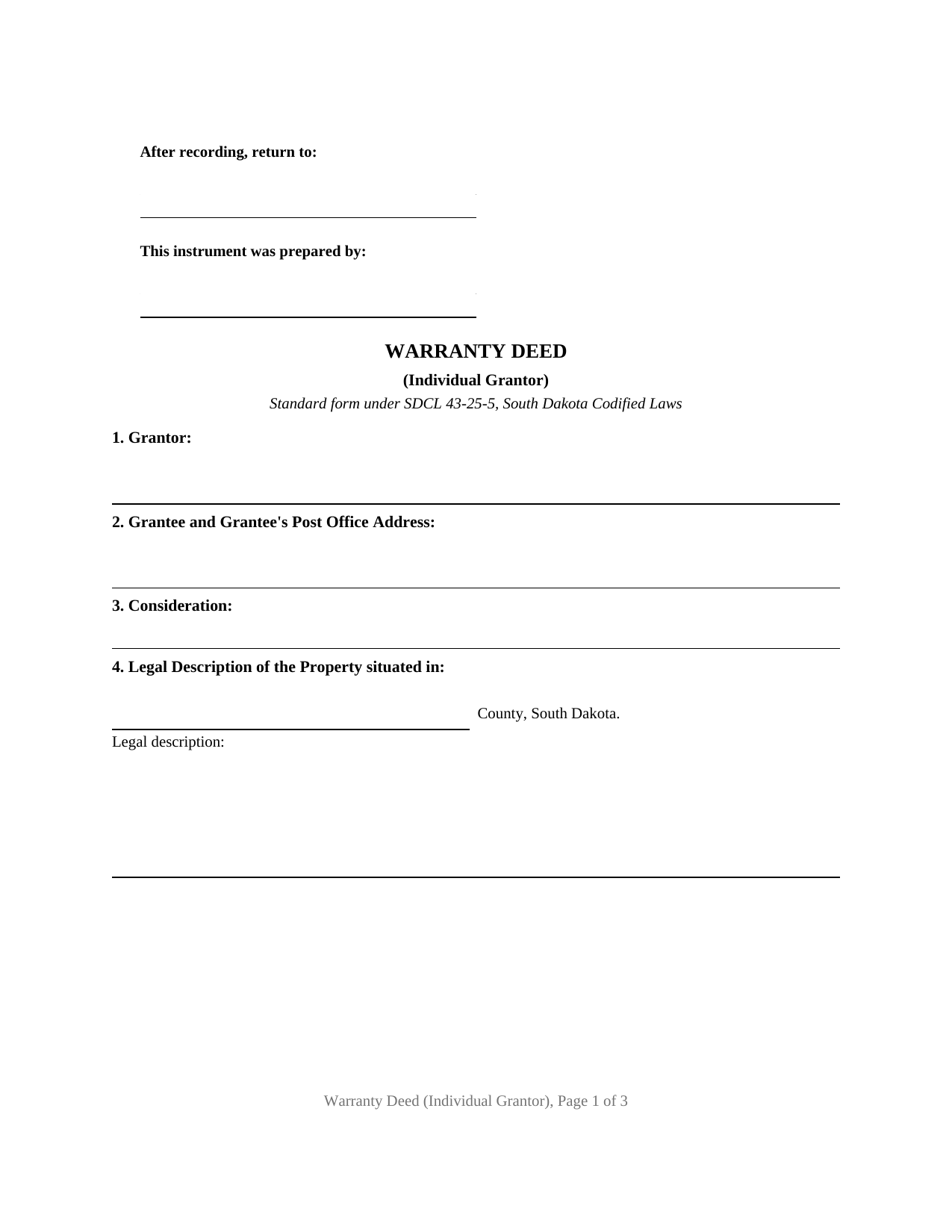
About the South Dakota Warranty Deed (Individual Grantor)
How to Use This Form
- Select your county from the list
- Download the county-specific form
- Fill in the required information
- Have the document notarized if required
- Record with your county recorder's office
What Others Like You Are Saying
"Easy to navigate site and download forms to PC!"
"My experience so far is quite good. Useful documents. It would be very helpful if the labels on the …"
"So easy and documents downloaded in a flash. Highly recommended. Just gotta fill out and submit done…"
"I had no issues downloading the template. The price was reasonable and the document was compliant wi…"
"This document was exactly what I needed and with the corresponding sample I was easily able to compl…"
4.8/5 from 4,825 reviews. Read all
One owner of record, one signature line, one acknowledgment certificate: this fillable South Dakota warranty deed is built for an individual grantor conveying real estate with the state's full statutory title covenants. The deed follows the standard form of SDCL 43-25-5, so its operative words, grants, conveys and warrants, do exactly the work the statute assigns them.
Three words that carry five promises
South Dakota compresses the traditional covenant package into the granting clause itself. Under SDCL 43-25-6, a deed made in the statutory form promises that the grantor was lawfully seized in fee simple and had good right to convey, that the property was free from encumbrances, that the grantee will hold quiet and peaceable possession, and that the grantor will defend the title against all lawful claims; after-acquired title passes as well under SDCL 43-25-11. That reach, covering the whole chain of title rather than the grantor's own acts alone, is what separates a general warranty deed from the quitclaim and limited-covenant patterns South Dakota law also recognizes. The form's subject-to section states the matters the covenants do not cover, recorded easements, restrictions, taxes not yet due, and any lien the grantee takes subject to, which is where the practical scope of a warranty deed gets written.
Built around a single grantor
The form recites exactly one grantor: a natural person conveying personally, with marital status stated after the name in the customary South Dakota style. One signature line and one notary certificate follow. A sole owner selling at closing, a single person conveying a rental parcel, and an unmarried owner transferring inherited land present the single-grantor pattern this deed recites. The form is not set up as a two-owner, trustee, or entity conveyance, and it prints no spousal joinder line; under SDCL 43-31-17, a married South Dakota resident's conveyance of the homestead is valid only when both spouses concur and sign, and the guide walks through that boundary in plain terms.
The receiving side has its own architecture. A deed to a single grantee vests sole ownership; a deed to two or more grantees vests a tenancy in common by statutory default under SDCL 43-2-12, and a joint tenancy with right of survivorship arises only when the deed expressly declares it. South Dakota does not recognize tenancy by the entirety; married co-owners take as tenants in common unless joint tenancy is expressly declared. The guide describes each vesting form the state recognizes and the words that create it, so the grantee section of the deed can carry the intended designation.
The blank three inches, the certificate, and the fee
South Dakota's format statute, SDCL 43-28-23, reserves a blank three-inch space across the top of the first page, with recording information on the right half and the left half open for the after-recording return address and the preparer statement the statute requires: the preparer's name and address. This form prints both blocks exactly that way, stacked at the top left, with one-inch margins and ten-point type to match the statute. At the counter, the register of deeds collects the statewide recording fee of thirty dollars for a document up to fifty pages under SDCL 7-9-15, plus the real estate transfer fee of fifty cents per five hundred dollars of value under SDCL 43-4-21; a completed Certificate of Real Estate Value, Form PT-56, accompanies a warranty deed under SDCL 7-9-7. A transfer exempt from the fee states the exemption on the face of the deed with its SDCL 43-4-22 subdivision, and the form carries that statutory statement ready to complete. The grantee's post office address is a recording condition under the same format chapter, and the deed's grantee section is built around it. Searches for this instrument also arrive as a South Dakota general warranty deed form or a full covenant deed; the operative statutory language is the same three words either way.
What arrives with the purchase
The download includes the warranty deed as a fillable PDF, a completed example showing the entire document filled in for a realistic Minnehaha County sale, and a plain-language guide that walks through every numbered section, the covenants, the vesting forms grantees may take title under, and the recording steps. The materials describe South Dakota law in general terms and are not legal advice.
Important: County-Specific Forms
Our warranty deed (individual grantor) forms are specifically formatted for each of the 66 counties in South Dakota.
After selecting your county, you'll receive forms that meet all local recording requirements, ensuring your documents will be accepted without delays or rejection fees.