Texas Enhanced Life Estate (Lady Bird) Deed (Joint Owners with Right of Survivorship)
County Specific Legal Forms Validated as recently as October 1, 2026 by our Forms Development Team
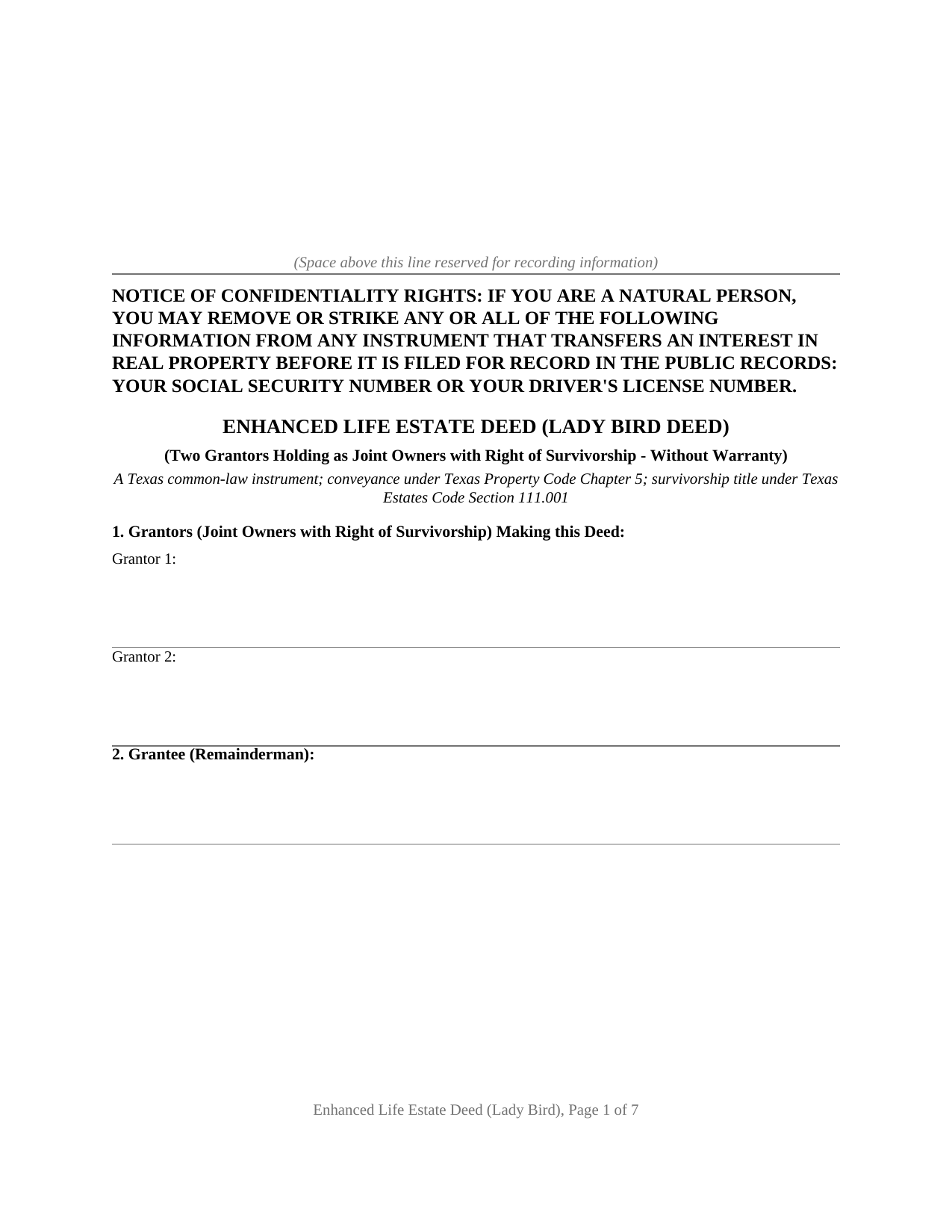
About the Texas Enhanced Life Estate (Lady Bird) Deed (Joint Owners with Right of Survivorship)
How to Use This Form
- Select your county from the list
- Download the county-specific form
- Fill in the required information
- Have the document notarized if required
- Record with your county recorder's office
What Others Like You Are Saying
"Document was well formatted with the extra help of an example and useful instructions. I ended up wi…"
"Amazing forms, thanks so much for making these available."
"This website is very user friendly. I easily found the form I needed and was given an example for fi…"
"All required forms readily available at fair price. Easy to create account. Immediately acquired doc…"
"Love this site! They are very fast in retrieving information. Will use this site again. Thank You fo…"
4.8/5 from 4,825 reviews. Read all
The enhanced life estate deed, better known in Texas as the lady bird deed, performs a trick no ordinary deed manages: it conveys the property today and still leaves the people who signed it free to sell, mortgage, lease, or give away that same property tomorrow, without asking anyone named in the deed. This version of the instrument is drafted for two co-owners who hold Texas real property as joint owners with right of survivorship, and it carries their plan across two deaths: the entire enhanced life estate belongs to the survivor after the first death, and the named remainderman takes only when the last owner dies.
A conveyance that keeps every power that matters
The deed grants, sells, and conveys the property to the grantee as remainderman, then reserves to the grantors, and to the survivor of them, an enhanced life estate: exclusive possession and income for life, together with the power to sell, convey, mortgage, lease, or otherwise dispose of the property, with no joinder, consent, or notice from the grantee, and all proceeds kept. If the owners dispose of the entire property during life, the remainder is divested and the deed transfers nothing at the second death. The conveyance is made without warranty of title and expressly excludes the covenants that Texas Property Code Section 5.023 would otherwise imply from words of grant, the drafting pattern that separates a no-warranty conveyance from a quitclaim.
Two owners, one survivorship, one remainder
The form recites title held under a written survivorship agreement made under Texas Estates Code Section 111.001, the arrangement common among unmarried pairs: siblings, partners, a parent and an adult child. While both grantors live, the reserved powers operate jointly; after the first death, the surviving grantor holds the entire life estate and every power alone. Spouses holding community property fall under a different regime, since community property survivorship arises under Estates Code Chapter 112 rather than Section 111.001, and different instruments recite that vesting.
No enabling statute, and what that means
Unlike the transfer on death deed, which the legislature codified in Estates Code Chapter 114 in 2015, the lady bird deed rests on Texas common law and long title practice. Chapter 114 itself steps aside: its nonexclusivity provision preserves every other lawful method of transferring real property. The absence of a statute cuts both ways, and the guide describes both edges: no statutory form or formality constrains the deed, and no Texas appellate decision has construed one, so title companies review these deeds case by case.
Probate, Medicaid recovery, and the recording counter
Property that passes under a lady bird deed passes outside probate, and the Texas Medicaid Estate Recovery Program presents its claim only against the probate estate under the state's administrative rules, which is the reason this deed appears so often in long-term-care planning. The completed deed is recorded with the county clerk of the county where the property is located; the first page carries the confidentiality notice Property Code Section 11.008 requires, and, effective December 4, 2025, a person presenting a document for recording in person shows photo identification at the counter.
The download includes the blank deed as a fillable PDF, with conditional joining-spouse signature blocks for the homestead situations Family Code Section 5.001 reaches, a completed example built on a realistic Williamson County fact pattern, and a plain-language guide that walks through every numbered section, the signing and notarization details, and the recording steps. The materials are informational and are not legal advice.
Important: County-Specific Forms
Our enhanced life estate (lady bird) deed (joint owners with right of survivorship) forms are specifically formatted for each of the 254 counties in Texas.
After selecting your county, you'll receive forms that meet all local recording requirements, ensuring your documents will be accepted without delays or rejection fees.