Utah Affidavit of Death of Transferor
County Specific Legal Forms Validated as recently as November 23, 2026 by our Forms Development Team
About the Utah Affidavit of Death of Transferor
How to Use This Form
- Select your county from the list
- Download the county-specific form
- Fill in the required information
- Have the document notarized if required
- Record with your county recorder's office
What Others Like You Are Saying
"Instructions are easy to follow which make filling out the forms easy and simple. I would definitely…"
"You should list the address of where to mail the forms, so we don't have to look it up. It would mak…"
"As advertised. Thanks."
"I found the process of uploading documentation / deeds simple and easy. Will use this service again!"
"I was looking for a certain form I needed. Deeds.com had the necessary form and I was able to purcha…"
4.8/5 from 4,863 reviews. Read all
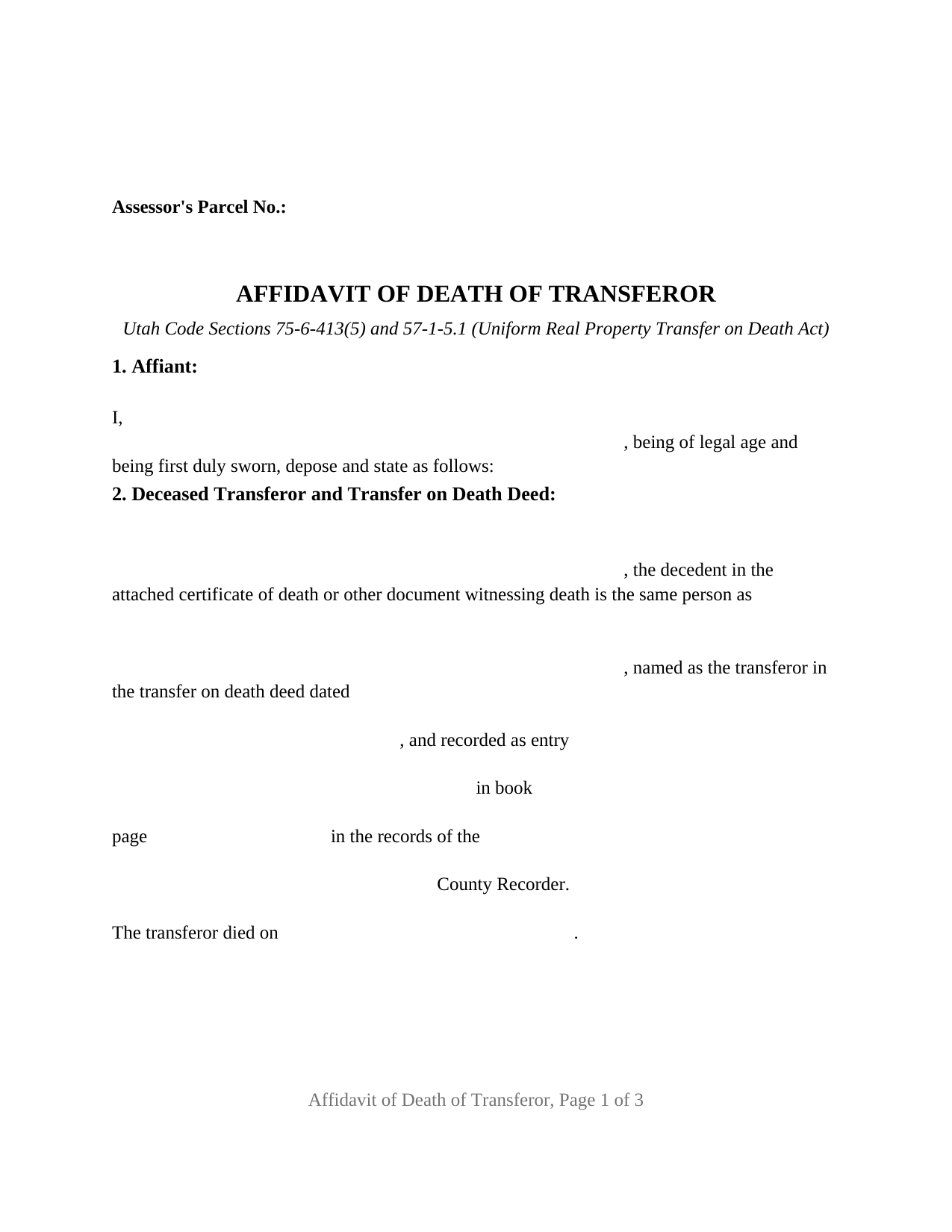
When the owner who recorded a Utah transfer on death deed dies, the property passes to the designated beneficiary at that moment, by force of the recorded deed and without probate. Utah then asks for one more recorded document. Section 75-6-413(5) of the Utah Code provides that following the death of the transferor, an affidavit in substantially the form found in Section 57-1-5.1 shall be recorded in the office of the recorder of the county where the property is located. This package prepares that affidavit: the sworn statement a beneficiary or other person of legal age records, with the death certificate attached, to place the transferor's death and the deed's operation into the county records.
A statutory form, adopted from the joint tenancy affidavit
Utah did not write a separate post-death affidavit for transfer on death deeds. Section 75-6-413(5) borrows the affidavit form that Section 57-1-5.1 prints for disclosing the termination of a joint tenancy or life estate at death, and adds three required items of its own: a legal description of the property, the entry number and the book and page of the previously recorded transfer on death deed, and a copy of the death certificate or other governmental document certifying the death, attached as an exhibit. This form carries the statutory sentences in the statute's own words. The affiant swears, being of legal age and being first duly sworn, that the decedent named in the attached certificate of death is the same person named as the transferor in the recorded deed, and that the affidavit is given to terminate of record the decedent's interest in the described property.
Around those sentences the form collects what a title examiner reads next: the decedent's name as the death certificate prints it and as the deed prints it, so a middle name or initial that differs between the two documents is disclosed rather than buried; the deed's date and its entry number, book, and page from the recorder's stamp; the date of death; the county; and the legal description copied from the deed. A county tax identification number line sits in the upper left of the first page, in the margin space Section 17-71-402(5) allows a county to ask for.
Who took under the deed, stated under oath
The transfer on death act makes a beneficiary's interest contingent on surviving the transferor, and Utah's general survival rule in Section 75-2-702 measures survival by 120 hours unless the deed itself says otherwise. A share that lapses passes to the other designated beneficiaries in proportion to their interests under Section 75-6-413(1)(d). The affidavit therefore lists, as sworn facts, the designated beneficiaries who survived the transferor by 120 hours, with their mailing addresses, and any who did not. Those entries are what connects the deed's designation to the people who hold title afterward, and the mailing addresses are what the county assessor reads for valuation and tax notices after the transfer. The form offers no selection and fixes no outcome; the chapter's own lapse and share rules decide who takes, and the affidavit reports the facts.
One affiant, one jurat
The statutory form is made by one affiant, and this form recites exactly that: one oath sentence with the affiant's name, one signature block, and one jurat certificate in the form Utah Code Section 46-1-6.5(2)(b) prints, in which the notary certifies that the affidavit was subscribed and sworn to before the notary on a stated date by the named signer. Section 46-1-6.5(2)(a) has the notary first ask whether the signer swears or affirms under penalty of perjury that the statements in the document are true. The statute names no particular person as the affiant; the completed example shows a designated beneficiary making the affidavit, and the surviving beneficiaries are listed inside it whether or not each of them signs. The form is not set up as an affidavit by two affiants on one instrument, by a corporate affiant, or by a person signing through an attorney-in-fact, and it is not the affidavit a surviving joint tenant records where no transfer on death deed is involved, although Utah prints one form for both uses.
The certificate's venue is left to the act: a beneficiary who lives outside Utah swears to the affidavit before a notary of that state, and Utah Code Section 57-2a-3(2) recognizes the act with the same effect as if a Utah notary had performed it.
Effective at death, documented of record
Recording the affidavit is not what transfers the property. Section 75-6-413(1) transfers the interests to the designated beneficiaries at the transferor's death in accordance with the deed, and Section 75-6-413(2) treats the deed as recorded at that moment for purposes of the recording act. The beneficiary takes subject to every mortgage, lien, and other interest affecting the property at death, and the deed transfers the property without covenant or warranty of title. What the affidavit adds is the evidence: a certified death certificate is prima facie evidence of the fact, date, and time of death and of the decedent's identity under Section 75-1-107, and once the affidavit and its exhibit are recorded, the chain of title shows the death, the deed, and the beneficiaries in one place. Where the transferor was a joint owner survived by another joint owner, the deed does not operate at that death at all; Section 75-6-413(3) gives the property to the surviving joint owner, and the deed takes effect only at the last joint owner's death.
The affidavit does not revoke or confirm the deed, and it does not cut off the claims the chapter preserves: under Section 75-6-415 an insufficient probate estate may reach the transferred property for allowed claims and statutory allowances within 12 months after death. A revocation of a transfer on death deed is a different instrument under Section 75-6-411, acknowledged and recorded during the transferor's life, prepared separately and not included in this package.
Built for the Utah recorder's counter
Utah recorders refuse nonconforming documents rather than charging a penalty fee, so the form is built to the full menu Section 17-71-402(4) lets a county adopt: letter size white paper, a title on the first page, the 2.5 by 4.5 inch stamp space in the upper right of page one, one inch margins, single sided black text, and the typed name beneath the signature that Section 17-71-403 asks for. The death certificate exhibit is attached as issued; Section 17-71-402(6) exempts a government death certificate from the county format rules. The statewide recording fee under Section 17-71-407 is 40 dollars for a document with up to ten legal descriptions, and 45 dollars in the counties that add the 5 dollar fee the 2026 amendment permits, with no transfer tax and no transfer declaration.
The package includes the fillable affidavit, a completed example filled in for a realistic Salt Lake County fact pattern, and the guide that walks through every numbered section, the jurat, and the recording steps. This description and the guide describe the form and the governing Utah statutes in general terms; they are not legal advice.
Important: County-Specific Forms
Our affidavit of death of transferor forms are specifically formatted for each of the 29 counties in Utah.
After selecting your county, you'll receive forms that meet all local recording requirements, ensuring your documents will be accepted without delays or rejection fees.