Utah Transfer on Death Revocation
County Specific Legal Forms Validated as recently as November 23, 2026 by our Forms Development Team
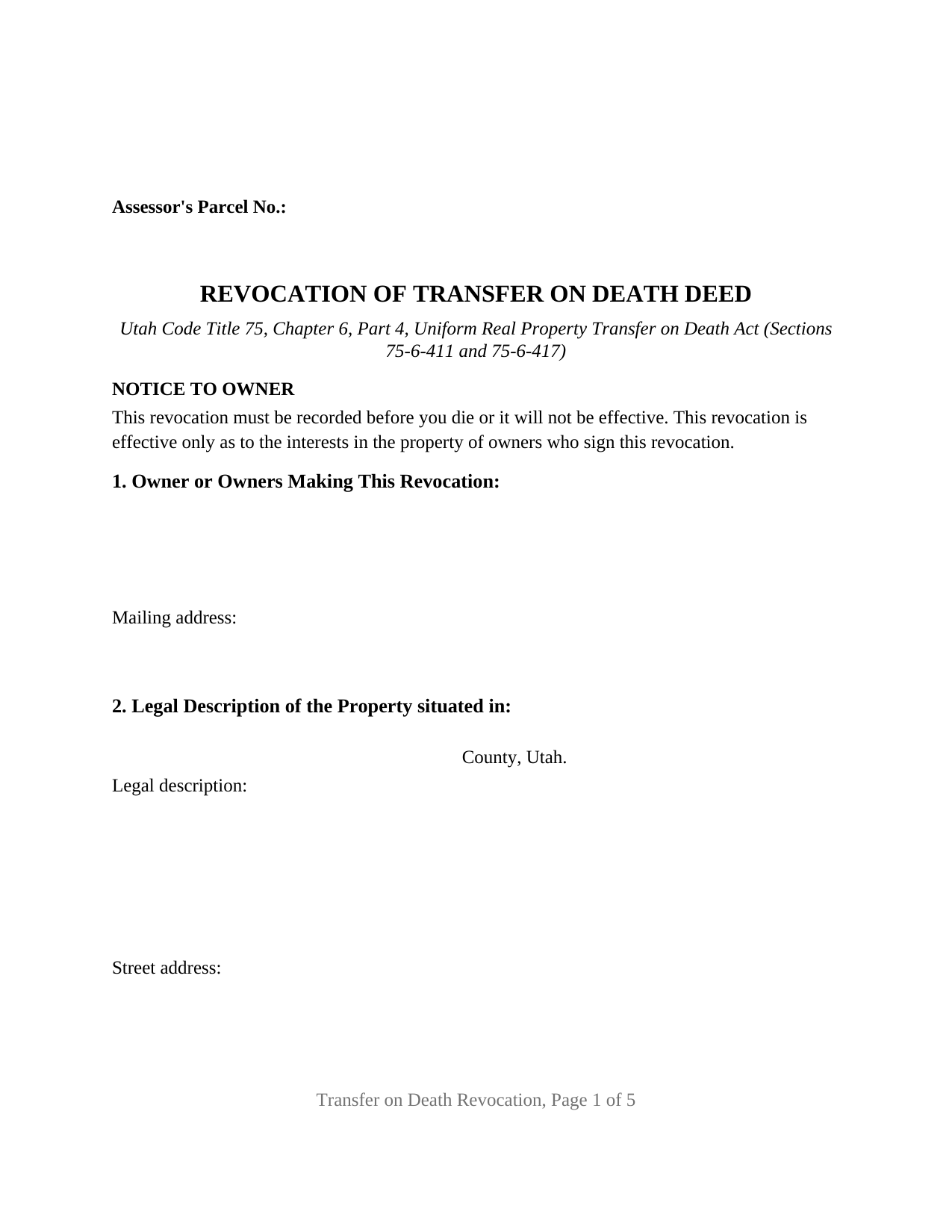
About the Utah Transfer on Death Revocation
How to Use This Form
- Select your county from the list
- Download the county-specific form
- Fill in the required information
- Have the document notarized if required
- Record with your county recorder's office
What Others Like You Are Saying
"I was pleased that I could send the documents this way rather than having to mail it or take time ou…"
"Absolutely Amazing Service! I learned about Deeds.com, created my Account, uploaded my documents int…"
"The product was just what I needed. Not being the sharpest computer user I stumbled a little but aft…"
"very easy to use this site as I live out of state."
"Perfect, thanks"
4.8/5 from 4,863 reviews. Read all
A recorded Utah transfer on death deed stays in force until an instrument the statute recognizes takes it out of force, and Utah Code Section 75-6-411 lists exactly three: a later transfer on death deed, an inter vivos deed, or an instrument of revocation. This form prepares the third, an instrument of revocation for one or two owners who made a recorded Utah transfer on death deed, the instrument also searched for as a beneficiary deed or TOD deed, and revoke it in full. The deed being revoked is identified by its acknowledgment date, recording date, entry number, book and page, and county, so the recorder and every later title examiner can match the two instruments in the chain.
A revocation that has to out-date the deed it undoes
Two timing conditions in Section 75-6-411(1)(b) give this instrument its distinctive shape. The revocation is acknowledged by the transferor after the acknowledgment of the deed being revoked, and it is recorded in the office of the county recorder where that deed is recorded before the transferor's death. The first condition is why the form asks for the date of acknowledgment of the earlier deed and not only its recording date, and why the notary certificate on the revocation carries a date of its own. The second is why the notice near the top of the first page, taken word for word from the optional statutory form in Section 75-6-417, states that the revocation must be recorded before the owner dies or it will not be effective. A revocation that is signed, notarized, and kept with the owner's papers revokes nothing. Neither does marking or destroying the recorded deed, which Section 75-6-411(3) makes ineffective once the deed is of record, and a will is not among the three instruments the section lists.
What the statutory sentence revokes
Section 4 of the instrument carries the revocation sentence of Utah's optional form word for word: I revoke all my previous transfers of this property by transfer on death deed. A second sentence applies that revocation expressly to the deed identified in Section 3 and to every other transfer on death deed by which the signer transferred an interest in the described property, which is the express revocation Section 75-6-411(1)(a)(ii) describes for an instrument of revocation. The revocation reaches the deed in whole. It transfers nothing and names no one; once it is recorded, the property passes at the owner's death by will, by intestacy, or under any transfer on death deed the owner later records. Under Section 75-6-411(5), property subject to a revocation of a transfer on death deed adeems, and Utah's nonademption statutes do not apply to the revoked deed. The instrument is not set up as a partial revocation, although Section 75-6-411(1)(a)(ii) permits an instrument that revokes part of a deed.
One owner or two, and what each signature reaches
The form is the general configuration of the revocation instrument. It carries one free-form block for the owner or owners making the revocation, with nothing about marital status, vesting, or capacity preprinted, followed by two signature blocks headed OWNER and SECOND OWNER (if applicable), each with its own acknowledgment certificate in the words of the affidavit Utah Code Section 46-1-6.5(3) prints. A sole transferor completes the first block and leaves the second blank. Two transferors who made one deed together each sign and each acknowledge, on one day before one notary or on different days before different notaries; the separate certificates are the form's layout, since the statutory certificate is written with plural alternatives and accommodates more than one signer. What each signature accomplishes follows Section 75-6-411(2): revocation by a transferor does not affect the deed as to the interest of another transferor, so tenants in common revoke interest by interest, while a deed of joint owners is revoked only if it is revoked by all of the living joint owners. Since May 1, 2024, Utah Code Section 57-1-5 has presumed that an interest granted to two or more persons in their own right is a joint tenancy with rights of survivorship, which makes the all-living-owners rule the one most two-transferor deeds answer to. The form is not set up as a revocation signed by an agent under a power of attorney, by a trustee, by an entity, or by three or more transferors.
Recording in the county that holds the deed
The revocation goes to the county recorder of the county where the transfer on death deed was recorded, which under Section 75-6-409(3) is the county where the property lies. Utah charges a flat fee per document rather than per page, $40 under Utah Code Section 17-71-407 as amended in 2026 plus $5 in counties of the second through sixth class, and no transfer tax or transfer declaration accompanies an instrument of this kind. The first page reserves the top 2.5 inches for the recorder's stamp, with a line at its left for the tax parcel number a county may require for abstracting under Section 17-71-402(5), and the instrument is built to the format menu Section 17-71-402(4) lets a county adopt: letter size, 1 inch side margins, black 12 point type over the seven-lines-per-inch density standard, single-sided pages, and a title on the first page stating the nature of the document. Each owner's name is printed beneath the signature for the recorder's index, as Section 17-71-403 asks.
The package includes the fillable revocation form, a completed example filled in for a realistic Salt Lake County fact pattern, and the guide that walks through every numbered section, the statutes behind them, and the recording process. This description and the guide describe the form and the governing Utah statutes in general terms; they are not legal advice.
Important: County-Specific Forms
Our transfer on death revocation forms are specifically formatted for each of the 29 counties in Utah.
After selecting your county, you'll receive forms that meet all local recording requirements, ensuring your documents will be accepted without delays or rejection fees.