Salt Lake County Transfer on Death Deed (Tenant in Common, Undivided Interest) Form
Last validated November 23, 2026 by our Forms Development TeamFormatted for recording in Salt Lake County, for property anywhere in the county: rural and unincorporated areas as well as Bingham Canyon, Draper, Herriman, Magna, Midvale, Riverton, Salt Lake City, Sandy and 2 more.
- 3 documents included
- Immediate PDF download
- Formatting guarantee
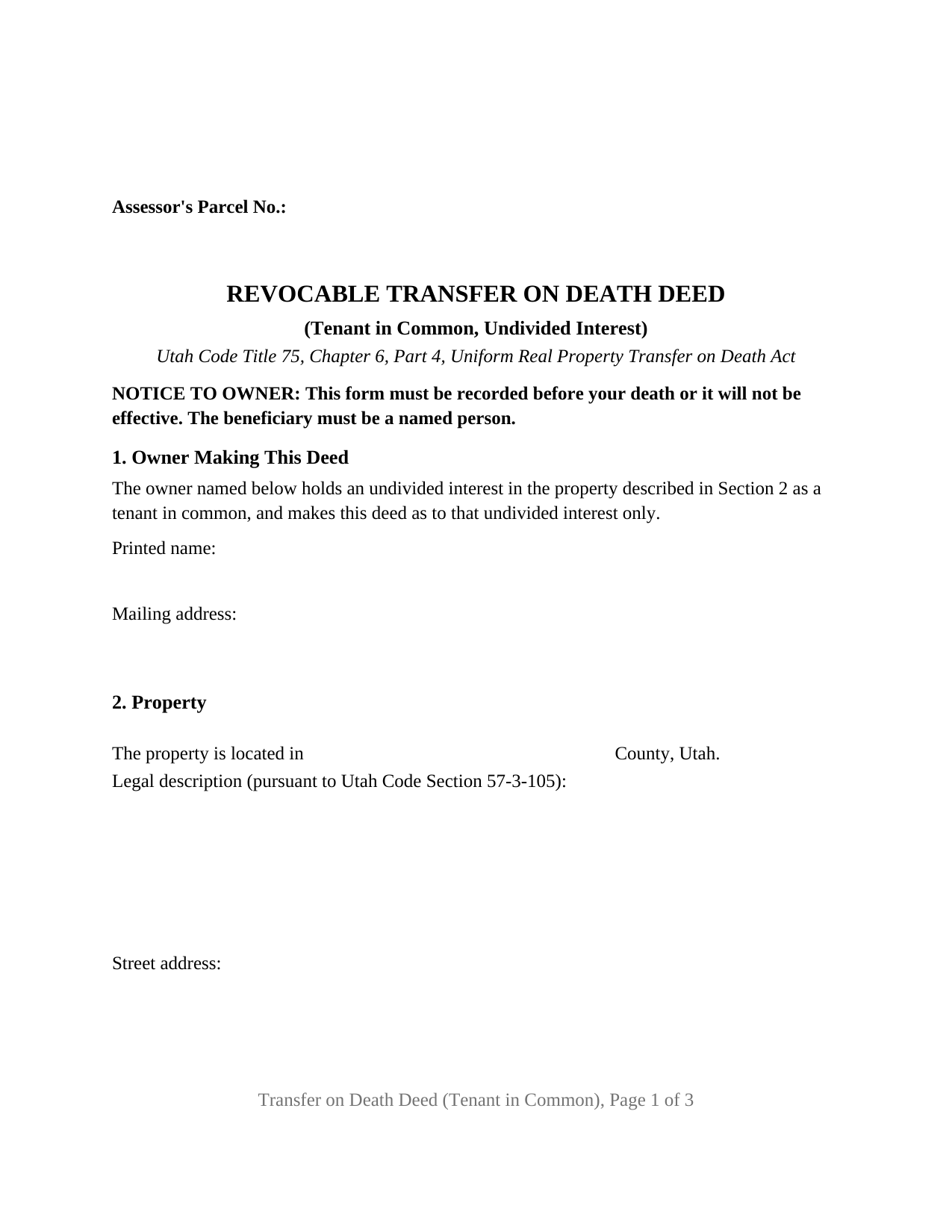
Salt Lake County Transfer on Death Deed (Tenant in Common, Undivided Interest) Form
Fill in the blank Transfer on Death Deed (Tenant in Common, Undivided Interest) form formatted to comply with all Utah recording and content requirements.
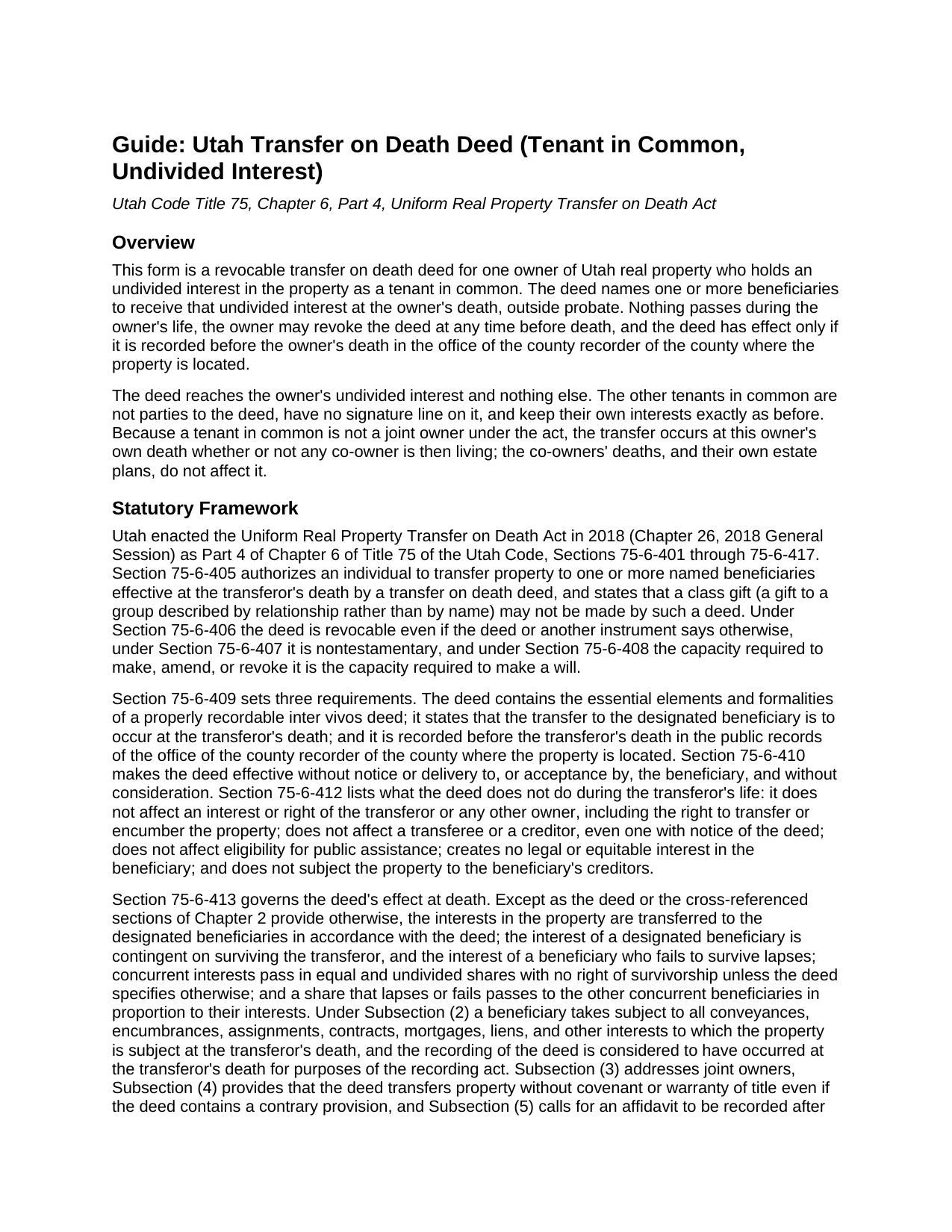
Salt Lake County Transfer on Death Deed (Tenant in Common, Undivided Interest) Guide
Line by line guide explaining every blank on the Transfer on Death Deed (Tenant in Common, Undivided Interest) form.
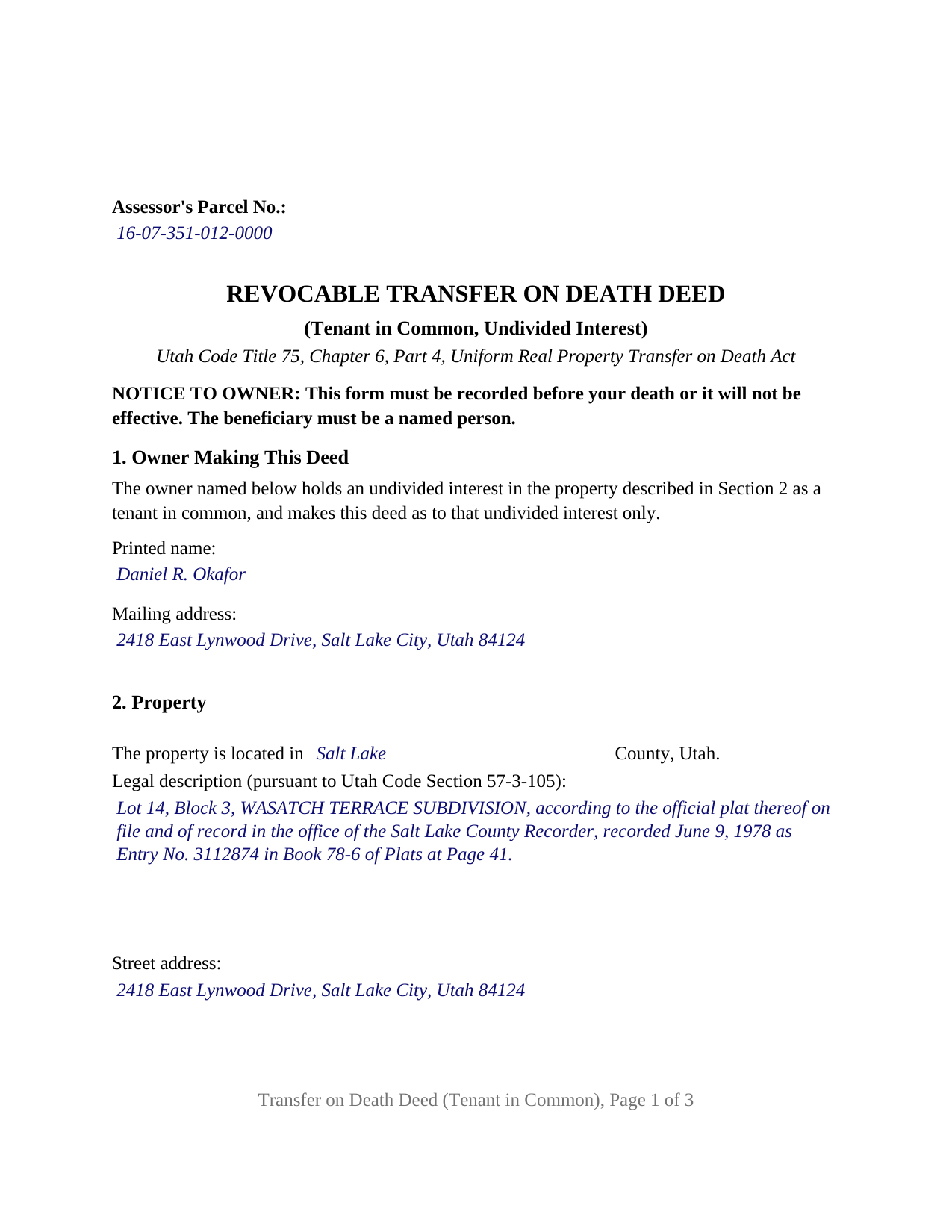
Salt Lake County Completed Example of the Transfer on Death Deed (Tenant in Common, Undivided Interest) Document
Example of a properly completed Utah Transfer on Death Deed (Tenant in Common, Undivided Interest) document for reference.
All 3 documents above included • One-time purchase • No recurring fees
Immediate Download • Secure Checkout
Additional Utah and Salt Lake County documents included at no extra charge:
Where to Record Your Documents
Salt Lake County Recorder
Salt Lake City, Utah 84190
Hours: 8:00 to 5:00 M-F
Phone: (385) 468-8145
Recording Tips for Salt Lake County:
- Bring your driver's license or state-issued photo ID
- Ensure all signatures are in blue or black ink
- Recorded documents become public record - avoid including SSNs
- Recording fees may differ from what's posted online - verify current rates
- Request a receipt showing your recording numbers
Cities and Jurisdictions in Salt Lake County
Properties in any of these areas use Salt Lake County forms:
- Bingham Canyon
- Draper
- Herriman
- Magna
- Midvale
- Riverton
- Salt Lake City
- Sandy
- South Jordan
- West Jordan
Hours, fees, requirements, and more for Salt Lake County
How do I get my forms?
Forms are available for immediate download after payment. The Salt Lake County forms will be in your account ready to download to your computer. An account is created for you during checkout if you don't have one. Forms are NOT emailed.
Are these forms guaranteed to be recordable in Salt Lake County?
Yes. Our form blanks are guaranteed to meet or exceed the applicable formatting requirements used for recording in Salt Lake County, including margin requirements, font requirements, and other layout standards. This guarantee applies to formatting, not to the legal sufficiency of information entered by the user or the suitability of a form for a particular transaction.
Can I reuse these forms?
Yes. You can reuse the forms for your personal use. For example, if you have multiple properties in Salt Lake County you only need to order once.
What do I need to use these forms?
The forms are PDFs that you fill out on your computer. The free Adobe Acrobat Reader is recommended, and most PDF apps also work. You do NOT enter your property information online - you download the blank forms and complete them privately on your own computer.
Are there any recurring fees?
No. This is a one-time purchase. Nothing to cancel, no memberships, no recurring fees.
How much does it cost to record in Salt Lake County?
Recording fees in Salt Lake County vary. Contact the recorder's office at (385) 468-8145 for current fees.
Questions answered? Let's get started!
One co-owner, one undivided share, one signature. This Utah transfer on death deed recites a single owner who holds a fractional interest in real property as a tenant in common, and it carries that interest, and only that interest, to a named beneficiary at the owner's death without probate. The deed recites the tenant in common configuration as fixed text, carries one OWNER signature block and one acknowledgment certificate, and leaves the other co-owners exactly where the vesting deed put them.
A deed that follows one undivided share
A tenant in common owns an undivided fraction of the whole: a one-half or one-third interest in every square foot, with no right of survivorship between the co-owners. When a tenant in common dies, that fraction goes where the owner's estate plan sends it, not to the surviving co-owners. A revocable transfer on death deed under Utah Code Title 75, Chapter 6, Part 4 gives that owner a recorded, revocable way to direct the fraction. The deed names the beneficiary now, transfers nothing while the owner lives, and takes effect at the owner's death as to whatever interest the owner then holds, which Section 75-6-413 transfers to the designated beneficiary in accordance with the deed.
The form states the scope in the operative paragraph itself: the interest transferred is the undivided interest the owner holds as a tenant in common at death, and the transfer occurs at the owner's death whether or not any other tenant in common is then living. A co-owner's later death, sale, or own beneficiary deed does not touch it, and the owner's deed does not touch theirs. Section 75-6-412 makes the lifetime side explicit, providing that the deed does not affect an interest or right of the transferor or any other owner, including the right to transfer or encumber the property.
Why a tenant in common is not a joint owner
The Uniform Real Property Transfer on Death Act draws a line that matters for this configuration. Section 75-6-402(5) defines a joint owner as an individual who owns property concurrently with others with a right of survivorship, a definition that reaches a joint tenant, an owner of community property with right of survivorship, and a tenant by the entirety, and that expressly does not include a tenant in common. For joint owners, Section 75-6-413(3) postpones everything: the property belongs to the surviving joint owner first, and a transfer on death deed is effective only if its maker is the last joint owner to die. A tenant in common is outside that rule. The undivided interest passes under the deed at that owner's own death, and the deed is not waiting on anyone else.
Because Utah has presumed joint tenancy for interests granted to two or more persons in their own right since May 1, 2024 (Section 57-1-5), the record itself answers which configuration an owner has. A vesting deed that names the co-owners as tenants in common, grants undivided interests, recites no right of survivorship, or joins the grantees with and/or without joint tenancy wording creates the tenancy in common this deed recites; so does a joint tenant's bona fide conveyance of that joint tenant's interest, which severs it. The guide walks through where those words appear and what they mean for the deed.
Beneficiaries of a fractional interest
The beneficiary sections carry the sentences of the optional statutory form in Section 75-6-416, re-enacted effective May 1, 2024: a primary beneficiary designated if the beneficiary survives the owner, and an optional alternate designated if the primary does not. Each beneficiary is named individually with a mailing address; the act permits an individual, a trust, or an entity as a beneficiary and bars a class gift. Where more than one primary beneficiary is named, Section 75-6-413(1)(c) transfers the undivided interest to them in equal and undivided shares with no right of survivorship unless the deed specifies otherwise, so a fractional interest can itself be divided again among the people who receive it. The beneficiary takes subject to the mortgages, liens, and other interests affecting the property at the owner's death, and the act transfers the interest without covenant or warranty of title whatever a deed says.
One signature, one certificate
The form recites exactly one record owner, a natural person signing in that person's own right. Section 1 states that the owner holds an undivided interest in the described property as a tenant in common and makes the deed as to that undivided interest only; the owner's printed name and mailing address are the only entries. Section 2 collects the county, the legal description copied from the vesting instrument, the street address, and the recording reference of the vesting instrument, with the parcel number carried in the recorder's space at the top of page one, the margin placement Section 17-71-402(5) allows for the tax identification number. The signature section has one OWNER block, followed by one acknowledgment certificate worded as the affidavit of acknowledgment in Utah Code Section 46-1-6.5(3), the certificate the statutory form names. No co-owner signs, no spouse who is not the record owner signs, and no second owner block exists on the deed. A married couple holding together, siblings holding as joint tenants, an owner of the whole parcel, and an entity or trustee transferor each present a different pattern on the recorded page, and this form is not set up as any of them. A beneficiary designation for a co-owner's own undivided interest is the subject of a separate deed, signed and recorded by that co-owner.
Recording before death in the county of the land
Recording is the condition that makes the deed work. Section 75-6-409 requires the deed to be recorded before the owner's death in the office of the recorder of the county where the property is located, and the deed's notice carries the statutory form's own warning that an unrecorded deed is not effective. The Utah statewide recording fee under Section 17-71-407 is $40 for a document with up to ten legal descriptions, with some counties adding a $5 class fee; no transfer tax or declaration accompanies a Utah deed. The form is laid out to the format menu Utah counties may adopt under Section 17-71-402(4), with letter-size pages, a 2.5-inch recording space on page one, and 1-inch margins, and the guide notes the published county variations such as Davis County's 3-inch first-page top margin. After the owner's death, the act calls for an affidavit in substantially the Section 57-1-5.1 form, with the death certificate attached, to be recorded against the property; that affidavit is prepared separately after death and is not part of this package. Likewise, a recorded deed is revoked only by a later acknowledged and recorded instrument, which is prepared separately and not included here.
The package contains the fillable transfer on death deed with its instructions cover page, a completed example showing the deed filled in for a fictional owner of an undivided one-half interest in a Salt Lake County lot, and a guide that explains each section, the governing statutes, the Utah notary certificate, and the recording steps. This description and the guide describe the form and the law in general terms; they are not legal advice and do not apply the law to any particular situation.
Important: Your property must be located in Salt Lake County to use these forms. Documents should be recorded at the county recording office listed above.
This Transfer on Death Deed (Tenant in Common, Undivided Interest) meets all recording requirements specific to Salt Lake County.
Our Promise
The documents you receive here are guaranteed to meet or exceed the applicable Salt Lake County recording format requirements. If there is a rejection caused by our formatting, we will correct the issue or refund your payment. This guarantee applies to document formatting only and does not extend to information entered by the user, the selection of the form, or the legal effect of the completed document.
Save Time and Money
Get your Salt Lake County Transfer on Death Deed (Tenant in Common, Undivided Interest) form done right the first time with Deeds.com Uniform Conveyancing Blanks. At Deeds.com, we understand that your time and money are valuable resources, and we don't want you to face a penalty fee or rejection imposed by a county recorder for submitting nonstandard documents. We constantly review and update our forms to meet rapidly changing state and county recording requirements for roughly 3,500 counties and local jurisdictions.
4.8 out of 5 - ( 4,867 Reviews )
ALAN C. 5 out of 5 stars
Everything was as advertised, and easily downloaded.
We appreciate your business and value your feedback. Thank you. Have a wonderful day!
Lucinda L. 5 out of 5 stars
mostly good; however, you need to update the annual exclusion gift amount from $14,000 to $15,000 (where it has ben for several years), and you need to make your Gift Deed final paragraph be gender neutral like "they" or "he or she" rather than just"he". We women lawyers and our women clients appreciate that.
Thank you for your feedback. We really appreciate it. Have a great day!
Howard W. 5 out of 5 stars
easy to use,inexpensive
Thank you — we appreciate you taking the time to leave a review.
James D. 5 out of 5 stars
I had a satisfying experience very informative and easy to navigate.
Thank you!
John B. 5 out of 5 stars
Forms are as advertised and easy to access.
Thank you for your feedback. We really appreciate it. Have a great day!
Rose M. 5 out of 5 stars
Easy to understand and complete. Lower cost than many others who offer same. Thanks so much!
We appreciate your business and value your feedback. Thank you. Have a wonderful day!
SheRon F. 5 out of 5 stars
It was a quick and easy process and deeds.com was very helpful and dealt with a very stressful situation, painless.
We appreciate your business and value your feedback. Thank you. Have a wonderful day!
Fritz C. 5 out of 5 stars
Quick and complete info
Thank you!
Catherine O. 5 out of 5 stars
Love the fact that you can buy a form instead of a subscription. I would highly recommend this site.
Thank you for your feedback. We really appreciate it. Have a great day!
david t. 5 out of 5 stars
No review provided.
Thank you!
Sarjit K. 5 out of 5 stars
excellent
Thank you!
Kent B. 2 out of 5 stars
Disappointed on most recent order. Format did not permit changing the "boilerplate" language to change "grantor" to "grantors". In so restricting, could not use pre-printed form to make a joint party conveyance.
Sorry to hear of your disappointment. We've canceled your order and payment for the warranty deed document. Have a wonderful day.
Carlos T. 5 out of 5 stars
Site was easy to use and forms were exactly what I needed. Will use this in the future for other needed forms. A+
We appreciate your business and value your feedback. Thank you. Have a wonderful day!
Gordon J. 5 out of 5 stars
The experience was generally very satisfactory. I was able to fill out the Trust Deed and send it via email no problem. However, I was not able to send the filled out form of the Note. It always erased my fill-ins when it was sent. I found that very frustrating.
Thank you, Gordon. Glad the Trust Deed worked well. Issues like the one you reported with the Note can sometimes be related to how the file is opened or sent. Using Adobe Reader to fill, save, and send the form is recommended. We also pass along all feedback like this to our team to confirm there are no issues.
Terry M. 4 out of 5 stars
Application is not well laid out. I guess it does the job but leaves a lot to be desired. Hard to follow
Thank you for your feedback. We really appreciate it. Have a great day!