Wisconsin Correction Deed (Individual Grantor)
County Specific Legal Forms Validated as recently as November 26, 2026 by our Forms Development Team
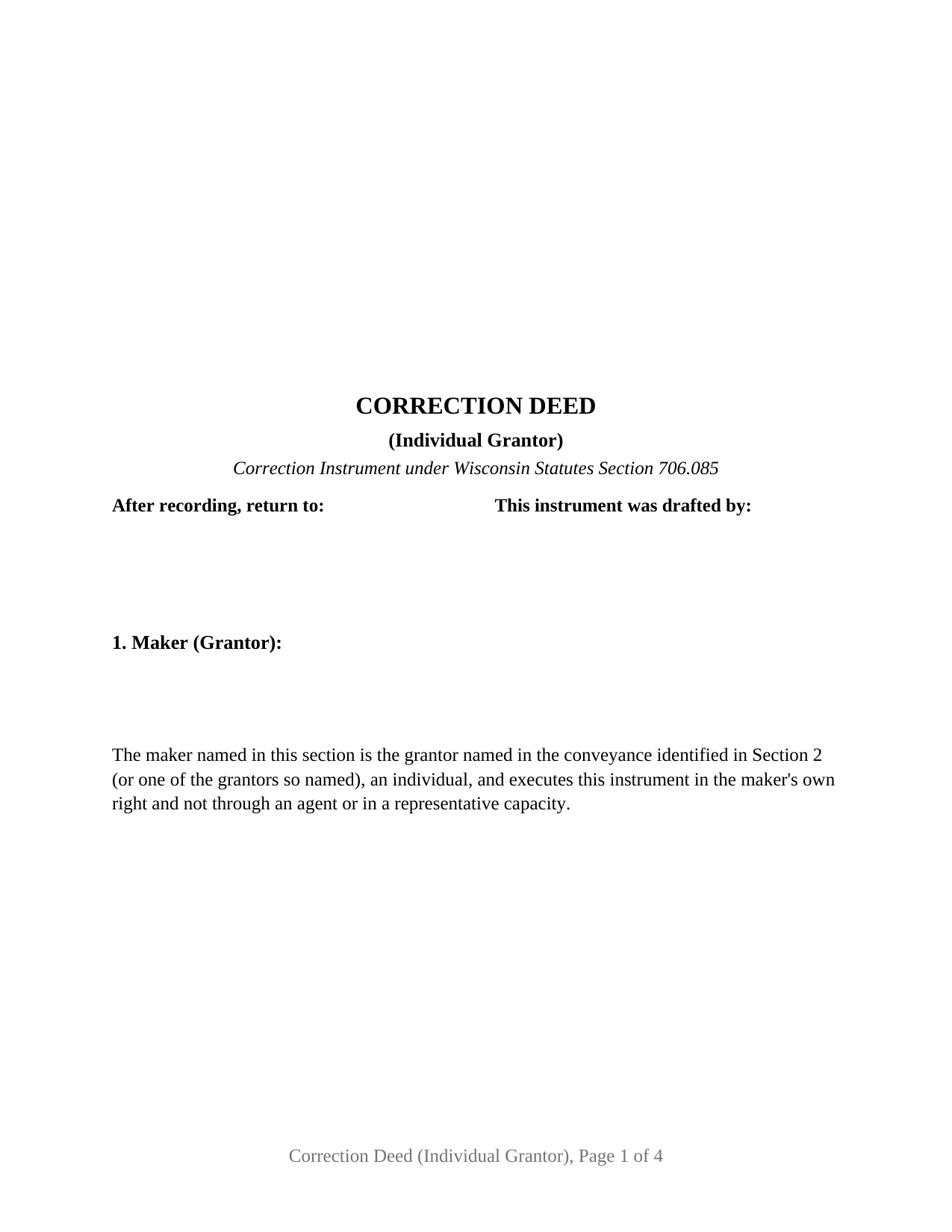
About the Wisconsin Correction Deed (Individual Grantor)
How to Use This Form
- Select your county from the list
- Download the county-specific form
- Fill in the required information
- Have the document notarized if required
- Record with your county recorder's office
What Others Like You Are Saying
"I was very pleased with Deeds.Com. It was easy to use."
"So convenient! I love this service. I highly recommend."
"Very happy I tried your service/product. The quit deed forms were excepted by the register of deeds …"
"I found the documents I needed on Deeds.com. It was so easy to use and I received the items I purcha…"
"very intuitive website. had no problem finding form ad printing."
4.8/5 from 4,867 reviews. Read all
A Wisconsin correction deed on this form is signed by one person: the grantor who made the recorded deed, an individual signing in that person's own right, correcting the record of that conveyance under Wisconsin Statutes Section 706.085. The form recites that configuration in fixed text, carries one signature block and one acknowledgment certificate, and identifies the deed being corrected by the items the statute requires.
The grantor who made the deed fixes the record
Section 706.085 calls the document a correction instrument and lets it be executed by a person having personal knowledge of the circumstances of the conveyance and of the facts recited, naming the grantor first among the persons who have that knowledge. The statute also requires the instrument to recite the basis of that knowledge. This form answers both requirements in its own text: Section 1 recites that the maker is the grantor named in the recorded conveyance, an individual, and the operative paragraph recites that the basis of the maker's personal knowledge is the maker's execution of the conveyance as its grantor. Nothing about the signer's identity is left to a selector or a blank, which is what makes this a one-grantor form rather than a general correction instrument.
The corrections it carries are the ones Section 706.085(1)(a) and (1)(b) describe: a legal description item such as a lot, block, unit, or building number, a plat or certified survey map reference, a section, township, or range figure, or a subdivision or condominium name; and information other than a legal description, such as a party's name and its spelling, a marital status statement, the execution date, a homestead statement, the tax parcel number, the drafter, a prior recording reference, the nature and purpose of the conveyance, its title, or facts relating to its acknowledgment. The correction section of the form takes the item as it appears in the conveyance and the item as corrected, so a reader of the record sees the two side by side.
What a recorded correction instrument does in Wisconsin
A correction instrument conveys nothing, and this form says so in a sentence of its own. What it does is give the public record a signed, acknowledged statement with statutory weight. Under Section 706.085(3), the record of a complying correction instrument is prima facie evidence of the facts stated, presumed true subject to rebuttal, and notice to a purchaser under Section 706.09 of the facts recited; a purchaser for value may assert it against an adverse or inconsistent claim. The deed being corrected stays of record as it was recorded, and the correction instrument is indexed beside it in the same chain of title, in the office of the register of deeds of the county in which that deed is recorded.
The statute reserves a few corrections to other signers. A parcel removed from a deed that also correctly conveys other land is corrected only by the grantee; so is a lot or unit number where the lot incorrectly recited is also owned by the grantor; a mortgagee's consent or subordination is signed by the consenting party. Those corrections belong to different signers, and the guide maps each paragraph of Section 706.085(2)(b) to the signer the statute names so the fit of this one-grantor form is clear before it is filled in.
One signature, one certificate, one recital of knowledge
The form recites exactly one maker, the grantor, signing as an individual and not through an agent or in a representative capacity. One signature block under the heading GRANTOR (MAKER) and one acknowledgment certificate in the Wisconsin short form of Section 140.16(1) follow the operative paragraph; Section 706.085(2)(a) requires a correction instrument to be acknowledged or authenticated under Section 706.06 or Chapter 140. A grantor who signed a warranty deed, quit claim deed, or land contract that was recorded with a misspelled grantee name, a wrong lot number, or a dropped plat reference presents the pattern this form recites. Where the recorded deed named two grantors, the fixed text reads the maker as one of the grantors so named, and one of them signs this form alone. The form is not set up as a correction by two makers, by the grantee, by the drafter or settlement agent, by a corporation or other entity grantor, by a trustee or personal representative, or by an attorney-in-fact; each of those changes who signs, what the knowledge recital says, or which acknowledgment form the certificate carries.
Recording in Wisconsin with no transfer fee
The instrument is recorded with the register of deeds for the statewide $30 document fee under Section 59.43(2)(ag), and the form is laid out to the standard document format of Section 59.43(2m)(a): the title, the return block, and the drafter block on the first page, the upper right recording area left blank, and the parcel identification number carried in the property section for counties that require one. Two Wisconsin details surround the recording. First, a transfer return still accompanies the instrument: the Department of Revenue's published position is that a correction instrument presented for recording requires an electronic real estate transfer return, filed new rather than as an amendment of the original deed's return, and that the instrument is exempt from the transfer fee under Section 77.25(3), which covers a conveyance executed for nominal, inadequate or no consideration that confirms, corrects or reforms a conveyance previously recorded. Section 77.22(1) requires the exemption to be stated on the face of the document by reference to that subsection, and the form carries that statement as fixed text. Second, Section 706.085(2)(c) requires the person who executes and records a correction instrument to send notice of that fact by first class mail to all parties to the transaction at their last known addresses, a duty recording does not discharge and the register does not perform; the guide describes it as a step of its own.
Whether searched for as a Wisconsin correction deed, a corrective deed, an affidavit of correction, or a correction instrument, the document this package prepares is the Section 706.085 instrument executed by the grantor alone. The package includes the fillable correction instrument form, a completed example filled in for a Dane County fact pattern in which the grantor corrects the spelling of the grantees' surname, and the guide that walks through every section, the corrections the statute permits, the signer each correction belongs to, the transfer return, and the mailed notice. This description and the guide describe the form and the governing Wisconsin statutes in general terms; they are not legal advice.
Important: County-Specific Forms
Our correction deed (individual grantor) forms are specifically formatted for each of the 72 counties in Wisconsin.
After selecting your county, you'll receive forms that meet all local recording requirements, ensuring your documents will be accepted without delays or rejection fees.