Wisconsin Correction Deed (Entity Grantor)
County Specific Legal Forms Validated as recently as November 27, 2026 by our Forms Development Team
About the Wisconsin Correction Deed (Entity Grantor)
How to Use This Form
- Select your county from the list
- Download the county-specific form
- Fill in the required information
- Have the document notarized if required
- Record with your county recorder's office
What Others Like You Are Saying
"You guys simplified my life. You offer very convenient services. Thank you."
"I was very happy with this site. It included all the papers I needed, instructions, and even an exam…"
"Fillable documents, after a download, would be helpful. Very good to have all these forms online and…"
"Super easy and quick. Love the service-"
"Just what we needed! Thank you!"
4.8/5 from 4,867 reviews. Read all
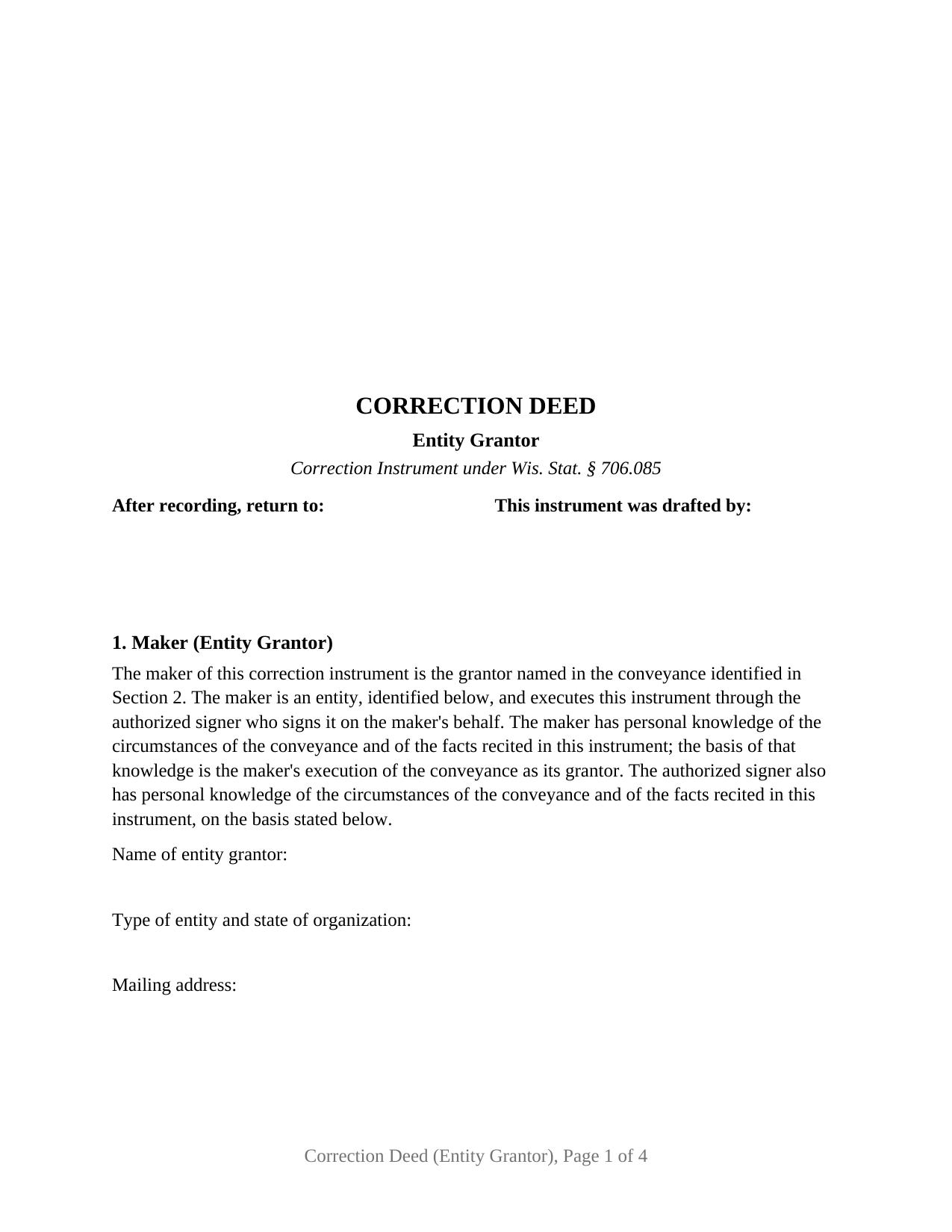
When the grantor on a recorded Wisconsin deed was a company rather than a person, the correction instrument that fixes an error in that deed is signed by the company through one authorized signer, and this Wisconsin Correction Deed (Entity Grantor) is built for exactly that execution. A corporation, limited liability company, partnership, or other organization that was the grantor named in the recorded conveyance is the maker; an officer, member, manager, or partner signs on its behalf, states a title, and acknowledges the instrument in the representative capacity form of Wis. Stat. § 140.16(2). The instrument corrects the recorded conveyance under Wis. Stat. § 706.085 and, in its own words, conveys no interest in real property.
A company's deed, corrected by the company
Section 706.085(2)(b)1. lets a correction instrument be executed by a person having personal knowledge of the circumstances of the conveyance and of the facts recited, the grantor among them, and it requires the instrument to recite the basis for that knowledge. An entity knows its own conveyance only through the people who act for it, and this form is written around that fact. Section 1 recites in fixed text that the maker is the grantor named in the conveyance, that it is an entity executing the instrument through its authorized signer, and that the basis of its knowledge is its own execution of the conveyance as grantor; the entity's name, its type and state of organization, its mailing address, and the basis of the signer's personal knowledge are the entries that complete the recital. The signer's own basis is written in, because the individual who holds the pen on the correction is sometimes the person who signed the original deed and sometimes the officer who now keeps the company's records of the transaction.
The corrections the instrument carries are the ones the statute lists for any maker: a legal description element under § 706.085(1)(a), or the addition, correction, or clarification of other information under § 706.085(1)(b), a party's name, an execution date, a tax parcel number, the drafter, a prior recording reference, the title of the conveyance, or acknowledgment facts. One item on that list belongs especially to this configuration. Paragraph (1)(b)1. names, among the party-name corrections, a description of an entity as a corporation, company, or similar identifier, and the completed example shows that correction: a Brown County warranty deed that described the grantor as Fox River Crossing Properties, Inc., a Wisconsin corporation, corrected by the grantor itself to read Fox River Crossing Properties, LLC, a Wisconsin limited liability company.
One signer, a title line, and a representative-capacity certificate
The signature block is captioned ENTITY GRANTOR (MAKER). The authorized signer signs, prints a name, dates the signature, and completes two lines the individual form of this instrument has no reason to carry: the signer's title and the entity grantor's name. Those two lines, with Section 1 and the certificate, identify the principal on whose behalf the signer acts, the identification Wis. Stat. § 706.03(1m) describes for a conveyance signed by one acting as agent for another. The acknowledgment that follows is the § 140.16(2) short form, which records that the instrument was acknowledged by the named individual as the stated type of authority of the named party on whose behalf the record was executed; the notarial officer completes the type of authority and the party's name as two further entries after the signer's name, and the certificate reserves an area for the officer's official stamp under Wis. Stat. § 140.15(2). The form carries one signature block and one certificate; a second signer, an attestation line, and a corporate seal are not drawn, and § 706.03(2) states that the absence of a corporate seal does not invalidate a corporate conveyance.
Authority to sign is a fact outside the instrument, and the guide describes where Wisconsin law places it: under § 706.03(2), any one officer of a private corporation may sign conveyances in the corporate name unless a different authorization is recorded under § 706.03(3) or appears in the articles of incorporation, and under § 183.0301(1) a member of a limited liability company is not the company's agent solely by reason of being a member, so an LLC signer's authority rests on the operating agreement and the company's management structure. The title line states the capacity the signer asserts; it does not by itself establish that authority.
What the form is not set up as
The form recites exactly one maker, an entity that was the grantor. It is not set up as a correction by an individual grantor signing in that person's own right, by two makers, by the grantee, by the drafter or settlement agent of the conveyance, by an entity acting through an attorney-in-fact under a power of attorney, by a trustee or personal representative, or by a public corporation, which § 706.03(2) says authorizes and executes conveyances as provided by law. It is likewise not set up for the corrections § 706.085 assigns to a different signer: a parcel removed from a conveyance that also correctly conveys other land, or a lot or unit number corrected where the grantor also owns the lot wrongly recited, each of which § 706.085(2)(b)3. assigns only to the grantee; a mortgagee's consent or subordination; and a grantee's disclaimer of interest. The guide maps each paragraph of § 706.085(2)(b) to the signer the statute names.
Recording beside the deed it corrects
The instrument is recorded with the register of deeds of the county where the corrected conveyance is on file, for the statewide $30 document fee under § 59.43(2)(ag), and it is laid out to the standard document format of § 59.43(2m)(a) with the title, the return address, and the drafter's name on the first recorded page. Section 2 recites the document number of the conveyance and the names of its grantor and grantee as the conveyance printed them, the items § 706.085(2)(a) requires, so an entity whose name was wrong on the deed enters the wrong name there and the right one in the correction section. Above the signature block the instrument states that it is executed for no consideration and is exempt from the real estate transfer fee under § 77.25(3), the face-of-document statement § 77.22(1) calls for; the Wisconsin Department of Revenue's published position is that a correction instrument presented for recording still requires a new electronic real estate transfer return claiming that exemption. After recording, § 706.085(2)(c) requires the person who executed and recorded the instrument to mail notice of that fact to all parties to the transaction, a step the register does not perform and the guide describes on its own. Once recorded, the instrument is prima facie evidence of the facts it states and notice to a purchaser under § 706.09, subject to rebuttal, under § 706.085(3).
Whether searched for as a Wisconsin corrective deed, an affidavit of correction, or a correction instrument signed by an LLC or corporation, the document this package prepares is the § 706.085 correction instrument executed by the entity grantor through its authorized signer. The package includes the fillable form, a completed example filled in for a fictional Brown County fact pattern in which a limited liability company corrects a deed that described it as a corporation, and the guide that takes up each section, the signer's authority, the representative-capacity acknowledgment, the transfer return, and the notice mailed after recording. This description, like the guide, describes the form and the Wisconsin statutes that govern it in general terms and is not legal advice.
Important: County-Specific Forms
Our correction deed (entity grantor) forms are specifically formatted for each of the 72 counties in Wisconsin.
After selecting your county, you'll receive forms that meet all local recording requirements, ensuring your documents will be accepted without delays or rejection fees.