Wisconsin Correction Deed (Married Couple as Grantors)
County Specific Legal Forms Validated as recently as November 27, 2026 by our Forms Development Team
About the Wisconsin Correction Deed (Married Couple as Grantors)
How to Use This Form
- Select your county from the list
- Download the county-specific form
- Fill in the required information
- Have the document notarized if required
- Record with your county recorder's office
What Others Like You Are Saying
"Very easy and efficient. The team was quick to respond when I had questions and made it very simple."
"Very helpful and quick customer service. Highly recommended"
"This was such an easy process and even tho you had to pay a $15 - to me it was well worth not having…"
"Deeds.com made the recording of our Deed in a county where we do not reside, VERY easy! Customer ser…"
"If my availability does not coincide with your business hours it should not prevent me from uploadin…"
4.8/5 from 4,867 reviews. Read all
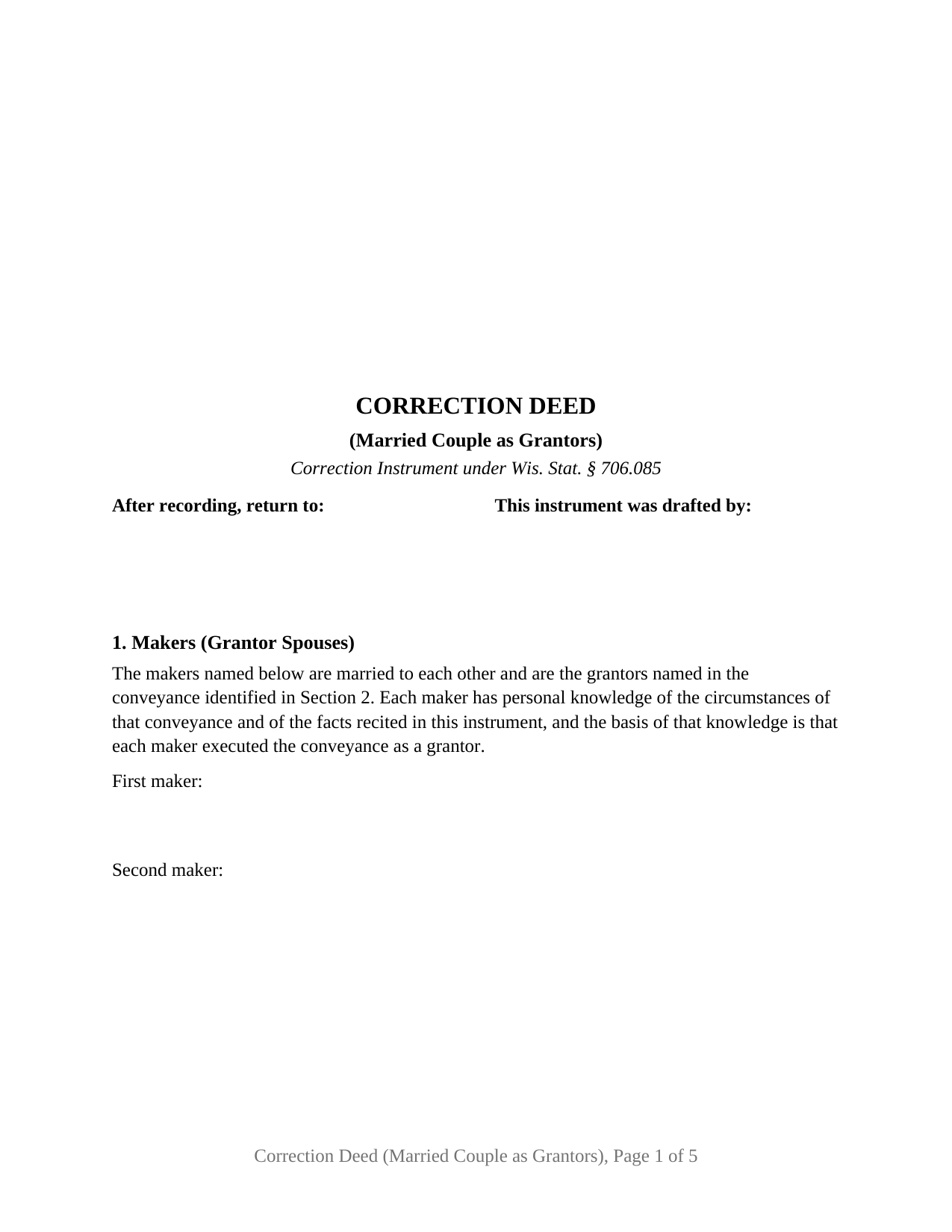
Two spouses who signed a Wisconsin deed together, and later found that the deed misstates something, can place the correction on the record themselves. This Wisconsin Correction Deed (Married Couple as Grantors) is drawn for exactly that pair: two makers who are married to each other and who are the grantors named in the recorded conveyance. Both spouses sign, each before a notarial officer, and the instrument is recorded with the register of deeds of the county where their original deed is on file, beside that deed and without replacing it.
Grantor spouses correcting their own deed
Wisconsin lets a correction instrument be executed by a person with personal knowledge of the circumstances of the conveyance, and Wis. Stat. § 706.085(2)(b)1. names the grantor first among them. The statute also asks the instrument to recite the basis of that knowledge. On this form the basis is fixed rather than left open: Section 1 recites that the makers are married to each other, that they are the grantors named in the conveyance identified in Section 2, and that each has personal knowledge of the conveyance and of the facts recited because each executed it as a grantor. The spouses fill in their names and mailing address under that recital; nothing about their status or their role is left to a blank or a checkbox. The operative paragraph in Section 5 restates the same configuration and corrects the conveyance as stated in Section 4, with a second sentence that the instrument conveys no interest in real property and changes nothing else in the deed, which remains of record as written.
The one correction only a grantor may sign
Section 706.085(2)(b)3. ties certain corrections to a particular party. When a parcel is added to a conveyance that also correctly conveys other land, the correction instrument is signed only by the grantor. The reverse corrections, a parcel removed or a lot or unit number corrected where the grantor also owns the lot wrongly recited, are signed only by the grantee. Because this form fixes both makers as the grantors, the grantor-only correction is within what it recites, as are the corrections the statute opens to any person with personal knowledge: an omitted lot, block, unit, or building number supplied, or a wrong one corrected where the grantor does not own the lot wrongly named. The form is not set up for a correction reserved to the grantee alone, for a mortgagee's consent or subordination, or for a grantee's disclaimer of interest, each of which the statute assigns to a different signer or treats as its own item.
A marital status recital, corrected by the people who know it
The completed example shows a correction that belongs naturally to a married couple: a warranty deed recorded in Waukesha County recited each grantor as a single person, and the grantor spouses correct the recital under § 706.085(1)(b)2. to state that they were married to each other on the date of the conveyance. The guide uses that example throughout, and the same three-part correction section, the item corrected, the information as recorded, and the information as corrected, carries a misspelled name, a mistaken execution date, a wrong tax parcel number, or a legal description element copied incorrectly. The guide also states the limit the example illustrates: a corrected status recital changes what the deed says about the parties, and it does not supply a signature the deed lacked, including a spouse's joinder on a homestead conveyance under § 706.02(1)(f). Where both spouses signed the original deed, as the grantor spouses on this form did, that joinder question does not arise.
Two signatures, two certificates, one exempt return
Each grantor spouse has a captioned signature block, MAKER (GRANTOR SPOUSE) and SECOND MAKER (GRANTOR SPOUSE), followed by a separate acknowledgment certificate in the short form of Wis. Stat. § 140.16(1), the authentication § 706.085(2)(a) and § 706.05(2)(b) call for. The two certificates are the form's layout, so the spouses may acknowledge on different dates or before different officers, including an officer of another state; no Wisconsin statute requires a certificate per signer. A correction instrument conveys and encumbers nothing, so the homestead joinder rule reaches no one beyond the two makers, and no other person signs. Above the signature blocks the instrument states, as § 77.22(1) requires of the face of a document, that it is executed for no consideration and is exempt from the real estate transfer fee under § 77.25(3). The guide describes the electronic transfer return the Department of Revenue treats as accompanying a correction instrument at recording, and the first class mail notice to the parties that § 706.085(2)(c) requires after recording, a step the instrument itself does not perform.
Built to Wisconsin's standard document format
The first recorded page reserves the three and one half inches the register's recording information occupies under § 59.43(2m)(a), then carries the title, the return address, and the drafter's name, and the property section takes the full legal description and the parcel identification number. The non-recorded instructions page at the front of the PDF is removed before recording. The statewide recording fee is $30 per document.
The download contains three files: the fillable Correction Deed (Married Couple as Grantors) form, a completed example filled with fictional Waukesha County entries, and a guide that takes up each section of the form, the execution rules of § 706.085, the acknowledgment certificates, the transfer return, and what the instrument does not do. This page and the guide describe the form and the governing Wisconsin statutes in general terms; they are not legal advice.
Important: County-Specific Forms
Our correction deed (married couple as grantors) forms are specifically formatted for each of the 72 counties in Wisconsin.
After selecting your county, you'll receive forms that meet all local recording requirements, ensuring your documents will be accepted without delays or rejection fees.