Wisconsin Disclaimer of Interest (Husband and Wife)
County Specific Legal Forms Validated as recently as November 20, 2026 by our Forms Development Team
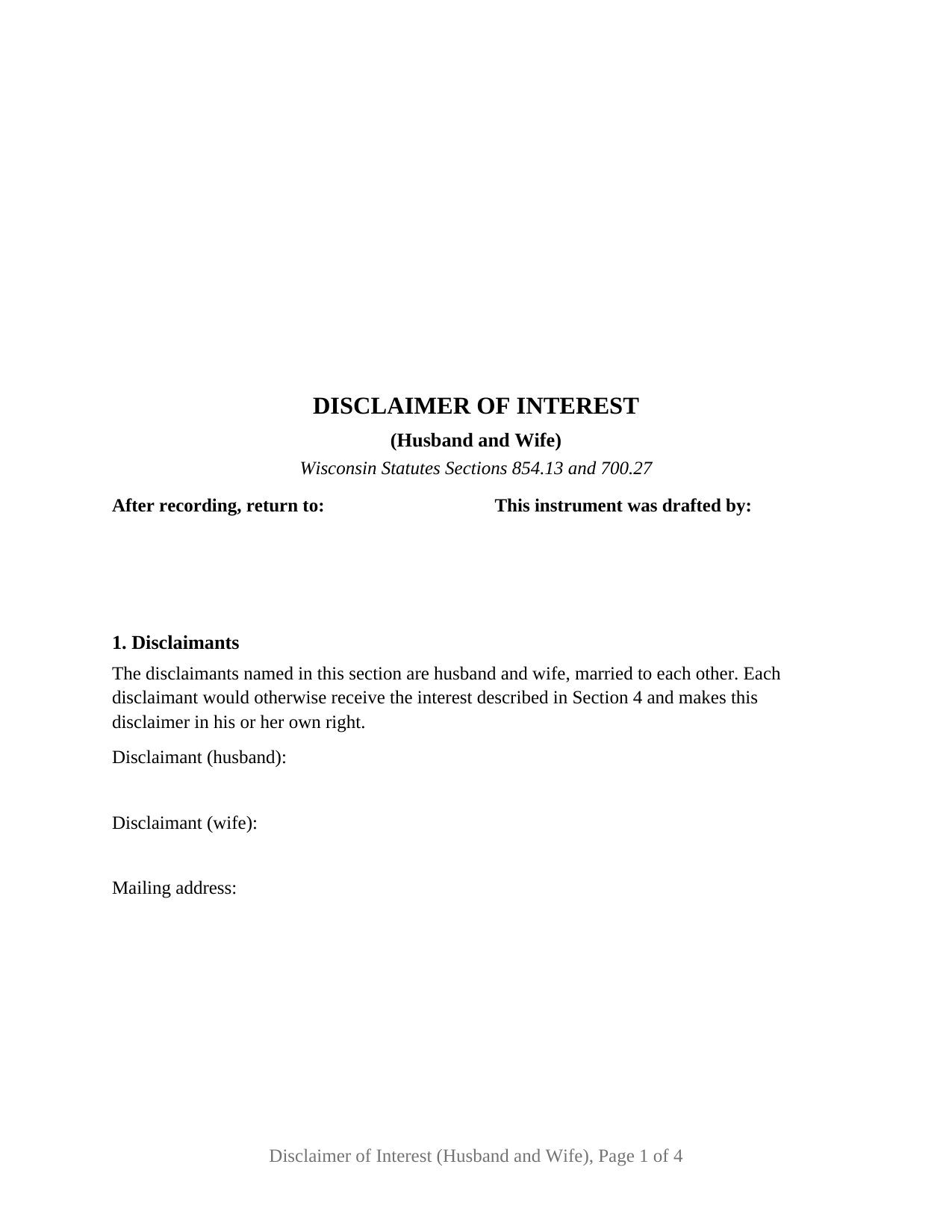
About the Wisconsin Disclaimer of Interest (Husband and Wife)
How to Use This Form
- Select your county from the list
- Download the county-specific form
- Fill in the required information
- Have the document notarized if required
- Record with your county recorder's office
What Others Like You Are Saying
"loads of forms and instructions....for a good buy...it would help to know where to send the forms af…"
"Awesome!"
"nice & easy, site needs to have notification as to security of credit card info. who and how?"
"Very easy & efficient to use! I would have had to drive an hour to the county office. So glad th…"
"This was great other than exemption codes did not populate and I couldn't refer to it."
4.8/5 from 4,862 reviews. Read all
A married couple named together in a will, a beneficiary designation, or a gift deed can refuse the Wisconsin real estate it would bring them, and refuse it on one document. This Wisconsin Disclaimer of Interest is written for exactly that configuration: two disclaimants who are husband and wife, married to each other, each refusing in his or her own right the same interest from the same transferor, with a signature block and a notary certificate for each of them. It is the instrument Wisconsin Statutes Section 854.13 describes for a transfer at death and Section 700.27 describes for a transfer during life, drafted for the two-spouse pattern.
One refusal, two signatures, two certificates
The form recites that the disclaimants are husband and wife and that each would otherwise receive the interest described in it. Both sign. The form carries a separate acknowledgment certificate for each spouse, each in the short form of Wisconsin Statutes Section 140.16(1), so the two may acknowledge on different days, before different notaries, or in different states; that is how the form is built, since Wisconsin law also permits one certificate to name both individuals who appeared together. A devise to a son and his wife, a transfer on death designation that names both spouses, a gratuitous deed to the couple, or a survivorship interest that would accrue to both presents the two-disclaimant pattern this form recites. The form is not set up as a disclaimer by one person, as a disclaimer by spouses refusing different interests, or as a disclaimer signed by a guardian, an agent under a power of attorney, a trustee, or a personal representative on a disclaimant's behalf.
Property that is treated as never received
Under Section 854.13(6), property that is disclaimed is considered not to have been vested in, created in, or transferred to the disclaimant. The disclaimed interest then devolves under Section 854.13(7) as if the disclaimant had died before the decedent, unless the governing instrument provides otherwise, and a disclaimed joint tenancy or survivorship marital property interest passes to the decedent's probate estate under Sections 854.13(8) and (9). The disclaimants direct none of this. A disclaimer that named a recipient would be a transfer by the disclaimant rather than a refusal, so the form carries no grantee, beneficiary, or recipient block of any kind, and its operative section states that the interest passes without any direction by either disclaimant. That same sentence tracks one of the elements of a qualified disclaimer under 26 U.S.C. 2518(b), which the guide describes without stating whether any particular disclaimer meets it.
What the statute puts in the instrument
Section 854.13(3) requires the instrument of disclaimer to describe the property disclaimed, to declare the disclaimer and the extent of the disclaimer, to be signed by the disclaimant, and to be delivered within the time and in the manner the section provides; Section 700.27(3) adopts the same contents for a transfer during life. The form follows that list. It identifies the transferor and the will, deed, designation, or survivorship arrangement through which the interest would pass, written in as facts rather than chosen from a menu; it carries the county, legal description, parcel identification number, and street address of the real estate; and it states the interest disclaimed and whether the disclaimer reaches the whole interest or an undivided portion, the partial disclaimer Section 854.13(2)(d) permits unless the governing instrument prohibits it. The declaration itself is fixed text: each disclaimant irrevocably and unqualifiedly disclaims and refuses to accept the interest, neither has accepted it or any benefit of it, and the disclaimer binds each of them and everyone claiming through either of them, which is the effect Section 854.13(11p) gives it.
Nine months, delivery, and the register of deeds
Timing and delivery are where a Wisconsin disclaimer of inheritance succeeds or fails. Section 854.13(4)(a) requires an instrument disclaiming a present interest to be executed and delivered not later than 9 months after the effective date of the transfer, with a court able to extend the period for cause shown, and Section 854.13(5)(a) makes the disclaimer effective only if, within that time, it is delivered to and received by the transferor if living, the personal representative or special administrator of a deceased transferor, or the holder of legal title to the property. Where delivery goes to a personal representative, a copy is filed in the probate court. Recording is a separate and permitted step: Section 854.13(5)(e) allows a copy of the disclaimer of real property to be recorded with the register of deeds of the county where the real estate is situated, which places the refusal in the chain of title beside the instrument through which the property passes. For that recording the form carries the acknowledgment certificates that supply the authentication Wisconsin's recording statute requires of an instrument offered for record, the document name and return information Section 59.43(2m)(a) places on the first page, the drafter's name, a parcel number entry, and a blank 3 inch by 3 inch recording area, with the statewide recording fee of 30 dollars under Section 59.43(2)(ag) regardless of page count.
Why both spouses sign
The two signatures on this form are the signatures of two disclaimants, not a spousal joinder. Wisconsin's homestead rule in Section 706.02(1)(f) reaches a conveyance that alienates a married person's interest in a homestead, and a disclaimer alienates nothing of the disclaimant's; the property is treated as never having been theirs. Wisconsin is a marital property state, and the form takes no position on how the refused interest would have been classified under chapter 766 had it been accepted, because the disclaimer makes that classification unnecessary. The form is a renunciation of an inheritance or gift, sometimes searched as a disclaimer of inheritance or a disclaimer deed, and it is built to be delivered and then recorded in Wisconsin.
The package includes the fillable disclaimer form, a completed example filled in for a realistic Dane County fact pattern, and the guide that walks through every numbered section, the delivery requirement, and the recording process. This description and the guide describe the form and the governing Wisconsin statutes in general terms; they are not legal advice.
Important: County-Specific Forms
Our disclaimer of interest (husband and wife) forms are specifically formatted for each of the 72 counties in Wisconsin.
After selecting your county, you'll receive forms that meet all local recording requirements, ensuring your documents will be accepted without delays or rejection fees.