Wisconsin Disclaimer of Interest
County Specific Legal Forms Validated as recently as November 20, 2026 by our Forms Development Team
About the Wisconsin Disclaimer of Interest
How to Use This Form
- Select your county from the list
- Download the county-specific form
- Fill in the required information
- Have the document notarized if required
- Record with your county recorder's office
What Others Like You Are Saying
"Being a first timer, I was hesitant at first to use the service. I was genuinely surprised at how ea…"
"I could not be happier with this service! It was so easy and fast!"
"Website easy to use and explanations available"
"Easy, quick and very proficient. I am glad I used Deeds."
"Very helpful!"
4.8/5 from 4,867 reviews. Read all
Wisconsin Disclaimer of Interest in Real Property
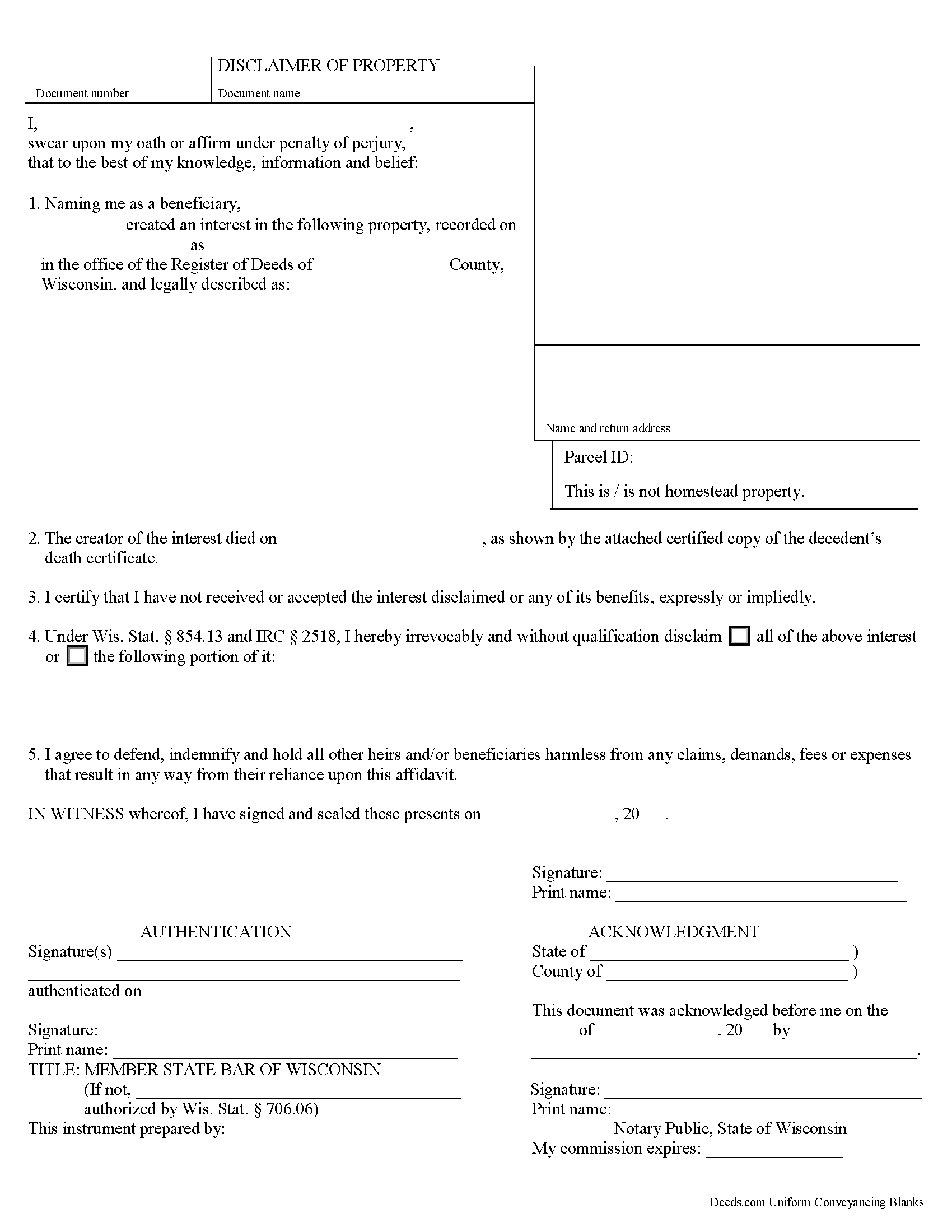
This download supplies the Wisconsin Disclaimer of Interest, the written instrument by which one or two natural persons, each acting in their own right, refuse to accept an interest in Wisconsin real property that would otherwise pass to them by will, intestate succession, a transfer on death designation, survivorship, a gift deed, or another gratuitous transfer. The form's title cites Wis. Stat. sections 854.13 and 700.27, and its preprinted operative sentence declares the disclaimer under section 854.13 for a transfer at death or under section 700.27 where the transfer was made during the transferor's life. Under both statutes, disclaimed property is treated as never having vested in or been transferred to the disclaimant, and the disclaimer, once made, binds the disclaimant and everyone claiming through them.
What the download includes
The package is a single statewide version with no county-specific variants. It consists of three PDFs:
- Disclaimer of Interest form – a fillable PDF with an instructions page marked not for recording, followed by the four-page recordable instrument.
- Disclaimer of Interest guide – a line-by-line explanation of the Wisconsin statutory framework in general terms, each part of the form, completing and printing, signing and notarization, recording, and what the form does not do.
- Completed example – the same instrument filled in with illustrative entries.
The guide notes that county register of deeds practices on payment, copies, and mail return vary and appear on each register's page.
What the form provides
The instrument identifies the disclaimant or disclaimants, the transfer by which the interest would pass (the transferor, the date of death or transfer, the governing instrument or event, and any recording or probate reference), the interest disclaimed in whole or in part, and the property by county, legal description, parcel number, and street address. The declaration of the disclaimer itself is preprinted and states the refusal as irrevocable and unqualified. The guide notes that a partial disclaimer is unavailable where the governing instrument expressly prohibits one.
The form accommodates one or two disclaimants on a single instrument, each refusing their own interest. It carries two signature blocks and two acknowledgment certificates in the Wis. Stat. section 140.16(1) short form for an individual acknowledgment taken in the notary's physical presence, which lets two disclaimants acknowledge on different dates, before different officers, or in different states. When a single person disclaims, the second signature block and its certificate remain blank. Three or more disclaimants are not accommodated on one instrument.
The form names no person who takes the disclaimed interest and carries no sentence directing a recipient. Wisconsin law decides where a disclaimed interest passes; the guide explains the statutory devolution rules in general terms and notes that an instrument directing the interest to a chosen person would be a transfer by the disclaimant rather than a disclaimer.
Recording and delivery
The first page reserves the recording area and carries the document title, a return-to block, and a drafted-by block, and the form is laid out for recording a copy with the register of deeds of the county where the land lies, which sections 854.13(5)(e) and 700.27(5)(c) permit. The guide is explicit that recording is permitted rather than required and is not what makes a disclaimer effective: the instrument is effective only when it is delivered to and received by a person the statute names within the statutory period, generally nine months from the effective date of the transfer. The guide summarizes those time and delivery rules, the bars to disclaiming such as acceptance of the property, and the separate probate-court filing and trustee copy the statute describes.
For a recording, the guide covers the $30 recording fee under Wis. Stat. section 59.43, the standard document format, the full legal description, and printing the fillable form single sided at actual size, with an over-long entry continued on an attached exhibit. No real estate transfer fee or transfer return statement is preprinted on the instrument. The guide explains that the Department of Revenue's published guidance treats a disclaimant who held no prior interest in the property differently from one who did, which is why no single statement appears, and it identifies the county register and the Department's published questions as the sources describing how a particular recording is presented. That guidance is administrative practice rather than statute.
What the guide and example show
The guide's section-by-section discussion states what each entry takes and where it commonly comes from – the will, the probate file, the transfer on death designation or gift deed, the recorded vesting deed, or the property tax bill – and cites the corresponding entry in the completed example. The example shows two disclaimants each refusing an undivided one-half interest devised to them under a probated will, with the recording reference, probate case reference, platted legal description, parcel number, and address filled in, and with the two acknowledgments completed on different dates before different notaries. Read together, the guide and example show what information each part of the form calls for and how a finished Wisconsin disclaimer of a devised interest reads. The example entries are fictional.
Boundaries of the supplied form
- The form describes natural persons disclaiming in their own right and recites no representative capacity. Disclaimers made for someone else by a guardian or conservator, an agent under a power of attorney, a trustee, or a personal representative, and disclaimers by a corporation, limited liability company, or other entity, follow different statutory conditions and are outside this form.
- The disclaimer does not by itself show the resulting ownership of record. The probate proceeding, a termination of decedent's property interest under Wis. Stat. section 867.045 or 867.046, a personal representative's deed, or a transfer on death beneficiary's confirmation under section 867.046 are separate instruments not included in this package.
- The form does not address federal tax treatment. The guide describes the Internal Revenue Code section 2518 qualified-disclaimer requirements in general terms only and notes that a disclaimer effective under Wisconsin law is not for that reason a federal qualified disclaimer.
- The disclaimer does not clear liens, does not change the decedent's debts, and does not affect any interest the disclaimant already holds in the property from another source.
The form and guide are general information about a Wisconsin disclaimer of interest and the statutes that govern it; they do not apply the law to any particular situation and are not legal advice.
Important: County-Specific Forms
Our disclaimer of interest forms are specifically formatted for each of the 72 counties in Wisconsin.
After selecting your county, you'll receive forms that meet all local recording requirements, ensuring your documents will be accepted without delays or rejection fees.