Wisconsin Disclaimer of Interest (Surviving Spouse)
County Specific Legal Forms Validated as recently as November 20, 2026 by our Forms Development Team
About the Wisconsin Disclaimer of Interest (Surviving Spouse)
How to Use This Form
- Select your county from the list
- Download the county-specific form
- Fill in the required information
- Have the document notarized if required
- Record with your county recorder's office
What Others Like You Are Saying
"Great, quick and easy to use"
"This was my first time using Deeds.com and I was very impressed on the professionalism and the exped…"
"Whomever "KCH" is, that person was of great help. It took me several tries due my inexperi…"
"I had prompt service thank you"
"Great service and very easy to complete"
4.8/5 from 4,862 reviews. Read all
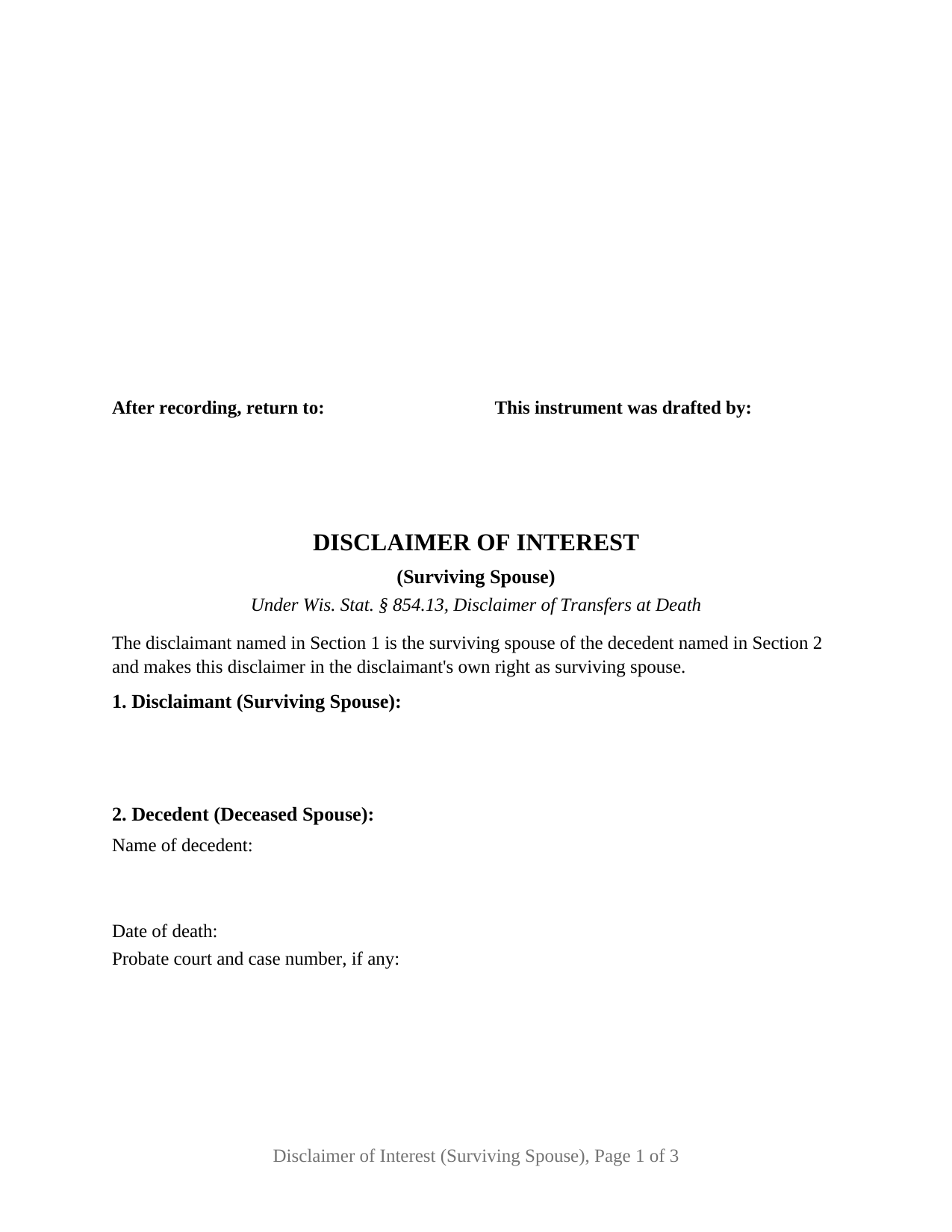
A Wisconsin surviving spouse who does not want to take the deceased spouse's interest in real estate can refuse it. This Wisconsin Disclaimer of Interest (Surviving Spouse) is the written refusal Wis. Stat. 854.13 describes, set up for exactly that person: one surviving spouse, one decedent, and one interest in Wisconsin land that would otherwise pass to the survivor at the death. The form recites the surviving spouse status as fixed text, carries one signature and one acknowledgment certificate, and is built to Wisconsin's standard document format so a copy can be recorded with the register of deeds.
Refusing the decedent spouse's half
Wisconsin's marital property system gives married couples title forms that pass automatically at death. Under Wis. Stat. 766.60(5)(a), survivorship marital property vests in the surviving spouse by nontestamentary disposition the moment the first spouse dies; a joint tenancy under Wis. Stat. 700.19 passes by survivorship the same way. Section 854.13 answers the question of what a survivor who does not want that interest can do. Subsection (2)(c) lets the surviving spouse, on the death of a spouse, disclaim the decedent spouse's interest in survivorship marital property. Subsection (2)(b) lets a surviving joint tenant disclaim the property that would otherwise accrue by right of survivorship. Subsection (2)(a) covers the rest: a surviving spouse named in the will, taking an intestate share, or named as a transfer on death beneficiary under Wis. Stat. 705.15 may disclaim that interest as a beneficiary under a governing instrument.
The disclaimer reaches only the decedent's side of the title. On survivorship marital property the surviving spouse's own one-half interest is not the subject of the statute's permission, and the completed example in this package describes the survivor's own half as not disclaimed. What the instrument refuses is the decedent's interest, and under Wis. Stat. 854.13(6) that interest is treated as never having vested in the disclaimant at all.
Where the refused interest goes
A disclaimer is not a gift and names no recipient. The instrument on this form directs nothing; the statute supplies the destination. For a joint tenancy, Wis. Stat. 854.13(8) sends the disclaimed interest to the decedent's probate estate unless the decedent provided otherwise in a governing instrument. For survivorship marital property, Wis. Stat. 854.13(9) does the same. For a devise, an intestate share, or a beneficiary designation, Wis. Stat. 854.13(7) treats the disclaimed property as passing as if the surviving spouse had died before the decedent, with the decedent's will, the intestacy statutes, or the designation deciding who takes next. Those rules are why the form carries no grantee block and no sentence about who receives the property: a refusal that directs the property to a chosen person is a transfer by the survivor, which the disclaimer statute does not describe.
Nine months, and delivery before recording
The statute puts two acts inside one window. Under Wis. Stat. 854.13(4)(a), the instrument disclaiming a present interest is executed and delivered not later than 9 months after the effective date of the transfer, which for an interest passing at death runs from the date of death; a court may extend the period for cause shown. Under Wis. Stat. 854.13(5)(a), the disclaimer is effective only if, within that time, it is delivered to and received by the transferor if living, the personal representative or special administrator of the deceased transferor, or the holder of legal title to the property. Where the personal representative receives it, a copy goes to the probate court under subsection (5)(c). Recording is a separate step the statute permits rather than requires: Wis. Stat. 854.13(5)(e) provides that when real property is disclaimed, a copy may be recorded in the office of the register of deeds of the county where the land lies. The guide walks through the delivery rule, the probate filing, and the recording step in that order, because a recorded disclaimer that was never delivered within the 9 months is not the instrument the statute makes effective.
The form also carries the three statements Wis. Stat. 854.13(3) requires of the instrument: a description of the property disclaimed, a declaration of the disclaimer and its extent, and the disclaimant's signature. The property is described by county, legal description, parcel number, and street address; the extent is written into its own section, in whole or in part as subsection (2)(d) permits; and the operative paragraph disclaims in the words irrevocably and unqualifiedly, the terms 26 U.S.C. 2518(b) uses for a qualified disclaimer, which Wis. Stat. 854.13(12)(b) recognizes as effective under Wisconsin law. A second operative paragraph states that the survivor has not accepted the interest or a benefit of it, has not transferred or encumbered it, and has not waived the right to disclaim, the three bars Wis. Stat. 854.13(11g) lists.
One signer, one certificate, recorded as a Wisconsin document
This configuration recites one disclaimant acting in the surviving spouse's own right. The form carries one signature block headed Disclaimant and one acknowledgment certificate in the Wisconsin short form of Wis. Stat. 140.16(1), the authentication Wis. Stat. 706.05(2)(b) asks of a document offered for record. No second signer appears, because the decedent is deceased and the instrument alienates nothing of the survivor's own interest; the homestead joinder rule for conveyances has no one left to join. The form is not set up as a disclaimer by an agent under a power of attorney, by a guardian, by a trustee, or by a personal representative after the survivor's own death, each of which Wis. Stat. 854.13(2) treats as its own configuration with its own authority, nor as a disclaimer of a lifetime gift, which Wis. Stat. 700.27 governs, nor for a disclaimant who is not the decedent's spouse.
The first page places the return information and the drafter's name where Wis. Stat. 59.43(2m)(a) looks for them, reserves the upper right recording area, and keeps the document name within the top six inches, so the register's standard document format is met on the page rather than by a cover sheet. A line for the parcel identification number sits in the property section for counties that require one, and a line for the real estate transfer fee statement carries the Wis. Stat. 77.25 reference where one is claimed; the guide describes the transfer return and the exemption subsections that address spouses and transfers at death. The recording fee is the statewide $30 per document.
A disclaimer, not a deed
Because the surviving spouse's interest is treated as never having vested, the instrument conveys nothing, warrants nothing, and reserves nothing. It does not terminate the decedent's interest of record, distribute the estate, or decide the surviving spouse's separate statutory rights under Wis. Stat. ch. 861. It does not disclaim the survivor's own half. And once made it is binding on the disclaimant and everyone claiming through the disclaimant under Wis. Stat. 854.13(11p). The guide states each of those limits with its statute, describes the federal qualified disclaimer requirements of 26 U.S.C. 2518 without applying them, and walks every section of the form against a completed Dane County example in which a surviving spouse disclaims the decedent's one-half interest in survivorship marital property.
The package contains the fillable Wisconsin Disclaimer of Interest (Surviving Spouse) form, a completed example filled in for a realistic Dane County fact pattern, and the guide that explains every section, the delivery and timing rules, and the recording process. This description and the guide describe the form and the governing statutes in general terms; they are not legal advice.
Important: County-Specific Forms
Our disclaimer of interest (surviving spouse) forms are specifically formatted for each of the 72 counties in Wisconsin.
After selecting your county, you'll receive forms that meet all local recording requirements, ensuring your documents will be accepted without delays or rejection fees.