Wisconsin Prime Contractors Claim of Lien
County Specific Legal Forms Validated as recently as November 27, 2026 by our Forms Development Team
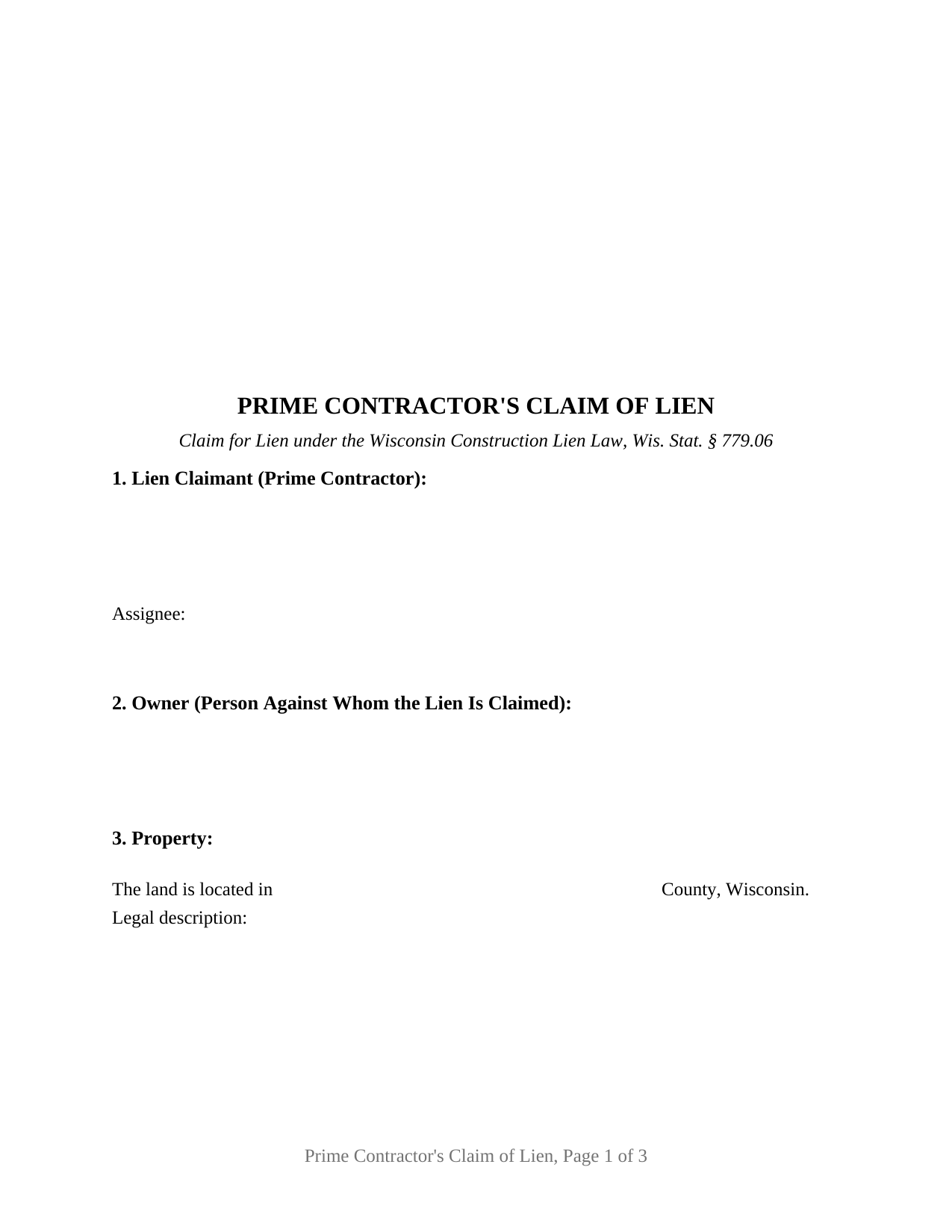
About the Wisconsin Prime Contractors Claim of Lien
How to Use This Form
- Select your county from the list
- Download the county-specific form
- Fill in the required information
- Have the document notarized if required
- Record with your county recorder's office
What Others Like You Are Saying
"Thanks. Was simple and easy to use."
"Very easy to use. Thanks for your quick response on my document submissions and follow up and guidan…"
"Easy to follow; user friendly."
"Good knowing the price right up front...and not a FREE one you pay at the end...."
"I liked the software, it's very easy to use. Once it's saved as a .pdf document on your computer, th…"
4.8/5 from 4,867 reviews. Read all
A Wisconsin prime contractor's claim of lien is filed in a place many contractors look for last: the office of the clerk of circuit court, not the register of deeds. This fillable form prepares the claim for lien that Wis. Stat. § 779.06 describes for a prime contractor, the person who contracted directly with the owner of the land to improve it, and it is built for one or two prime contractors who sign in their own names. The package includes a completed example for a Dane County roofing and siding contract and a guide that walks through every section, the notices that come before the claim, and the deadlines that follow it.
A lien that lives in the court's docket, not the deed records
Wisconsin's construction lien law, subchapter I of chapter 779 of the Wisconsin Statutes, gives any person who performs, furnishes, or procures labor, services, materials, plans, or specifications for the improvement of land a lien on all interests in the land belonging to its owners. The lien exists only if a claim for the lien is filed within 6 months from the date the lien claimant performed, furnished, or procured the last labor, services, materials, plans, or specifications, and the filing office is the clerk of circuit court of the county in which the land lies. Upon filing, the clerk enters the claim in the judgment and lien docket under the nine headings that Wis. Stat. § 779.07 prescribes, opposite the name of the person against whom the lien is claimed, and the docket is presumptive evidence of its entries. A construction lien claim recorded with the register of deeds instead does not satisfy the statute. The claim is sometimes called a Wisconsin mechanics lien or a construction lien claim; the statute's own term is claim for lien.
Two notices before the claim and three clocks after it
The Wisconsin claim for lien sits at the end of a notice sequence. A prime contractor who has contracted or will contract with subcontractors, suppliers, or service providers includes a notice of lien rights in the written contract with the owner, or serves it separately within 10 days after the work begins, in the language Wis. Stat. § 779.02(2)(a) sets out; the statute excuses the notice on nonresidential projects, on wholly residential projects of more than four family living units, and in the owner-contractor situations it lists. Then, whether or not that first notice was required, every lien claimant serves a written notice of intent to file a lien claim on the owner at least 30 days before the claim is filed. That notice of intent is prepared separately and is not included in this package; the statute requires a copy of it, and a copy of any notice of lien rights, to be attached to the claim when it is filed.
After filing, three periods run. The lien claimant serves a copy of the filed claim on the owner within 30 days after filing. An action to enforce the lien is brought within 2 years from the date of filing. And the 6 month filing period itself is measured backward from the last date of performing, furnishing, or procuring the work, which is why the claim states that date on its face.
What the claim for lien recites
Wis. Stat. § 779.06(3) lists what the claim document contains, and the form follows that list in prose rather than as a checklist. It names the lien claimant and any assignee of the claim, names the person against whom the demand is claimed, states the contract or demand on which the claim is founded, describes the labor, services, materials, plans, or specifications furnished, gives the last date of furnishing them, carries a legal description of the property against which the lien is claimed, states the amount claimed, and leaves room for the other material facts the statute calls for. A notices section records when and how the notice of lien rights and the notice of intent were given, and a printed sentence states that copies are attached. The operative paragraph then does the legal work: the lien claimant claims a lien under Wis. Stat. § 779.01 on all interests in the land belonging to its owner or owners for the amount claimed, and files the claim with the clerk of circuit court. Because the lien reaches the owner's interests in the land, the claim is signed by the lien claimant alone; the owner does not sign it, and no spouse of the owner has a signature line.
Signed by the claimant and not sworn
Unlike the lien claims of many states, the Wisconsin claim for lien is not an affidavit. The statute provides that the claim document is signed by the claimant or attorney and need not be verified. The form therefore carries no notary certificate of any kind: each lien claimant signs a block with a printed name line and a date line, and the signed original is what the clerk files. The clerk's fee for filing and entering a lien is set by Wis. Stat. § 814.61(5)(am), $14 as that paragraph reads as amended effective November 1, 2026 by 2025 Wisconsin Act 179. Filing is the beginning of enforcement rather than the end of it: the claim may be amended as pleadings are once an action is brought, the owner may substitute a surety undertaking or a deposit of 125 percent of the claim for the lien under Wis. Stat. § 779.08, and a claimant who has been paid executes a satisfaction for the docket under Wis. Stat. § 779.13.
One or two prime contractors signing in their own names
The form recites one or two lien claimants who are natural persons and who contracted with the owner as prime contractor in their own names, such as a sole proprietor or two individuals who together undertook one contract. Its lien claimant block receives one or two names with mailing addresses, its signature section carries a LIEN CLAIMANT block and a SECOND LIEN CLAIMANT block, and it preprints nothing about the claimants' business form, marital status, or capacity. Where one person is the claimant, the second block is left blank. The form is not set up as a claim by a corporation, limited liability company, or other entity signing through a representative, as a claim signed by an attorney on the claimant's behalf, as a claim by three or more claimants, or as a claim filed in the name of an assignee, and it is not the claim of a subcontractor, supplier, or service provider who did not contract with the owner, whose lien rights rest on the separate 60 day notice of Wis. Stat. § 779.02(2)(b). A sole proprietor who roofed a house under a direct contract with the homeowners and remains unpaid, and two tradespeople who together took one remodeling contract, present the pattern this claim recites.
The package includes the fillable claim of lien form, a completed example filled in for a realistic Wisconsin fact pattern, and the guide that explains each section, the notice sequence, the filing and service deadlines, and the clerk's docket. The description and the guide describe the form and the governing Wisconsin statutes in general terms; they are not legal advice.
Important: County-Specific Forms
Our prime contractors claim of lien forms are specifically formatted for each of the 72 counties in Wisconsin.
After selecting your county, you'll receive forms that meet all local recording requirements, ensuring your documents will be accepted without delays or rejection fees.