Wisconsin Special Warranty Deed (Married Couple as Grantors)
County Specific Legal Forms Validated as recently as November 19, 2026 by our Forms Development Team
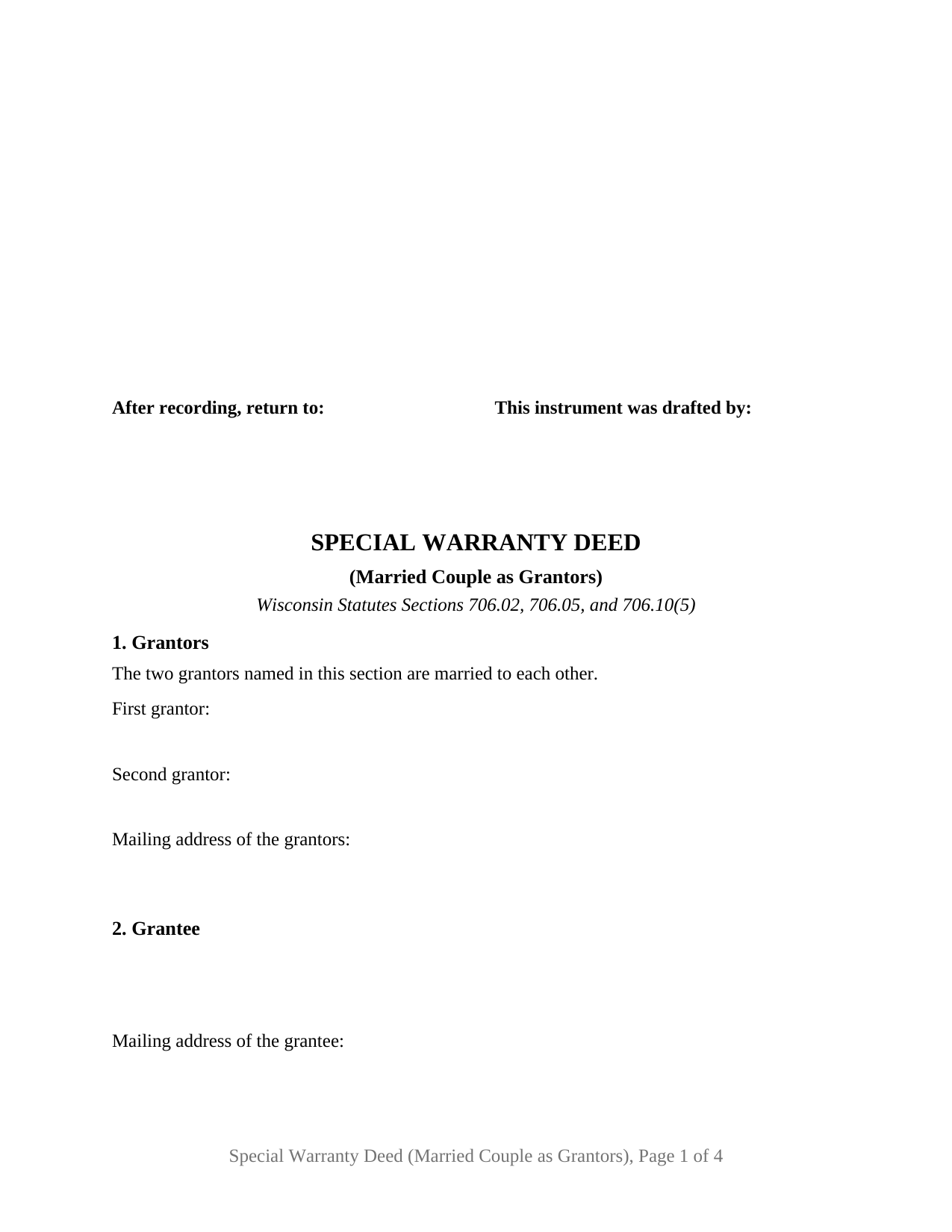
About the Wisconsin Special Warranty Deed (Married Couple as Grantors)
How to Use This Form
- Select your county from the list
- Download the county-specific form
- Fill in the required information
- Have the document notarized if required
- Record with your county recorder's office
What Others Like You Are Saying
"Needed some help at the beginning but once I was into the program it was smooth sailing."
"The forms that I downloaded from Deeds were perfect for what I needed. I even checked with a lawyer …"
"I found your site easy to use, though I would prefer an option to download to MWords but Adobe works…"
"User friendly!"
"So happy, great forms made everything a breeze."
4.8/5 from 4,860 reviews. Read all
A Wisconsin special warranty deed on which both spouses are the grantors puts the whole of a married couple's interest on one instrument, under one limited warranty, with two signatures and two acknowledgment certificates. This form prepares that deed for two natural persons who are married to each other and who convey Wisconsin real property together: Section 1 recites that the two grantors are married to each other, Section 9 recites that each grantor signs and conveys all of that grantor's interest, and the signature section carries a block for each spouse.
Two spouses on the grantor side
Wisconsin's marital property system is what makes the two-grantor shape the ordinary shape for a married couple's deed. Under Wis. Stat. § 766.31, property spouses acquire during marriage is presumed marital property, and each spouse holds a present undivided one-half interest in it whatever name the recorded deed carries. Wis. Stat. § 766.51(2) provides that marital property held in the names of both spouses, other than in the alternative, may be managed and controlled only by both spouses acting together. A deed signed by both spouses is the act of both, and it carries both halves of the marital property interest to the grantee. Where the couple instead holds as survivorship marital property under Wis. Stat. § 766.60(5), as joint tenants under Wis. Stat. § 700.19, or as tenants in common, the two signatures convey the whole estate the same way.
The homestead rule reinforces the structure from a second direction. Wis. Stat. § 706.02(1)(f) makes a conveyance that alienates any interest of a married person in a homestead invalid unless each spouse signs it or joins in it by separate conveyance, a rule the Wisconsin Supreme Court held to its terms in Weber v. Weber, 176 Wis. 2d 1085 (1993). On this deed both spouses are grantors and both sign, so the instrument meets that requirement by its own construction whether the homestead stands in one name or both, and no separate spousal joinder block exists because no spouse is outside the conveyance. The spouses who present this pattern are a couple selling the house they own together, a couple conveying a rental duplex or a lake lot they hold as marital property, and a couple whose record title names one of them while the marital property interest belongs to both.
A warranty measured by the grantors' own ownership
The deed's covenant is a special warranty, and it is written into Section 8 in the deed's own words because Wisconsin lets the deed set its own warranty. Wis. Stat. § 706.10(5) construes a conveyance in which the grantor warrants the title to carry the full statutory covenants of seisin, right to convey, freedom from encumbrance, and defense of title against all lawful claims originating before the conveyance, except as the terms of the conveyance may otherwise provide. This form provides otherwise. The grantors convey and warrant, and then limit the warranty: the title is free of every encumbrance made, created, or suffered by the grantors or by anyone claiming by, through, or under them, except as listed in Section 7, and the grantors will warrant and defend the title and quiet possession against the lawful claims of persons claiming by, through, or under the grantors, and against no other claims. Wis. Stat. § 706.10(6) adds that no covenant is implied in a conveyance whether or not it contains special warranties, so the written limitation is the whole of the promise.
In practice the warranty runs from the date the couple took title to the date they convey. A mortgage they granted and did not list, an easement they signed, a mechanic's lien that attached during their ownership: those are inside the covenant. A boundary dispute that predates their purchase, or a restriction a developer recorded decades earlier, is not. Section 7 lists the exceptions that the conveyance and the warranty are subject to, and on this configuration the encumbrances a couple created during their own ownership, a refinance mortgage, a utility easement, a recorded driveway agreement, are the entries that appear on that list in practice, since an unlisted encumbrance of the grantors' own making is the one thing the limited warranty still answers for.
Grantees and the title they take
Section 2 receives one or two grantees and, for two, the words that fix how they hold. The completed example conveys from Daniel R. Kowalski and Megan L. Kowalski to two unmarried buyers as joint tenants, so that the survivor takes the whole under Wis. Stat. § 700.19. Married grantees may take as marital property, which creates no survivorship on its own, or as survivorship marital property, which passes the deceased spouse's interest to the survivor by nontestamentary disposition under Wis. Stat. § 766.60(5)(a). The guide describes each Wisconsin vesting form, the words that create it, and the default that applies when a deed to two grantees names none.
Transfer fee, exemption statement, and the register of deeds
A sale by a married couple to a third party is subject to the real estate transfer fee, which Wis. Stat. § 77.22(1) imposes on the grantor at 30 cents per $100 of value and makes, together with the electronic transfer return, a prerequisite to the register's acceptance of the deed for recording. Section 4 of the form carries the exemption statement that the same subsection requires on the face of an exempt conveyance, by reference to the applicable subsection of Wis. Stat. § 77.25; a conveyance that is subject to the fee carries the entry None there, as the completed example does. The recording fee itself is a flat $30 under Wis. Stat. § 59.43(2)(ag)1. The form's first page keeps the blank 3 by 3 inch recording area and the return information that the standard document format of Wis. Stat. § 59.43(2m) places there, and its upper right block carries the drafter's name that Wis. Stat. § 59.43(5)(a) requires on every instrument conveying an interest in real estate.
The form is not set up as a conveyance by one grantor, by two grantors who are not married to each other, by three or more grantors, or by a corporation, limited liability company, trustee, personal representative, or attorney-in-fact. Each of those changes the recital in Section 1, the signature blocks, and the certificates. What this deed fixes is the married couple on the grantor line, the two signatures that Wisconsin's marital property and homestead rules both call for, and the warranty that reaches the couple's own ownership and stops there.
The package includes the fillable form, a completed example filled in for a Waukesha County sale, and the guide that walks through each section, the Wisconsin vesting forms, the spousal signature rules, and recording. This description and the guide describe the form and the governing statutes in general terms; they are not legal advice.
Important: County-Specific Forms
Our special warranty deed (married couple as grantors) forms are specifically formatted for each of the 72 counties in Wisconsin.
After selecting your county, you'll receive forms that meet all local recording requirements, ensuring your documents will be accepted without delays or rejection fees.