Wyoming Trustee Deed (Individual)
County Specific Legal Forms Validated as recently as November 10, 2026 by our Forms Development Team
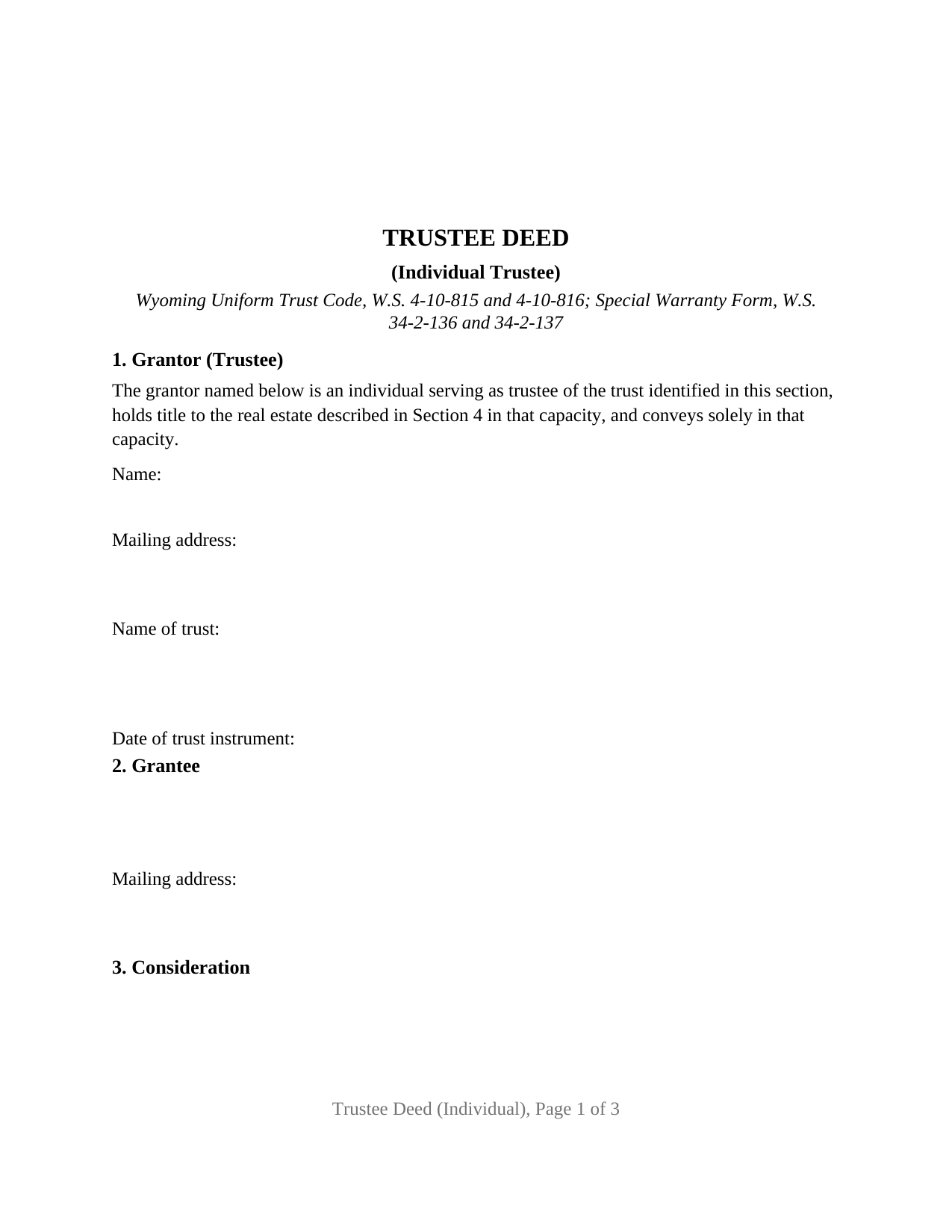
About the Wyoming Trustee Deed (Individual)
How to Use This Form
- Select your county from the list
- Download the county-specific form
- Fill in the required information
- Have the document notarized if required
- Record with your county recorder's office
What Others Like You Are Saying
"Easy to find the necessary documents needed"
"Very easy to use"
"Great service. Very helpful and quick. Love Deeds.com and will be using their services again."
"Excellent product!!!! Accepted at my courthouse without a hitch. I recommend this company whole hear…"
"Amazingly easy! I absolutely love it because it is so efficient and I only have to pay for when I us…"
4.8/5 from 4,848 reviews. Read all
When Wyoming real estate is held in a trust, the person who signs the deed that sells or distributes it is the trustee, and the trustee signs in a capacity that is not the trustee's own. This Wyoming Trustee Deed is built for exactly that signature: one individual serving as trustee of a named trust conveys the trust's real estate to a grantee, under the powers the Wyoming Uniform Trust Code gives a trustee, with the special warranty covenants the Wyoming statutes attach to the words the deed uses.
One signature, in a fiduciary capacity
The deed opens by reciting that the grantor is an individual serving as trustee of the trust it names, holds title to the property in that capacity, and conveys solely in that capacity. The trust is identified the way W.S. 34-2-122 and W.S. 4-10-402 treat as sufficient for trust-held real estate: the trustee's name, the name of the trust, and the date of the trust instrument. The operative paragraph then ties the conveyance to W.S. 4-10-815, under which a trustee may exercise, without a court order, the powers the trust instrument confers and all powers over trust property that an unmarried competent owner has over individually owned property, and to W.S. 4-10-816(a)(ii), the specific power to sell property at public or private sale. A closing sentence states that the trustee signs and delivers the deed solely as trustee and not individually, and that the deed discloses the fiduciary capacity, the disclosure W.S. 4-10-1010(a) speaks to when it limits a fiduciary's personal liability on a contract entered into in that capacity.
One trustee signs, so the form carries one signature block and one acknowledgment certificate. The certificate is the representative-capacity form from W.S. 32-3-115(a)(ii) rather than the individual form: the notarial officer certifies that the record was acknowledged by the named person as trustee of the named trust, and the form fixes the words as trustee of so that only the trust's name and date are entered. The trustee's own marital status never appears, because the property being conveyed is the trust's and not the trustee's.
A warranty that reaches the trustee's own period of ownership
Wyoming gives deeds their covenants through statutory words, and W.S. 34-1-135 provides that no covenant is implied in a conveyance of land other than minerals. This trustee deed uses the special warranty form of W.S. 34-2-136, enacted in 2015: the grantor conveys and specially warrants against all who claim by, through, or under the grantor, but against none other. Under W.S. 34-2-137 a deed in that form conveys the property in fee simple with its appurtenances, rights, and privileges, and carries a covenant that the property is free from encumbrances made by that grantor and that the grantor will warrant and defend the title against claims arising by, through, or under the grantor. Claims that predate the trust's ownership sit outside the covenant, which is the warranty posture a trustee conveying property the trust acquired from someone else can give without warranting a chain of title the trustee never held. The form places an exceptions section directly after the legal description, the position W.S. 34-2-137(b) names for exceptions to the covenant, so easements of record, the current year's taxes, or a mortgage the grantee takes subject to can be stated without changing the operative words.
What a grantee from a trustee relies on
A person who deals with a Wyoming trustee in good faith and for value is protected by W.S. 4-10-1013 as if the trustee properly exercised the power, and is not required to inquire into the extent of the trustee's powers or the propriety of their exercise. W.S. 4-10-1014 lets the trustee furnish a certification of trust, stating the trust's existence and date, the settlor, the currently acting trustee, the pertinent powers, and the manner of taking title, instead of the trust instrument itself; a title company examining the sale commonly asks for one. The certification of trust is prepared separately and is not included in this package, and the deed's source-of-title section names the recorded instrument by which the trustee took title so the chain in the county records reads continuously from the vesting deed to this conveyance.
Recording a trustee deed in Wyoming
The deed goes to the county clerk of the county where the land lies. Three things travel with it. The grantee's mailing address is on the face of the deed, since W.S. 34-1-119(a) provides that the clerk does not record a document until the grantee's address is furnished. The sworn Statement of Consideration under W.S. 34-1-142, a separate confidential form published by the Wyoming State Board of Equalization, discloses the actual price and terms; the clerk does not accept a transfer instrument for recording until it is received. The recording fee under W.S. 18-3-402 is twelve dollars for the first page and three dollars for each additional page, and Wyoming imposes no state transfer tax or documentary stamp tax on a deed. The form reserves the top two inches of its first page for the clerk's recording label and keeps one-inch margins and twelve-point type, the dimensions the larger Wyoming county clerks publish for recordable documents.
What this configuration recites
The form recites exactly one grantor, an individual trustee signing for one trust, and leaves the receiving side open: one grantee, two or more grantees with the vesting words Wyoming recognizes, an entity, or another trustee. The ownership patterns that present this configuration appear throughout the county records: a surviving spouse serving as sole trustee of the couple's revocable living trust selling the family home after the first death, an adult child who succeeded a parent as trustee distributing a parcel to the beneficiaries named in the trust, and a settlor-trustee selling an investment property the trust acquired years earlier. The form is not set up as a conveyance by two or more cotrustees, who each sign and each acknowledge; as a conveyance by a bank or trust company serving as trustee, which signs through an officer under its own authority; or as a conveyance by a personal representative of an estate, which rests on the Wyoming Probate Code rather than the Uniform Trust Code.
The package includes the fillable trustee deed, a completed example filled in for a realistic Natrona County sale by a trustee, and the guide that walks through each numbered section, the trustee's statutory authority, the acknowledgment, and the recording steps. This description and the guide describe the form and the governing Wyoming statutes in general terms; they are not legal advice.
Important: County-Specific Forms
Our trustee deed (individual) forms are specifically formatted for each of the 23 counties in Wyoming.
After selecting your county, you'll receive forms that meet all local recording requirements, ensuring your documents will be accepted without delays or rejection fees.