Wyoming Trustee Deed (Two Individuals)
County Specific Legal Forms Validated as recently as November 11, 2026 by our Forms Development Team
About the Wyoming Trustee Deed (Two Individuals)
How to Use This Form
- Select your county from the list
- Download the county-specific form
- Fill in the required information
- Have the document notarized if required
- Record with your county recorder's office
What Others Like You Are Saying
"I haven't actually used any forms yet, but I am very pleased with the simplicity of the website. I l…"
"I received every form I requested, immediately upon payment. All forms were up to date and easy to e…"
"Very good service .I recommend it if you need your documentation on a weekend or when offices are cl…"
"Easy to use"
"Easy to use, fast!"
4.8/5 from 4,850 reviews. Read all
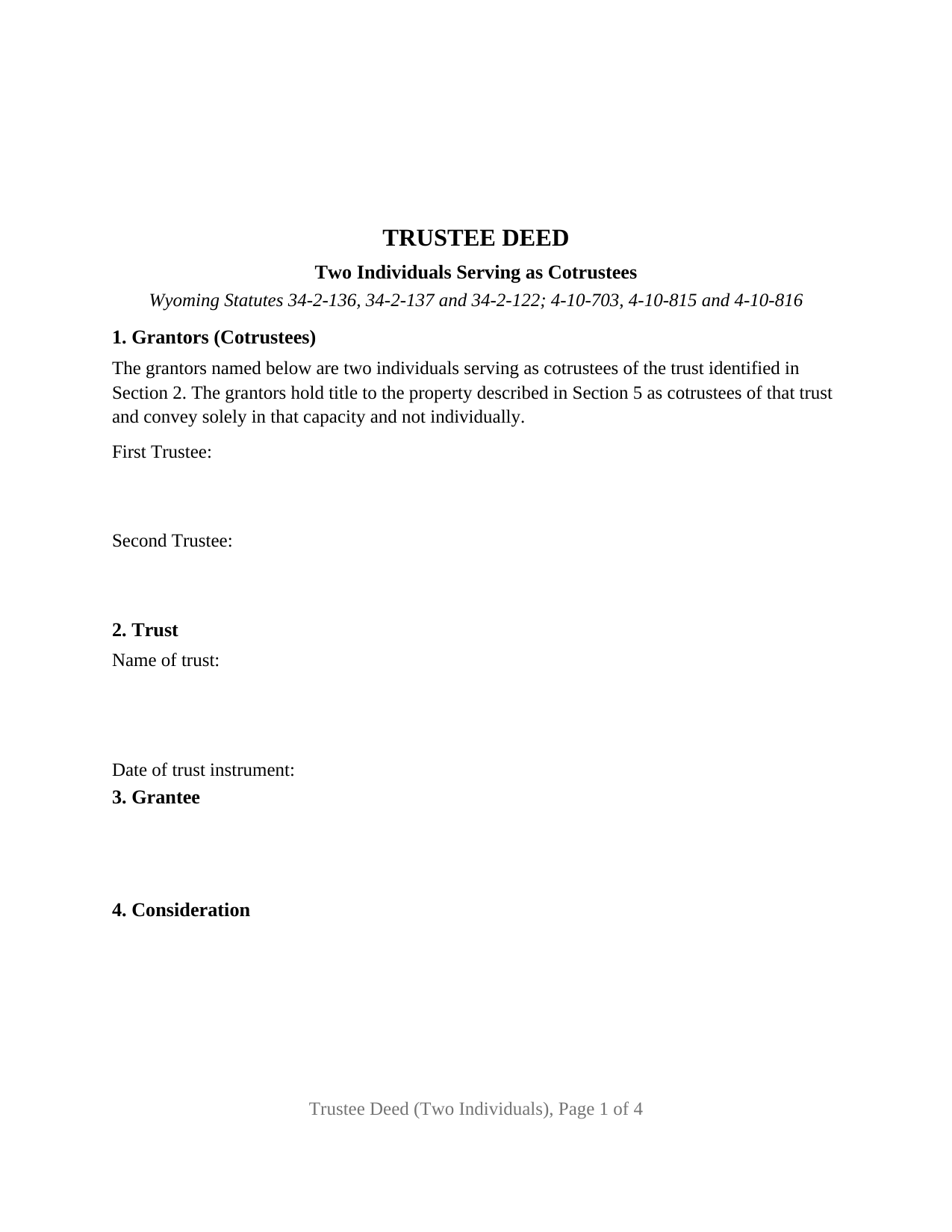
Two people who serve together as cotrustees of a Wyoming trust sell or distribute the trust's land with one deed that both of them sign. This Wyoming Trustee Deed is built for that pair: two individuals, named as the cotrustees of one trust, convey real estate titled in the trust to a grantee with the special warranty words of W.S. 34-2-136, and each cotrustee acknowledges the deed in a representative capacity before a notarial officer. It is the trustee's deed in the plural, and everything about its architecture follows from the second signature.
Two cotrustees, acting together
The Wyoming Uniform Trust Code treats cotrustees as a body. Under W.S. 4-10-703(a), cotrustees who cannot reach a unanimous decision may act by a majority, and with two cotrustees a majority is both of them; under W.S. 4-10-703(c), each cotrustee participates in the performance of a trustee's function unless unavailable or unless the function has been properly delegated. The deed therefore opens with a recital that the grantors are two individuals serving as cotrustees of the trust it names, that they hold title to the property as cotrustees of that trust, and that they convey solely in that capacity and not individually, and its operative paragraph states that both cotrustees join. The powers they exercise are the ones W.S. 4-10-815 gives every trustee without a court order, the powers conferred by the trust instrument and all powers over trust property that an unmarried competent owner has over individually owned property, together with the specific power in W.S. 4-10-816(a)(ii) to sell property at public or private sale. The trust is identified by the two trustees' names, the trust's name, and the date of the trust instrument, the identification W.S. 34-2-122 treats as sufficient in a Wyoming conveyance.
Two signatures and two certificates, each as trustee
Each cotrustee has a signature block under a heading of its own, FIRST TRUSTEE and SECOND TRUSTEE, and each has a separate acknowledgment certificate. The certificate sentence is the representative-capacity short form of W.S. 32-3-115(a)(ii), which certifies that the record was acknowledged by the named person as a stated type of authority of a named party; the form fixes the words as trustee of and leaves only the trust's name and date to be entered. Because the certificates are separate, the two cotrustees may acknowledge on different dates, before different notarial officers, or in different states, and the completed example shows exactly that, one acknowledgment in Laramie County and the other in Albany County a day later. The separate certificates are the form's design rather than a requirement of Wyoming law, whose short forms are written for one or more persons. Nothing on the deed asks about either cotrustee's marital status, because the property is the trust's and the cotrustees convey only in their fiduciary capacity; the deed states that they sign and deliver it solely as cotrustees and not individually and that it discloses their fiduciary capacity, the disclosure W.S. 4-10-1010(a) ties to a fiduciary's freedom from personal liability on a contract made in that capacity.
A special warranty limited to the trust's own chain
Wyoming attaches covenants to statutory words, and W.S. 34-1-135 implies none. This deed uses the special warranty form of W.S. 34-2-136: the grantors convey and specially warrant against all who claim by, through, or under the grantors, but against none other. Under W.S. 34-2-137(a), a deed in substance in that form conveys the property in fee simple with all the appurtenances, rights and privileges belonging to it and carries a covenant that the property is free from all encumbrances made by that grantor and that the grantor will forever warrant and defend the title against any person claiming by, through, or under the grantor. A claim that arose before the trust took title, or that was created by someone other than the cotrustees, sits outside the covenant, which is the warranty two fiduciaries can give for property they administer but never personally owned. The exceptions section follows the legal description, the placement W.S. 34-2-137(b) names, so the current year's taxes, easements of record, or a mortgage the grantee assumes can be listed without touching the operative words.
What travels with the deed to the county clerk
W.S. 4-10-1013 protects a buyer who deals with the cotrustees in good faith and for value as though they properly exercised their powers, with no duty to inquire into the extent of those powers. The document that commonly answers a buyer's and a title insurer's questions is the certification of trust under W.S. 4-10-1014, which states the trust's existence and date, the settlor, the currently acting trustees, their pertinent powers, and, in the words of subsection (a)(vi), the authority of cotrustees to sign and whether all or less than all are required to exercise the trustee's powers; it is prepared separately and is not included in this package. At recording, the deed carries the grantee's mailing address on its face, the item W.S. 34-1-119(a) requires before the county clerk records any document, and it is accompanied by the sworn Statement of Consideration under W.S. 34-1-142, a confidential form of the Wyoming State Board of Equalization without which the clerk does not accept a transfer instrument. The statutory recording fee under W.S. 18-3-402 is twelve dollars for the first page and three dollars for each additional page; this deed runs four recordable pages, with both certificates kept whole. Wyoming levies no deed transfer tax.
What this configuration recites
The form recites exactly two grantors, two individuals serving as cotrustees of one trust, both of whom sign; the receiving side is open to one grantee, two or more grantees taking under the ownership words Wyoming recognizes, an entity, or the trustee of another trust. The patterns that present this configuration in the county records include two adult children who succeeded a parent as cotrustees of the parent's revocable trust and are selling the residence after the parent's death, two settlors who serve as cotrustees of a trust holding an investment parcel, and a family member and a professional named together as cotrustees of an irrevocable trust that is distributing land to a beneficiary. The form is not set up as a conveyance by one trustee acting alone, as a conveyance by three or more cotrustees, as a conveyance by a remaining cotrustee after a vacancy under W.S. 4-10-703(b), as a conveyance by a bank or trust company serving as trustee, or as a conveyance by a personal representative under the Wyoming Probate Code.
The package includes the fillable trustee deed, a completed example filled in for a realistic Laramie County sale by two successor cotrustees, and the guide that walks through each numbered section, the cotrustees' statutory authority, the two acknowledgment certificates, and the recording steps. This description and the guide describe the form and the Wyoming statutes that govern it in general terms and are not legal advice.
Important: County-Specific Forms
Our trustee deed (two individuals) forms are specifically formatted for each of the 23 counties in Wyoming.
After selecting your county, you'll receive forms that meet all local recording requirements, ensuring your documents will be accepted without delays or rejection fees.