Wyoming Affidavit of Trust
County Specific Legal Forms Validated as recently as November 10, 2026 by our Forms Development Team
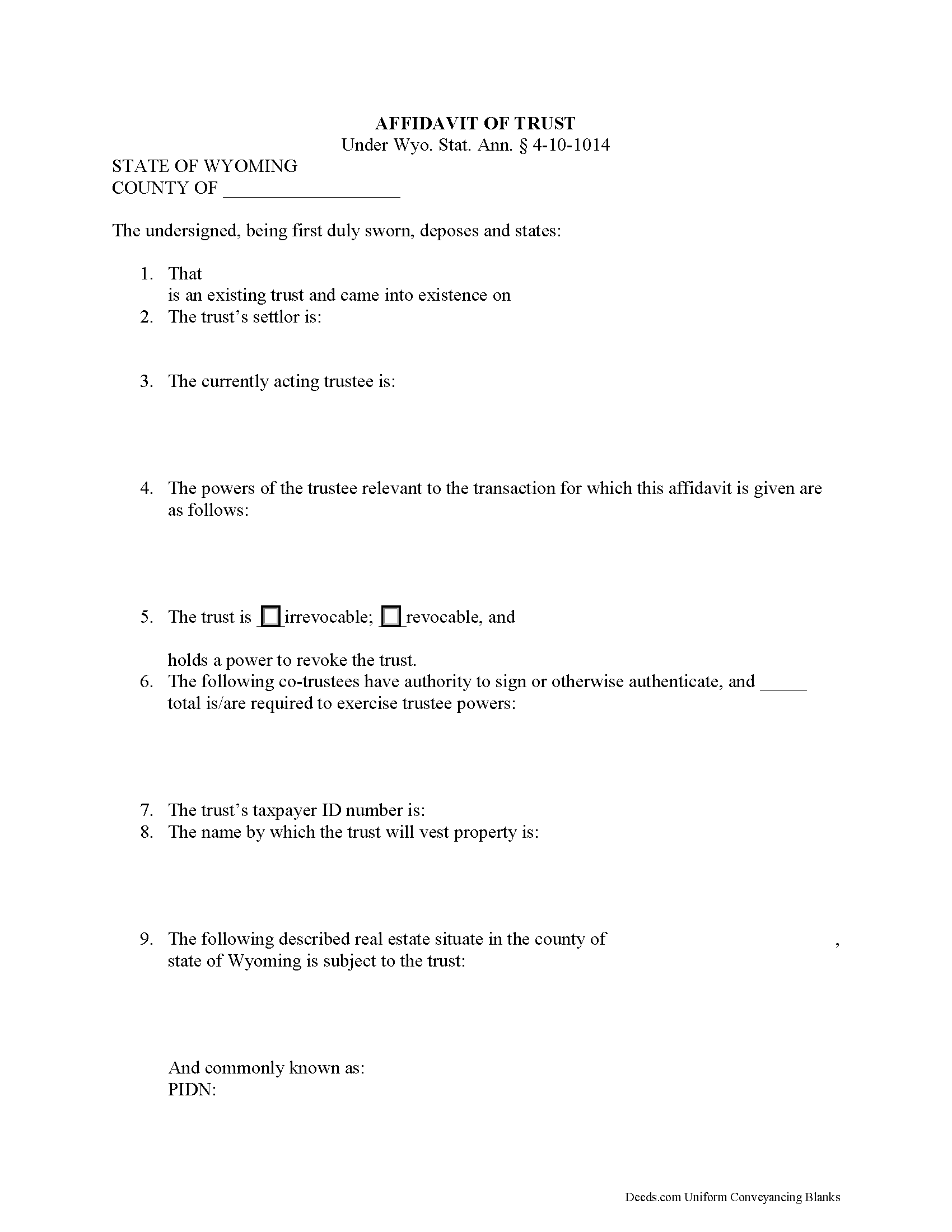
About the Wyoming Affidavit of Trust
How to Use This Form
- Select your county from the list
- Download the county-specific form
- Fill in the required information
- Have the document notarized if required
- Record with your county recorder's office
What Others Like You Are Saying
"Easy to use and I really like having the guides that come along with the forms."
"got the forms we needed, and ones we did not even know we needed!"
"When I found this website, I was confused and hesitant to use this website to submit paperwork that …"
"Exceptionally helpful instruments that are compliant with State law and anticipate various contingen…"
"Delivered as promised. Highly recommend!"
4.8/5 from 4,858 reviews. Read all
This Wyoming Affidavit of Trust package supplies a fillable affidavit drafted under W.S. 4-10-1014, the statute that lets a trustee furnish a certification or affidavit of trust to a person other than a beneficiary instead of a copy of the trust instrument. The affidavit is laid out for recording with the county clerk as an affidavit of facts affecting title to real property under W.S. 34-11-101, so the trust facts behind a trustee's title to Wyoming land can appear in the land records without recording the trust instrument itself. Wyoming prescribes no official state form; the statute lists the contents, and this form is drafted to supply them.
What the download includes
- Affidavit of Trust form: a fillable five-page instrument preceded by a one-page do-not-record instructions sheet.
- Affidavit of Trust guide: a seven-page guide that explains the affidavit section by section, the statutory items behind each entry, signing and notarization, recording, and the instrument's limits.
- Completed example: the same instrument filled in for a fictional two-cotrustee revocable trust holding a platted lot in Laramie County, with both signature blocks and both jurat certificates completed.
All three PDFs are delivered on a single statewide scope. No deed, mortgage or Statement of Consideration form is included.
What the affidavit states
The form collects the information W.S. 4-10-1014(a) lists for a certification of trust: that the trust exists and the date the trust instrument was executed, the settlor, the currently acting trustee and mailing address, the trustee's pertinent powers, whether the trust is revocable and who holds a power to revoke it, the authority of cotrustees to act, and the manner of taking title to trust property. Because the affidavit is drawn for recording, it also identifies the Wyoming county where the property lies, the legal description, street address, parcel number, the record owner of the land and the instrument that vested title. W.S. 34-11-101(c) requires the land description and the record owner's name in an affidavit affecting title, and the county clerk indexes the affidavit in that name in the same manner as deeds.
The trustee's sworn statements are preprinted and contain no blanks. The trustee states from personal knowledge that the facts in the affidavit are true and certifies that the trust has not been revoked, modified or amended in any manner that would make the affidavit's representations incorrect, which is the statement W.S. 4-10-1014(c) requires. The same text states that the affidavit is furnished in place of a copy of the trust instrument and does not set out the trust's dispositive terms.
Sworn, not acknowledged
The affidavit is sworn before a notarial officer rather than acknowledged. Each trustee signature block pairs with its own verification on oath or affirmation in the short form W.S. 32-3-115(a)(iii) provides, and W.S. 34-11-101(a) provides that an affidavit containing a jurat does not need a certificate of acknowledgment in order to be recorded. The guide explains the difference between a jurat and an acknowledgment, which Wyoming law defines as distinct notarial acts, and notes that the venue entered on the certificate is where the notarial officer is physically located, which may differ from the county where the land lies. The printed certificates are drawn for a conventional, in-person notarial act.
Who the form describes
The form accommodates one trustee or two cotrustees of a single trust, each a natural person who is currently acting as trustee and swears to the affidavit in that capacity. It carries two signature blocks, the second marked for a second trustee if applicable, and a separate jurat certificate for each, so two cotrustees can swear on different dates or before different officers; when one trustee certifies, the second block and its certificate remain unused. W.S. 4-10-1014(b) requires only that the certification be signed or otherwise authenticated by any trustee, and the two-certificate layout is a feature of this form's design rather than a Wyoming requirement.
According to the guide, the form is not set up as an affidavit by a trustee that is a bank, trust company or other entity; by three or more cotrustees; by an agent under a power of attorney signing in place of a trustee; by a trust protector; or by a beneficiary. It describes one trust per affidavit and is drawn for a trust that holds, or is about to hold or convey, Wyoming real property. A certification furnished to a bank or brokerage for an account with no land involved is a different use of the same statute that this recorded form is not laid out for.
What the affidavit does not do
The affidavit conveys nothing. It does not create, fund, amend or revoke a trust, and it does not convey, mortgage or otherwise affect title to the property it describes. The deed into the trust, the deed out of it and any mortgage are separate instruments prepared and recorded separately, and none is included in this package. Because the affidavit transfers no title and names no grantee, the sworn Statement of Consideration that accompanies a recorded deed is not part of this affidavit.
The form carries no entry for the trust's taxpayer identification number, its beneficiaries or its dispositive terms. W.S. 4-10-1014 lists the taxpayer identification number as optional, and subsection (d) provides that a certification or affidavit of trust need not contain either the dispositive terms or the number. The guide explains that, because the trust instrument itself is not recorded, those terms stay off the public record. The affidavit also does not replace trust-instrument excerpts a recipient may require under W.S. 4-10-1014(e) and does not satisfy a title insurer's own underwriting requirements.
How a recipient may rely on it
Under W.S. 4-10-1014(f), a person who acts in reliance on a certification or affidavit of trust without knowledge that its representations are incorrect is not liable to any person for so acting, and under subsection (g) a person who in good faith enters into a transaction in reliance on it may enforce the transaction against the trust property as if the representations were correct. Subsection (e) still lets a recipient require the trustee to furnish excerpts from the trust instrument that designate the trustee and confer the power to act in the pending transaction. The guide explains that these protections run to the person who receives and relies on the affidavit, while recording places the trust facts in the land records with the prima facie effect W.S. 34-11-101(a) gives a recorded affidavit.
About the guide and example
The guide follows the sections of the form in order and, for each, quotes the entry shown in the completed example and explains the statutory item behind it. It also covers completing and printing the form, signing and notarization, recording in the county where the property is situated, and closes with a What This Does Not Do section. The example demonstrates a completed affidavit for a fictional revocable trust with two settlors serving as cotrustees and a platted lot in Laramie County, showing the trustee vesting, the property and record-owner entries, both signature blocks, both jurat certificates and the return and prepared-by blocks filled in.
This description and the included guide are general information about the product and are not legal advice.
Important: County-Specific Forms
Our affidavit of trust forms are specifically formatted for each of the 23 counties in Wyoming.
After selecting your county, you'll receive forms that meet all local recording requirements, ensuring your documents will be accepted without delays or rejection fees.