Santa Cruz County Full Release of Memorandum And Notice of Agreement Form
Last validated October 8, 2026 by our Forms Development TeamFormatted for recording in Santa Cruz County, for property anywhere in the county: rural and unincorporated areas as well as Amado, Elgin, Nogales, Patagonia, Rio Rico, Sonoita, Tubac, Tumacacori.
- 3 documents included
- Immediate PDF download
- Formatting guarantee
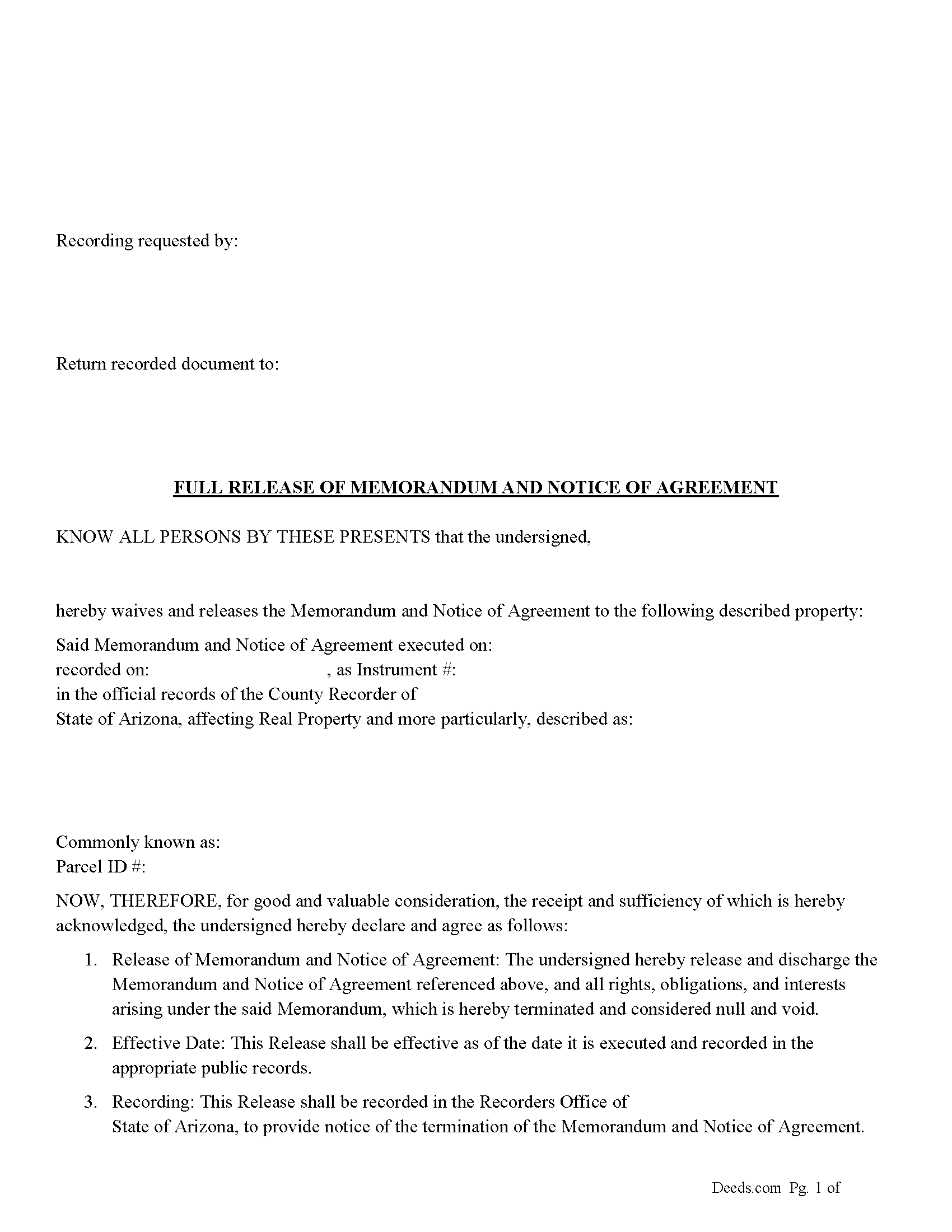
Santa Cruz County Full Release of Memorandum And Notice of Agreement Form
Fill in the blank Full Release of Memorandum And Notice of Agreement form formatted to comply with all Arizona recording and content requirements.
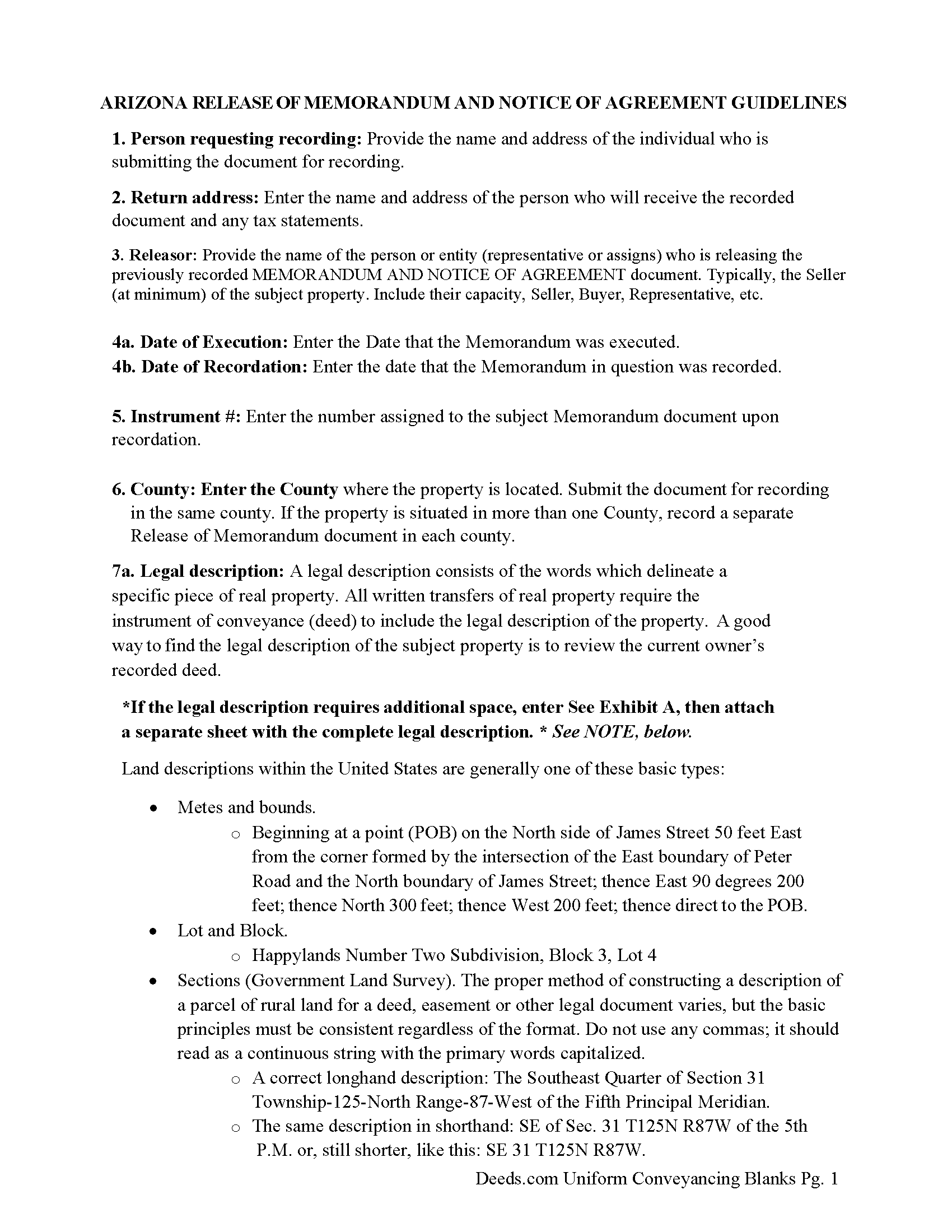
Santa Cruz County Full Release of Memorandum And Notice of Agreement Guide
Line by line guide explaining every blank on the Full Release of Memorandum And Notice of Agreement form.

Santa Cruz County Completed Example of the Full Release of Memorandum And Notice of Agreement Document
Example of a properly completed Arizona Full Release of Memorandum And Notice of Agreement document for reference.
All 3 documents above included • One-time purchase • No recurring fees
Immediate Download • Secure Checkout
Additional Arizona and Santa Cruz County documents included at no extra charge:
Where to Record Your Documents
Recorder's Office
Nogales, Arizona 85621
Hours: 8:00am - 5:00pm M-F
Phone: 520-375-7990
Recording Tips for Santa Cruz County:
- Bring your driver's license or state-issued photo ID
- Ensure all signatures are in blue or black ink
- Documents must be on 8.5 x 11 inch white paper
- Double-check legal descriptions match your existing deed
- Verify all names are spelled correctly before recording
Cities and Jurisdictions in Santa Cruz County
Properties in any of these areas use Santa Cruz County forms:
- Amado
- Elgin
- Nogales
- Patagonia
- Rio Rico
- Sonoita
- Tubac
- Tumacacori
Hours, fees, requirements, and more for Santa Cruz County
How do I get my forms?
Forms are available for immediate download after payment. The Santa Cruz County forms will be in your account ready to download to your computer. An account is created for you during checkout if you don't have one. Forms are NOT emailed.
Are these forms guaranteed to be recordable in Santa Cruz County?
Yes. Our form blanks are guaranteed to meet or exceed the applicable formatting requirements used for recording in Santa Cruz County, including margin requirements, font requirements, and other layout standards. This guarantee applies to formatting, not to the legal sufficiency of information entered by the user or the suitability of a form for a particular transaction.
Can I reuse these forms?
Yes. You can reuse the forms for your personal use. For example, if you have multiple properties in Santa Cruz County you only need to order once.
What do I need to use these forms?
The forms are PDFs that you fill out on your computer. The free Adobe Acrobat Reader is recommended, and most PDF apps also work. You do NOT enter your property information online - you download the blank forms and complete them privately on your own computer.
Are there any recurring fees?
No. This is a one-time purchase. Nothing to cancel, no memberships, no recurring fees.
How much does it cost to record in Santa Cruz County?
Recording fees in Santa Cruz County vary. Contact the recorder's office at 520-375-7990 for current fees.
Questions answered? Let's get started!
The Arizona Full Release of Memorandum and Notice of Agreement is the instrument used to clear a previously recorded memorandum of purchase agreement, option, right of first refusal, or similar executory real estate agreement from the county's chain of title. Because Arizona is a race-notice state under ARS 33-412, the recorded memorandum operates as a genuine cloud on the seller's title until something new is recorded — not because the underlying agreement necessarily survives, but because the record does not know the agreement has ended. A purchase contract that fell through, an option that expired unexercised, a right of first refusal that was extinguished by the beneficiary's decision not to exercise — none of those terminations shows up in the recorder's index. Until the release is filed, the memorandum remains there, and every future title examiner will treat it as a matter affecting title.
When the Arizona Full Release of Memorandum Is Used
This form is used to clear any previously recorded memorandum when the underlying agreement no longer supports it. The most common trigger is failure of a purchase contract to close, whether from a buyer financing failure, a failed inspection contingency, a negotiation breakdown, or mutual rescission during the due diligence period. Other triggers include expiration of an option to purchase without exercise, termination of a right of first refusal, mutual cancellation of a lease-purchase arrangement, completion of a purchase transaction where the memorandum was used as priority protection and is no longer needed after the deed records, and settlement of disputes where the parties have agreed to unwind an agreement that was publicly noticed. The form is also used by buyers who completed a purchase under the protection of a recorded memorandum and want to clear the record after closing — once the deed conveys full title, the memorandum has served its purpose and should come off.
Why Both Sides Can Have a Stake in Recording the Release
The party usually most motivated to record the release is the seller, because the unreleased memorandum prevents the seller from selling to another buyer or refinancing against the property. A title company running a commitment will flag the memorandum as an exception to coverage and will typically require evidence of release or termination before insuring any subsequent transaction. Lenders underwriting a new loan will refuse to fund until the memorandum is cleared. For the seller, the release is not optional when the deal has failed; it is a prerequisite to moving on.
Buyers have their own reasons to want the release recorded at the right moment. When a buyer has successfully closed a purchase that was noticed by a memorandum, the buyer is now the owner and is the party who will later want to sell, refinance, or develop the property. At that future moment, the unreleased memorandum in the buyer's own chain will surface as a title exception that has to be resolved before the buyer's new transaction can close. Clearing the memorandum at closing — at the same time the deed records — avoids having to track down the former seller years later to sign a release document.
Clearing Title for Future Transactions
The practical mechanics of clearing title make the release more important than it might appear on first reading. When a future buyer's title insurer runs a search and finds the memorandum, the insurer's standard response is to require a release or other document showing the underlying agreement has been terminated. Explanations from the current owner — "that contract fell through years ago" — do not satisfy the insurer. What the insurer wants is a recorded document showing a clear chain. If the original parties are still available and cooperative, obtaining the release is usually straightforward, but "still available and cooperative" becomes progressively less reliable with time. Former business partners move, divorce, sell their companies, die, or lose interest in signing documents for transactions they have long forgotten. The release recorded contemporaneously with the termination is worth several multiples of the release obtained five years later through a quiet title action or indemnity.
Preventing Future Legal Disputes
The release also serves a substantive legal purpose beyond the title-clearing function. When a purchase agreement fails and the parties walk away, the parties' positions on what happened are sometimes unclear — did the buyer breach, did the seller breach, was the cancellation mutual, did either side make claims that were never resolved? The release is the document that records the parties' agreement that the underlying contract is over and that no further claims are being asserted under it. A release signed by both parties, or structured to include a mutual release of claims arising out of the terminated agreement, converts what might otherwise remain a latent dispute into a clean closure. Without a release, the party whose memorandum is on the record retains theoretical grounds to argue later that the agreement continues, that the other side's actions constituted a breach giving rise to damages, or that specific performance is still available. The release takes those arguments off the table.
Who Signs
The party whose recorded interest is being released must sign — the buyer under a purchase memorandum, the optionee under an option memorandum, the beneficiary under a right-of-first-refusal memorandum. That party is the one giving up rights that the memorandum established, and the release is effective against that party when it signs. Many Arizona releases are executed by both the buyer and seller (or optionor and optionee) to confirm mutual agreement on the termination, which is the cleaner practice and eliminates arguments about the scope of the release and whether the releasing party had authority to speak for the other side.
When the releasing party is a business entity, trust, or fiduciary, the signatory's representative capacity and underlying authority should be reflected in the signature block. When the original signing party has since died, the personal representative of the estate signs, with letters of appointment available for the recorder and title insurer to examine. When a party cannot be located despite reasonable efforts, a release is not available and the remedy is either a quiet title action under ARS 12-1101 et seq. or a title insurer's willingness to insure over the exception with an indemnity — both meaningfully more expensive than a simple contemporaneous release.
Reference to the Original Memorandum
The release must tie itself to the specific memorandum being cleared. The instrument should identify the original memorandum by its recording date, recording reference (docket and page or instrument number), county of recording, and the names of the parties to the underlying agreement. The legal description of the property should match the description in the memorandum. Without that explicit tie, the county recorder's index will not link the release to the memorandum, and a title examiner running the chain may not find the connection when it matters. This is the same principle that governs every corrective or releasing instrument in Arizona: the record has to show the link on its face, because the recorder's indexing system cannot infer relationships between documents that do not reference each other.
Execution and Acknowledgment
Under ARS 33-401, a release affecting real property must be in writing, subscribed by the party releasing, and acknowledged before a notary public or other officer authorized to take acknowledgments. Arizona does not require subscribing witnesses. Acknowledgments taken outside Arizona must comply with ARS 33-501, which recognizes notaries, judges and clerks of courts of record, and other officers authorized to perform notarial acts in the jurisdiction where the acknowledgment is taken. A release with a defective acknowledgment is not recordable, and an unrecordable release does nothing to clear the record regardless of the parties' intentions.
Affidavit of Property Value Exemption
Arizona requires an Affidavit of Property Value to accompany most instruments affecting interests in real property (ARS 11-1133), but a release of memorandum typically qualifies for an exemption under ARS 11-1134 because no transfer is occurring — the release is clearing a recorded notice, not conveying property. The exemption must be claimed on the face of the release with a statement that the transfer is exempt and a citation to the specific exemption subsection, placed below the legal description. Releases that omit the exemption recital are routinely rejected at the recorder's window, even though the transaction is plainly exempt. When a release is given in exchange for meaningful consideration — for example, a buyout of an optionee who declines to exercise but wants compensation to release — the affidavit may actually be required rather than exempt.
Formatting and Recording
ARS 11-480 sets the formatting requirements for every recordable instrument: legible type of at least ten points, white paper no larger than 8.5 by 14 inches, a caption identifying the document (for example, "Full Release of Memorandum and Notice of Agreement"), a top margin of at least two inches on the first page reserved for the recorder's stamp, and minimum half-inch margins elsewhere. Record the release in the same county where the original memorandum was recorded. When the memorandum was recorded in more than one county because the property spans county lines, the release must be recorded in each county where the original appeared; a release recorded in only one of two counties clears only that county's record. Confirm current recording fees and accepted forms of payment with the recorder's office in advance, and verify that the release has actually been indexed rather than relying on a drop-off or mailing receipt.
Race-Notice Consequences of Delayed Recording
Arizona's race-notice rule at ARS 33-412 attaches specific consequences to unrecorded instruments that cut both ways. A release executed but not recorded is effective between the original parties but does not protect against a subsequent purchaser for value who records something first without notice. More practically for the memorandum context, an unrecorded release does nothing to clear the cloud on title — title examiners cannot see documents that are not in the recorder's index. A party who has obtained an executed release and is holding it unrecorded has not achieved the outcome the release was meant to produce. The recording step is the entire point of the exercise.
What's Included in the Download Package
The Arizona Full Release of Memorandum and Notice of Agreement package includes the release form drafted to reference the original recorded memorandum and claim the ARS 11-1134 exemption on the face of the instrument, detailed guidelines covering the Arizona-specific drafting and recording requirements, and a completed example showing how the form should look for a typical release. The form is suitable for releasing memoranda of purchase agreements, options, rights of first refusal, lease-purchase agreements, and similar notice instruments. All files are available for instant download after purchase.
Important: Your property must be located in Santa Cruz County to use these forms. Documents should be recorded at the county recording office listed above.
This Full Release of Memorandum And Notice of Agreement meets all recording requirements specific to Santa Cruz County.
Our Promise
The documents you receive here are guaranteed to meet or exceed the applicable Santa Cruz County recording format requirements. If there is a rejection caused by our formatting, we will correct the issue or refund your payment. This guarantee applies to document formatting only and does not extend to information entered by the user, the selection of the form, or the legal effect of the completed document.
Save Time and Money
Get your Santa Cruz County Full Release of Memorandum And Notice of Agreement form done right the first time with Deeds.com Uniform Conveyancing Blanks. At Deeds.com, we understand that your time and money are valuable resources, and we don't want you to face a penalty fee or rejection imposed by a county recorder for submitting nonstandard documents. We constantly review and update our forms to meet rapidly changing state and county recording requirements for roughly 3,500 counties and local jurisdictions.
4.8 out of 5 - ( 4,824 Reviews )
Andrew S. 5 out of 5 stars
This is fast and easy.
We appreciate your business and value your feedback. Thank you. Have a wonderful day!
Mary Ann H V. 5 out of 5 stars
I'm very happy with your service! It saved me, at least, hundreds of dollars vs. going through a lawyer in a different state.
We appreciate your business and value your feedback. Thank you. Have a wonderful day!
Jeffrey L. 5 out of 5 stars
I like using Deeds.com for all of our out-of-state deeds because they make the process almost completely hassle free for us and our clients. I am confident that the service they provide for us is the absolute best anywhere. Because of Deeds.com, we look great to our clients and our people enjoy a level of trust that other firms do not offer them.
Thank you for your feedback. We really appreciate it. Have a great day!
Mary Ann G. 2 out of 5 stars
Couldn't find the deed form that I needed. Needs to have a short summary to determine the correct form.
Sorry to hear that Mary Ann, we appreciate your feedback.
Kerrin S. 5 out of 5 stars
This was so efficient. Thank you for offering this service!
Thank you for your feedback. We really appreciate it. Have a great day!
Allan S. 5 out of 5 stars
Using this sofftware was a piece of cake! Donload was fast and simple. Using the guide supplied I did the Beneficiary Deed in no time. Would certainly use this service again without hesitation.
Your feedback is greatly appreciated. Thank you for taking the time to share your experience!
Audra P. 5 out of 5 stars
Deeds.com was so easy to use and understand. So fairly priced too in my opinion, worth every penny! Thank you deeds.com and I'm grateful my county uses and encourages using them.
We appreciate your business and value your feedback. Thank you. Have a wonderful day!
Robert L. 5 out of 5 stars
It was easy for me to open an account and upload a document for recording.
Thank you for your feedback. We really appreciate it. Have a great day!
Jennifer T. 5 out of 5 stars
I got instant access to the exact forms I needed! The guide to completing the form was very thorough and easy to understand. I am very thankful for this service!
Thank you for the kind words Jennifer. We appreciate you!
Rebecca M. 4 out of 5 stars
EASY DOWNLOAD AND PRINT AND / OR SAVE TO YOU PC WHICH SHOULD BE DONE BEFORE FILLING OUT. AFTER I actually use them I'll let you know if its all good, Thanks
Your feedback is greatly appreciated. Thank you for taking the time to share your experience!
Christina A G. 5 out of 5 stars
It was easy to locate, purchase, and download the documents I needed on the Deeds.com website.
We appreciate your business and value your feedback. Thank you. Have a wonderful day!
Kathryn M. 5 out of 5 stars
Never know an online service was available for recording county documents. It was so easy and simple and FAST! Within a matter of a couple hours it's done. I would definitely recommend Deeds.com to anyone.
Thank you Kathryn, we really appreciate that.
Meg R. 5 out of 5 stars
Good system fairly easy to use
Thank you!
George A. 5 out of 5 stars
Excellent Service.
Thank you for your feedback. We really appreciate it. Have a great day!
Mark W. 5 out of 5 stars
Great form and easy to complete. Sending a sample and instructions was very helpful. Thank you!
We appreciate your business and value your feedback. Thank you. Have a wonderful day!