Arizona Grant Deed Condominium
County Specific Legal Forms Validated as recently as October 13, 2026 by our Forms Development Team
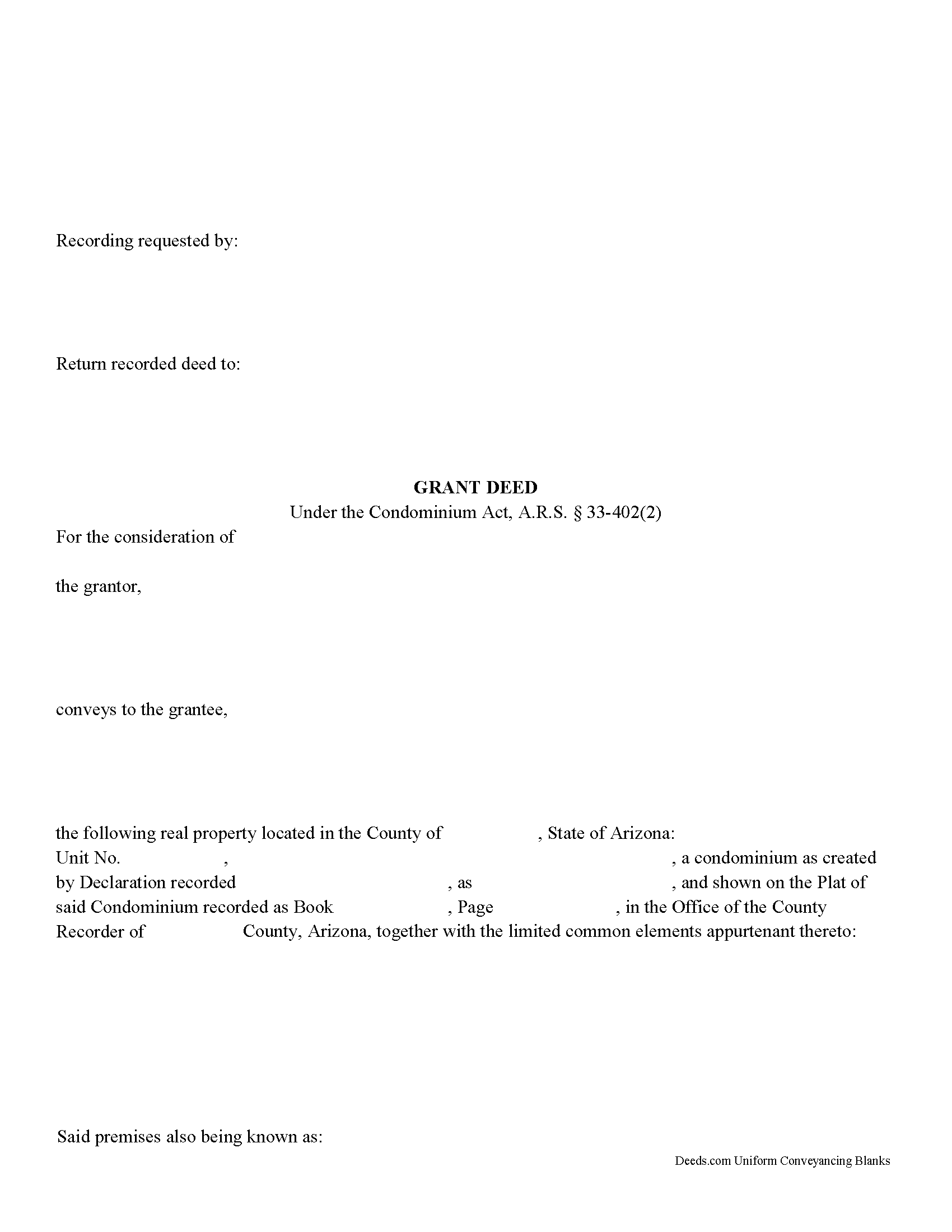
About the Arizona Grant Deed Condominium
How to Use This Form
- Select your county from the list
- Download the county-specific form
- Fill in the required information
- Have the document notarized if required
- Record with your county recorder's office
What Others Like You Are Saying
"Ordered and received the appropriate quitclaim deed docs for my area. Recorded with no questions or …"
"No review provided."
"Very easy to us & thanks for all the info to fill out the form."
"Deed.com had some hard to find mineral interest deeds for Oklahoma.I'm an attorney in Texas with no …"
"Very useful and right at your fingers when you need a form. Recommend these forms highly. Thank you!…"
4.8/5 from 4,829 reviews. Read all
The Arizona Grant Deed Condominium form layers two distinct bodies of Arizona law into a single instrument: the implied covenants that attach under ARS 33-435 when a deed uses the words "grant" or "convey," and the unit-specific description rules of the Arizona Condominium Act at ARS 33-1214. A standard grant deed form won't satisfy the second set of requirements — a condominium conveyance has to identify the unit, the declaration, and the allocated interest in the common elements, or the deed fails to reach what the parties actually intended to transfer. This form is drafted to trigger the statutory covenants while meeting the condominium description rules in one recordable document.
When the Arizona Grant Deed Condominium Is Used
Grant deeds occupy the middle of Arizona's warranty spectrum: stronger than a quitclaim, weaker than a general warranty deed. For condominium units, that middle position is useful in transfers where the parties want more than "whatever interest the grantor happens to hold" but the grantor is not prepared to defend against defects predating its own ownership. Typical uses include transfers between closely related parties where some consideration is changing hands, conveyances from an entity to its principals or between affiliated entities, certain estate and trust distributions, and transactions where title insurance will cover the earlier chain and the deed only needs to speak to the grantor's own acts. Arm's-length sales of condo units with institutional financing are more commonly done by general warranty deed.
The Implied Covenants Under ARS 33-435
Using "grant" or "convey" in an Arizona deed triggers two implied covenants, and only two: that the grantor has not previously conveyed the same estate or any interest in it to someone other than the grantee, and that at execution the estate is free from encumbrances made by the grantor. Both cover the grantor's own period of ownership. They do not reach defects originating before the grantor took title — an unreleased mortgage from a prior owner, a missing signature two transfers back, an easement predating the grantor's purchase. Grant deeds in Arizona also pass after-acquired title automatically: if the grantor later acquires a better interest in the same unit, that interest flows through to the grantee under the deed already delivered, unless the deed expressly excludes it. The grant deed does not, however, carry a covenant to defend title against third-party claims; for that protection, the deed would need to use the full warranty language under ARS 33-402 instead.
Unit-Specific Legal Description
ARS 33-1214 governs how a condominium unit must be described in any deed, and the requirements are strict. The instrument must identify the unit by its designation in the declaration, name the condominium, recite the recording date and location of the declaration establishing the project, and identify the county or counties where the condominium is located. The description must also address the common elements (ARS 33-1212(7)) — hallways, exterior walls, landscaping, parking structures, recreational facilities — and the unit's allocated interest under ARS 33-1202(2), which is the undivided interest in the common elements, the share of common expense liability, and the votes in the unit owners' association assigned to the unit.
The correct unit designation, declaration recording information, and allocated interest must come from the recorded declaration and any amendments — not reconstructed from the prior deed alone, and not approximated. Discrepancies between the deed and the recorded declaration are the leading cause of rejected condominium conveyances in Arizona and of title defects that surface years later on resale.
Community Property, Marital Status, and Vesting
Arizona is a community property state, and the conveyancing clause must recite the marital status of each grantor and grantee. Property acquired by either spouse during marriage is presumed to be community property unless a separate-property exception applies (ARS 25-211). When a unit held as community property is being conveyed, both spouses must join the deed, because a conveyance by one spouse alone is voidable by the other. When the grantor is a business entity or a fiduciary, the signature block and acknowledgment should reflect the representative capacity, and any underlying authority document should be recorded or referenced where the conveyance depends on it.
Vesting options for the grantee under ARS 33-431 include sole and separate property, tenancy in common, joint tenancy with right of survivorship, community property, and community property with right of survivorship. A conveyance to two or more grantees without a specified tenancy defaults to tenancy in common. Survivorship features and the community-property-with-right-of-survivorship form must be stated expressly — they are not implied from the fact of marriage.
Execution and Acknowledgment
Under ARS 33-401, a conveyance of real property in Arizona must be in writing, subscribed by the grantor, and acknowledged before a notary public or other officer authorized to take acknowledgments. Arizona does not require subscribing witnesses. Acknowledgments taken outside Arizona must comply with ARS 33-501, which recognizes notaries, judges and clerks of courts of record, and other officers authorized to perform notarial acts in the state where the acknowledgment is taken. A statement of consideration should appear in the deed and reflect the full amount paid for the transfer, including any liens assumed by the grantee (ARS 11-1131(2)); the deed should also reference the source of the grantor's title and note any restrictions affecting the unit.
Affidavit of Property Value and Exemptions
Arizona requires an Affidavit of Property Value, signed by both grantor and grantee, to accompany most instruments transferring an interest in real property (ARS 11-1133). The consideration recited on the deed must reconcile with the figures reported on the affidavit. Grant deed conveyances of condominium units often fall within one of the exemptions at ARS 11-1134 — transfers to or from a revocable trust by the trustor, transfers between entities under common control, corrective deeds, deeds merely confirming a prior transfer — and when an exemption applies, a statement that the transfer is exempt, together with a citation to the specific subsection, must appear on the face of the deed below the legal description. Without that recital, the recorder treats the deed as non-exempt and requires the affidavit.
Resale Disclosures for Condominium Units
Arizona imposes statutory disclosure obligations when a unit changes hands, and ARS 33-1260 assigns the duty by project size. In condominiums with fewer than fifty units, the selling unit owner must furnish the buyer with the declaration, bylaws, current budget, and other statutory financial and insurance information within ten days of a notice of pending sale. In projects of fifty or more units, the association is responsible. Whether a formal disclosure package is required in a particular grant deed transaction depends on the nature of the transfer — intra-family and intra-entity transfers often proceed without the full resale disclosure, while any transaction that qualifies as a "sale" triggers the full statutory duty.
Formatting, Recording, and Priority
ARS 11-480 sets formatting requirements for every recordable instrument: ten-point or larger legible type, white paper no larger than 8.5 by 14 inches, a caption identifying the document type, a top margin on the first page of at least two inches reserved for the recorder's stamp, and half-inch minimums on the remaining margins. County recorders reject non-conforming documents, and several counties enforce the first-page margin rule strictly.
Record the deed in the county where the condominium is situated, and confirm current fees and accepted forms of payment in advance. ARS 33-411.01 places an affirmative duty on the transferor to record within sixty days of the transfer. Recording provides constructive notice to subsequent purchasers and encumbrance holders (ARS 33-411), and Arizona's race-notice rule at ARS 33-412 makes an unrecorded conveyance void as against a later purchaser for value who records first without notice of the prior transfer.
What's Included in the Download Package
The Arizona Grant Deed Condominium package includes the deed form drafted around the ARS 33-435 implied covenants and the ARS 33-1214 unit description rules, detailed guidelines covering Arizona-specific drafting and recording requirements, and a completed example showing how the form should look for a typical unit conveyance. All files are available for instant download after purchase.
Important: County-Specific Forms
Our grant deed condominium forms are specifically formatted for each of the 15 counties in Arizona.
After selecting your county, you'll receive forms that meet all local recording requirements, ensuring your documents will be accepted without delays or rejection fees.