Arizona Revocation of Beneficiary Deed (Two Original Owners, Both Signing)
County Specific Legal Forms Validated as recently as October 7, 2026 by our Forms Development Team
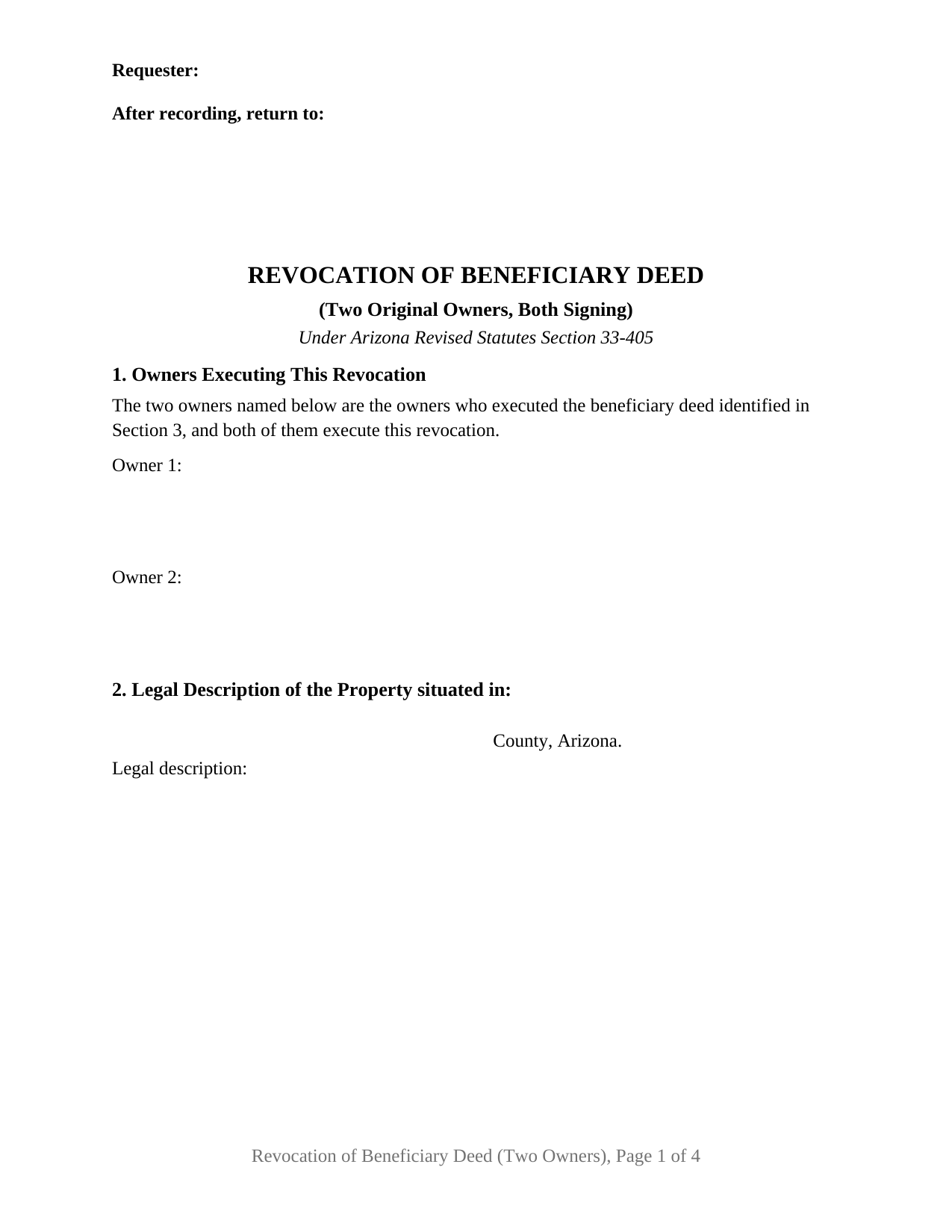
About the Arizona Revocation of Beneficiary Deed (Two Original Owners, Both Signing)
How to Use This Form
- Select your county from the list
- Download the county-specific form
- Fill in the required information
- Have the document notarized if required
- Record with your county recorder's office
What Others Like You Are Saying
"Fast accurate service"
"Excellent find (Deeds.com) from a google search, first hit. This was exactly what we were looking fo…"
"All I needed to do was changed from my previously married name to my now maiden name and a Quit Clai…"
"Fast and relaible service every time. I wouldn't use any other service. I love deeds.com"
"Very helpful."
4.8/5 from 4,829 reviews. Read all
Two owners signed the beneficiary deed, so two signatures take it back out of the Arizona record. This form is built for that pattern: both of the people who executed the recorded beneficiary deed sign one revoking instrument, each of them acknowledges separately, and the document shows the withdrawal coming from everyone who made the designation.
Both original signers, joining in one instrument
A.R.S. 33-405, subsection M, defines owner for this section as any person who executes a beneficiary deed, and subsection F lets any of those persons revoke. This form does not lean on that permission alone. Section 1 recites, as printed text, that the two owners named in it executed the beneficiary deed identified later in the document and that both of them execute the revocation, so the instrument reads on its face as the act of the whole group that made the designation. Subsection F carries a separate proviso for survivorship title, aimed at a revocation that fewer than all owners sign; a document both owners execute never reaches it.
Two certificates because two owners rarely sign together
Section 5 carries a signature block for each owner, headed OWNER 1 and OWNER 2, and one acknowledgment certificate follows each block. That layout answers an ordinary scheduling fact: one certificate holds one venue, one date, and one officer, so co-owners who appear on different days or in different states cannot share it. In the completed example the two acknowledgments fall a day apart before two different Arizona notaries. Each certificate's operative sentence is the short form at A.R.S. 41-265(1), and the venue lines are left open, since a notarial act happens where the officer is rather than where the ground is.
Each certificate names the other signer
A.R.S. 41-264(F) calls for a certificate that reaches a tangible record on a separate sheet to describe that record: its title or type, its date, its page count, and any signers of the record besides the individual the certificate itself names. On a record two people sign, that last item is an entry rather than a fixed word. The form prints the statutory label with a blank beneath it inside each certificate, and in the completed example the Owner 1 certificate names Owner 2 and the Owner 2 certificate names Owner 1, so each one describes the entire record it travels with.
A deadline measured against each signer
Effectiveness is a timing question here, and subsection F measures it against the person who signs: the revocation must be executed and recorded in the office of the county recorder of the county where the real property is located, before the death of the owner who executes the revocation. The form prints that condition in capitals ahead of the signature blocks. Section 3 pins down the deed being withdrawn using the identifiers the statutory form at 33-405(L) uses, and those same identifiers answer A.R.S. 11-480(D), which asks an instrument that modifies a previously recorded document to state the recording date and the docket and page of what it modifies. Arizona indexes vary between docket or book and page and a single instrument number, so both routes have blanks.
The configuration this form recites
Two revoking owners are fixed in the printed text: two named owner blocks, two signature blocks, two record-identification blocks, two certificates, and no entry asking a signer to classify how title is held or whether either owner is married. A.R.S. 25-214(C)(1) reaches a transaction acquiring, disposing of, or encumbering community real property, and withdrawing a death-time designation is none of the three. Siblings who inherited a parcel together and named a nephew on one deed, and spouses who signed a single beneficiary deed over jointly held ground, present the two-owner pattern the form recites. A designation made by one owner acting alone, a revocation signed by fewer than all of the owners who executed the deed, and an owner signing through an agent or as a trustee each belong to a different pattern than the one printed here.
Arizona's document is also searched as a beneficiary deed cancellation or a transfer on death deed revocation, and a TOD deed is the same thing under another name; the instrument is the one A.R.S. 33-405 describes. The download holds the fillable form, a completed example set in Yavapai County, and a guide walking through each numbered section, the notarial requirements, and Arizona recording practice. These materials describe the form and the statutes in general terms and are not legal advice.
Important: County-Specific Forms
Our revocation of beneficiary deed (two original owners, both signing) forms are specifically formatted for each of the 15 counties in Arizona.
After selecting your county, you'll receive forms that meet all local recording requirements, ensuring your documents will be accepted without delays or rejection fees.