Arizona Revocation of Beneficiary Deed (Individual Sole Owner)
County Specific Legal Forms Validated as recently as October 20, 2026 by our Forms Development Team
About the Arizona Revocation of Beneficiary Deed (Individual Sole Owner)
How to Use This Form
- Select your county from the list
- Download the county-specific form
- Fill in the required information
- Have the document notarized if required
- Record with your county recorder's office
What Others Like You Are Saying
"I requested a property detail report on two houses that I own. The requests were easy to make. After…"
"My mind is blown! For some reason, our veteran title companies wouldn't record our deed but luckily,…"
"I got what I needed very quickly. Thank you."
"I have uploaded 2 documents for E recording, I have searched thinking it would prompt me to a busine…"
"Thank you fine Deeds Company. I hope all goes well for you and all your team!"
4.8/5 from 4,829 reviews. Read all
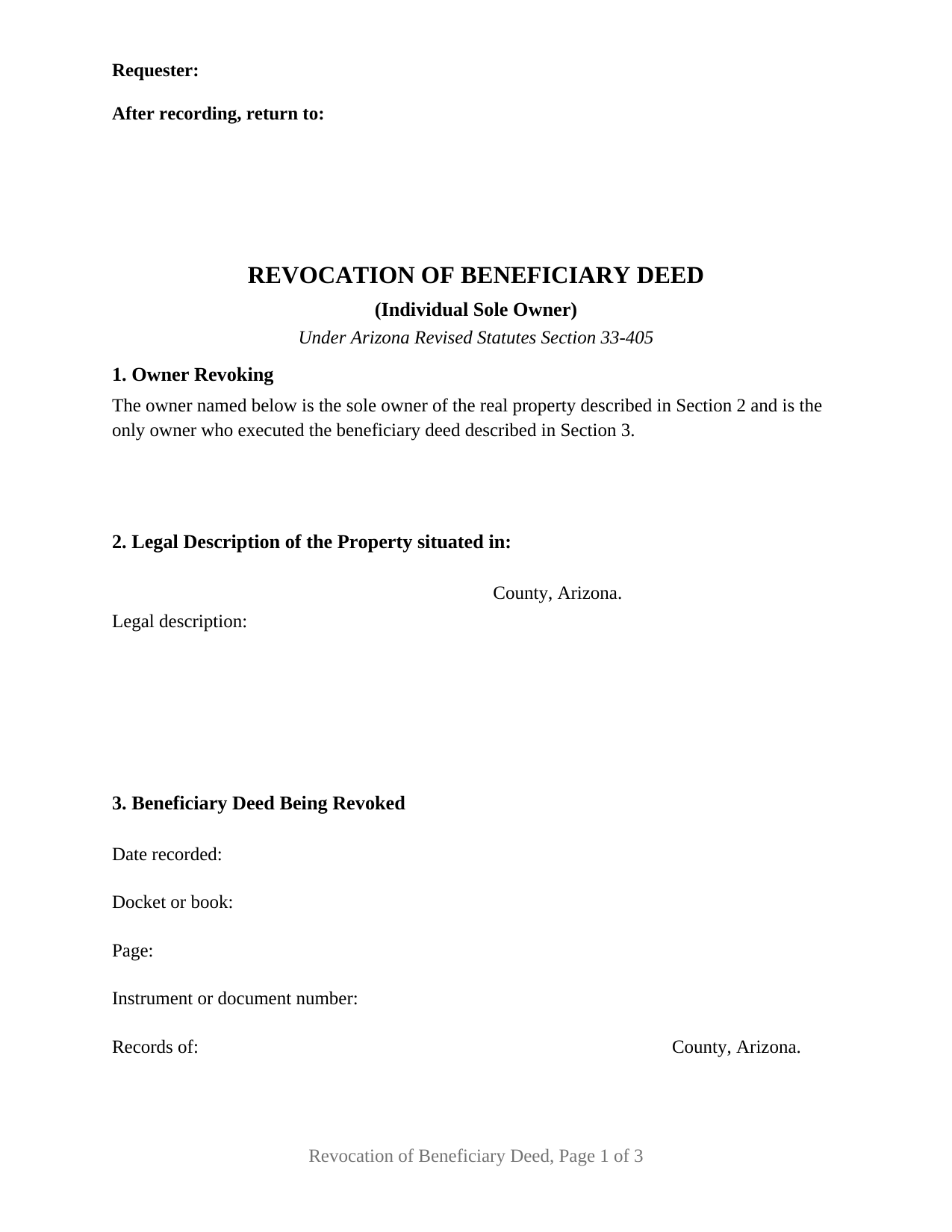
One owner signed the beneficiary deed, and one owner ends it. This form prepares an Arizona revocation of beneficiary deed for that configuration: a sole owner of the property, who was also the only person to execute the recorded deed now being cancelled, signing alone under A.R.S. 33-405(F).
One owner, one signature, one certificate
The configuration is printed into the instrument rather than left to the person completing it. Section 1 recites that the owner named in it is the sole owner of the described property and the only owner who executed the beneficiary deed identified later in the document. Below that recital the form carries a single signature block headed OWNER, followed by a single acknowledgment certificate. There is no second signature line, no co-owner block, and no box asking the signer to classify an ownership arrangement.
Marital status is absent by design as well. A.R.S. 25-214(C)(1) calls for both spouses to join a transaction for the acquisition, disposition, or encumbrance of an interest in community real property, and a revocation does none of those things: it cancels a designation that would have operated at a future death. The signing requirement the instrument answers is the one the beneficiary deed statute states.
Why Arizona counts signatures on a revocation
A.R.S. 33-405(F) allows a beneficiary deed to be revoked at any time by the owner, or, where more than one owner exists, by any of the owners who executed it. The same subsection then adds a rule for survivorship title: where property is held in joint tenancy with right of survivorship or as community property with right of survivorship and the revocation is not executed by all of the owners, it is ineffective unless the last surviving owner executes it. That rule is the reason a single-owner revocation and a multi-owner revocation are different documents on paper. This one recites the pattern in which the question never arises, because the signer is the whole of the ownership and the whole of the earlier deed's execution.
The deed is identified by its place in the record
A revocation works only if the record can tell which instrument it cancels. The statutory form at A.R.S. 33-405(L) identifies the earlier deed by its recording date, by docket or book and page or by instrument number, and by the county whose records hold it, and Section 3 collects exactly those items. A.R.S. 11-461(F) treats a docket and page, a book and page, and similar indications as a recorded instrument's location in the record, and Arizona counties differ in which of them an entry carries, so the section provides for both.
Recording is the step that gives the instrument force. Under A.R.S. 33-405(F) the revocation takes effect only on being executed and recorded with the county recorder where the land lies, before the death of the owner executing it, and the form prints that condition in capitals above the signature line. Page one reserves the top two inches for the recorder under A.R.S. 11-480(C), with the requester and return blocks in the left three and one half inches, where the statute allows them.
A certificate that describes the record it closes
Arizona notarial law shapes the last page. The certificate's operative sentence is the short form at A.R.S. 41-265(1), which states that the record was acknowledged before the officer on a given date by a named individual, and the venue lines stay blank because the place of the notarial act and the place of the land are separate facts. Directly under the caption the certificate carries a description of the record it belongs to: title or type, date, number of pages, and additional signers other than the individual named in the certificate, the items A.R.S. 41-264(F) calls for when a certificate reaches a tangible record on a separate sheet. On a document one person signs, that last line prints as None.
This document is also searched as a revocation of a transfer on death deed or a TOD deed cancellation; the instrument is the one A.R.S. 33-405 describes. The download contains the fillable form, a completed example filled in for a Pima County fact pattern, and a guide covering each numbered section, the notarial requirements, and Arizona recording practice. Those materials describe the form and the statutes in general terms and are not legal advice.
Important: County-Specific Forms
Our revocation of beneficiary deed (individual sole owner) forms are specifically formatted for each of the 15 counties in Arizona.
After selecting your county, you'll receive forms that meet all local recording requirements, ensuring your documents will be accepted without delays or rejection fees.