Arizona Revocation of Beneficiary Deed (Last Surviving Original Owner)
County Specific Legal Forms Validated as recently as October 2, 2026 by our Forms Development Team
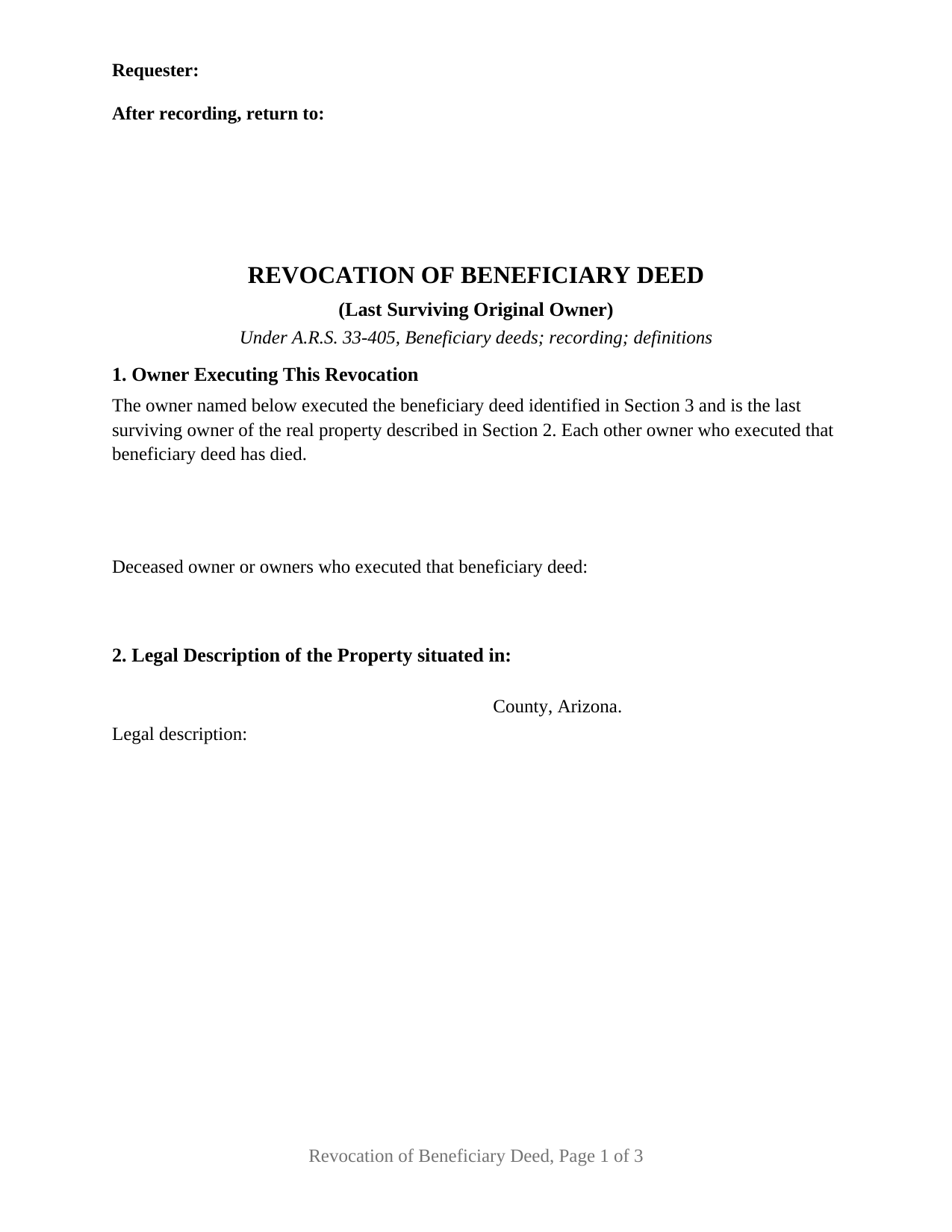
About the Arizona Revocation of Beneficiary Deed (Last Surviving Original Owner)
How to Use This Form
- Select your county from the list
- Download the county-specific form
- Fill in the required information
- Have the document notarized if required
- Record with your county recorder's office
What Others Like You Are Saying
"Your Service was excellent. Very responsive. Thank you."
"I am filing a Personal Representative Deed. Haven't used the forms yet but the package sent is compr…"
"Form was easy to complete, price was reasonable and everything worked out just fine. Would absolutel…"
"very good. got my info in minuetes. thank you"
"AMazing service. Fast and affordable."
4.8/5 from 4,832 reviews. Read all
Two owners once put their names to a single Arizona beneficiary deed. One of them has since died, and the survivor is now the only person who can reach that designation. This form prepares the revocation for that position: one signer, who joined in executing the recorded deed and who is now the last surviving owner of the land, cancelling the designation with no other signature on the page.
One signer, one certificate, the deceased owner named
The configuration is printed as deed text, not left to a checkbox. Section 1 states that the owner named in it executed the beneficiary deed identified in Section 3 and is the last surviving owner of the property described in Section 2, and that each other owner who executed that deed has died. A second entry takes the name of the deceased owner or owners, so the record shows how ownership came to rest in one living person. Under the recital sit one party block, one signature block headed OWNER, and one acknowledgment certificate. No entry asks the signer to classify co-ownership or marital status: A.R.S. 25-214(C)(1) speaks to acquiring, disposing of, or encumbering community real property, and this instrument does none of the three.
Why the lone survivor's signature carries
Arizona permits a beneficiary deed to be undone at any time, and where several people executed it, any one of them may cancel. The chapter then adds a rule for survivorship title. Where the land is held as joint tenants with right of survivorship, or as community property with right of survivorship, and every owner has not signed the cancelling instrument, A.R.S. 33-405(F) withholds effect unless the last surviving owner is the person who signed. This form is built to that clause: its signer is at once an original signer of the deed and the last owner left. The named beneficiary stays out of it, since A.R.S. 33-405(I) makes a grantee beneficiary's signature, consent, agreement, or notice unnecessary for any purpose while the owner lives.
A recorded paper that points at another one
Two Arizona statutes want the earlier deed pinned down. The statutory revocation form at A.R.S. 33-405(L) reaches it through the recording date, the docket or book and page or the instrument number, and the county whose records hold it. A.R.S. 11-480(D) then provides that an instrument presented for recording which modifies a previously recorded document states the date of recordation and the docket and page of the document being modified. Section 3 gathers those entries, and Section 4 draws them into the revocation sentence, which opens in the language of the statute.
Recorded in a lifetime, or not at all
Effect turns on timing, not on telling anyone. A.R.S. 33-405(F) gives the instrument force only once it has been executed and recorded with the recorder of the county where the property lies, before the death of the owner who signs it, and the form sets that condition in capital letters over the signature line. A will is no substitute: A.R.S. 33-405(J) provides that a beneficiary deed executed, acknowledged and recorded in accordance with the section is not revoked by the provisions of a will. Neither does the record tidy itself, because A.R.S. 33-405(G) treats the last beneficiary deed recorded before the owner's death as the effective one where an owner recorded more than one.
What the last page carries
The certificate is Arizona's own, its operative sentence drawn from A.R.S. 41-265(1), and the state and county lines above it stay open for the place where the notarial act happens, which need not be Arizona: A.R.S. 41-259 gives a qualifying act performed in another state the same effect here. Beneath the caption, the certificate describes the record it is attached to, the four identifying items A.R.S. 41-264(F) sets out. One date deserves a note: on September 12, 2026, an amendment to A.R.S. 41-254 begins requiring a notary journal thumbprint for real property documents, a change reaching the notary's book rather than the face of this instrument.
Searches for this document run under other names, among them revocation of a transfer on death deed and TOD deed cancellation, and the instrument behind each is the one A.R.S. 33-405 authorizes. The package holds the fillable form, a completed example worked through a Maricopa County fact pattern, and a guide walking the sections, the certificate, and Arizona recording mechanics. It describes the form and the cited statutes in general terms and is not legal advice.
Important: County-Specific Forms
Our revocation of beneficiary deed (last surviving original owner) forms are specifically formatted for each of the 15 counties in Arizona.
After selecting your county, you'll receive forms that meet all local recording requirements, ensuring your documents will be accepted without delays or rejection fees.