Arizona Revocation of Beneficiary Deed (Individual Tenant in Common)
County Specific Legal Forms Validated as recently as October 9, 2026 by our Forms Development Team
About the Arizona Revocation of Beneficiary Deed (Individual Tenant in Common)
How to Use This Form
- Select your county from the list
- Download the county-specific form
- Fill in the required information
- Have the document notarized if required
- Record with your county recorder's office
What Others Like You Are Saying
"I couldn't be more pleased or more impressed with the e-recording services I received from deeds.com…"
"Great service... patient with me through the process."
"Great website and very easy to use"
"I am so glad I chose Deeds.com for my forms! The directions were clear and comprehensive, and the fo…"
"I found this site when looking for help filing a quitclaim deed to change my property deed to my mar…"
4.8/5 from 4,833 reviews. Read all
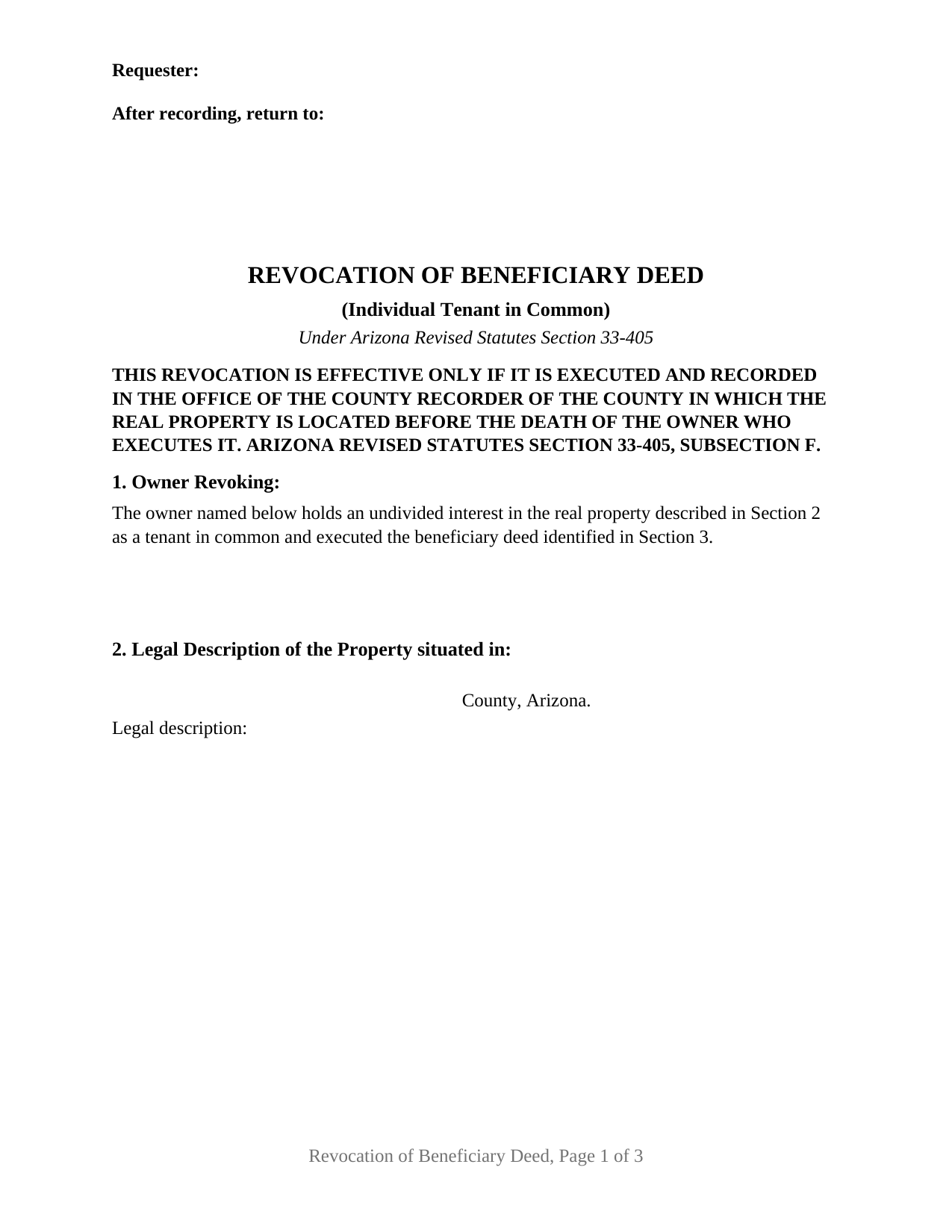
A tenancy in common splits a parcel into shares that move independently, and an Arizona beneficiary deed follows the share rather than the parcel. This form prepares a revocation for that arrangement: an owner holding an undivided fractional interest as a tenant in common, cancelling the beneficiary deed that owner put on record and leaving every other share where the record found it.
A revocation measured by the share, not by the parcel
A.R.S. 33-405(A) passes the interest the owner holds, so a tenant in common who signs a beneficiary deed designates a fraction. The cancellation answers in the same units. Section 4 revokes the identified deed as to the undivided interest of the signing owner, then states plainly that it leaves the deed alive as to any other owner's interest and transfers no interest in the real property. Where three co-owners each hold an undivided third and each recorded a beneficiary deed, one instrument on this form closes one designation and leaves two standing.
Where the last surviving owner rule stops
A.R.S. 33-405(F) opens with a general permission: a beneficiary deed may be revoked at any time by the owner or, where there is more than one owner, by any of the owners who executed it. The sentence after it narrows to survivorship title, where a revocation short of every owner's signature answers to the last surviving owner. A tenancy in common is the estate A.R.S. 33-431(A) supplies by default on a grant to two or more persons, and it carries no survivorship, so that condition speaks to a different vesting. Above the numbered sections the form prints the condition that does govern, in capitals: recorded where the property sits, during the lifetime of the owner who signs.
One fractional owner, one signature block, one certificate
The configuration is printed into the deed rather than left to the person filling it in. Section 1 recites that the owner named below holds an undivided interest in the described property as a tenant in common and executed the beneficiary deed identified in Section 3. Nothing asks the signer to classify an ownership arrangement, and no second name is invited. Beneath the sections sit one signature block headed OWNER and one acknowledgment certificate. Heirs holding a family parcel in unequal shares, two unrelated buyers who split a rental duplex, and a parent and an adult child holding halves acquired years apart all sit in the record as tenants in common, each with a designation that stands or falls alone. This form recites one such owner; survivorship title, and two owners signing across one page, are patterns it is not set up to recite.
Pointing back at the deed being undone
Section 3 collects the identifiers the statutory revocation form in A.R.S. 33-405(L) uses: the date the earlier deed was recorded, a docket or book with a page, an instrument number, and the Arizona county whose records hold it. A.R.S. 11-480(D) adds a rule aimed squarely at paperwork of this kind, under which an instrument that modifies a previously recorded document states the recordation date and the docket and page of what it modifies. A cancellation carrying the recorder's own numbers turns up in the chain where a title examiner will look for it.
What the recorder sees
A.R.S. 11-480 sets the counter standards: a caption naming the nature of the instrument, original signatures, ten point print or larger, a sheet within 8.5 by 14 inches, and two inches held clear at the top of page one. This Arizona revocation of beneficiary deed, searched by some as a beneficiary deed cancellation and by others as a transfer on death deed revocation, prints at twelve point, with the requester and return entries in the left three and one half inches A.R.S. 11-480(C) opens to them. The value affidavit is a separate question: A.R.S. 11-1133(A) attaches that duty to a deed evidencing a transfer of title and to a sale contract, and the guide works through it against an instrument whose own text says it transfers nothing.
Three files arrive: the fillable form, a completed example on a Maricopa County fact pattern, and a guide covering the numbered sections, the certificate and its record identification items, and recording. The package is informational and supplies no legal advice.
Important: County-Specific Forms
Our revocation of beneficiary deed (individual tenant in common) forms are specifically formatted for each of the 15 counties in Arizona.
After selecting your county, you'll receive forms that meet all local recording requirements, ensuring your documents will be accepted without delays or rejection fees.