California Affidavit of Death of Joint Tenant
County Specific Legal Forms Validated as recently as September 17, 2026 by our Forms Development Team
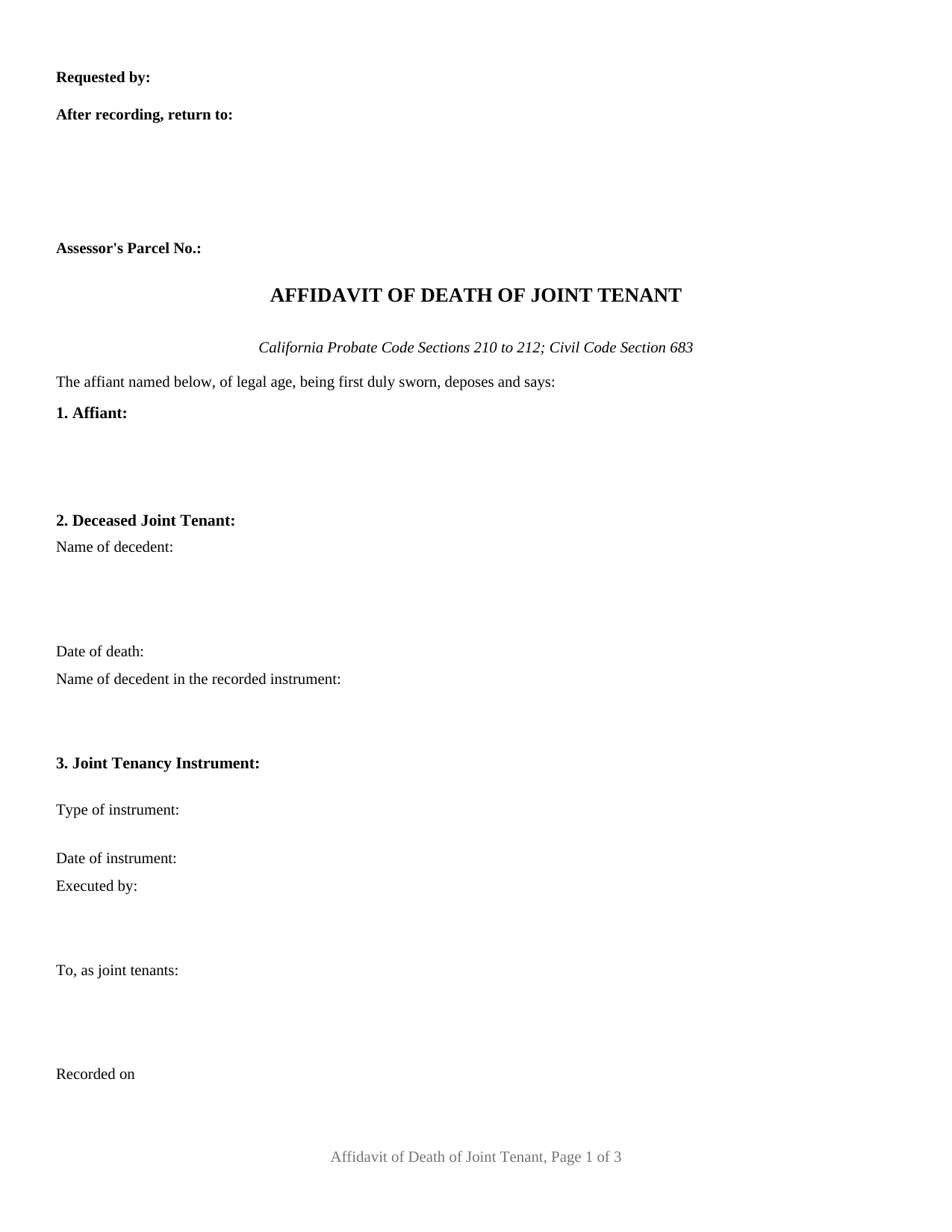
About the California Affidavit of Death of Joint Tenant
How to Use This Form
- Select your county from the list
- Download the county-specific form
- Fill in the required information
- Have the document notarized if required
- Record with your county recorder's office
What Others Like You Are Saying
"The deed is great. However, I do not believe your Statement of Full Consideration is up to date as i…"
"Great service, but still needs some knowledge to complete. Also missing Michigan right to farm parag…"
"They respond fast, the process is simple, and it's obviously convenient. I'm not sure what else ther…"
"I paid for and received the form for a Quit Claim Deed. Hoping it is the form I need to complete my …"
"Thank you so much for making this process seemless. We are very pleased with the service."
4.8/5 from 4,820 reviews. Read all
When a California joint tenant dies, the survivorship built into the title does its work at the moment of death: the deceased owner's interest passes to the surviving joint tenant by operation of law, outside probate. The county land records, though, still show the deceased owner on title. The California Affidavit of Death of Joint Tenant is the one-page sworn statement that closes that gap. Recorded with an attested or certified copy of the death record in the county where the property sits, it places evidence of the death in the chain of title, so the record matches what the law already did.
Prima facie evidence in the county index
The affidavit rests on Probate Code Sections 210 to 212. Section 210 permits any person having knowledge of the facts to record an affidavit of death in the county where the property is located when title to real property is affected by a death; the statute requires a particular description of the real property and an attached attested or certified copy of the record of death. Section 211 directs the county recorder to index the recorded affidavit in the index of grantors and grantees, with the decedent deemed the grantor, which is exactly where a later title search looks. Section 212 then gives the recorded affidavit its force: it is prima facie evidence of the death insofar as it identifies real property in the county whose title the death affects. Title examiners, insurers, and buyers rely on that recorded evidence when the survivor later sells, refinances, or passes the property on.
What the affidavit recites
The core of the document is an identification. Names drift between records: the person on the death certificate and the grantee on a deed recorded decades earlier are often the same human being under slightly different names. The affidavit states, under oath, that the decedent named in the attached death record is the same person named as one of the joint tenants in a described recorded instrument, and it sets out that instrument by type, date, parties, and recording reference, together with the full legal description of the property and the assessor's parcel number. The affiant is most often the surviving joint tenant, but Probate Code Section 210 accepts the sworn statement of any person who knows the facts. Where two or more joint tenants survive, title continues in the survivors, and the same pattern serves each later death in turn.
A sworn statement, not a conveyance
Nothing is granted, sold, or transferred by the affidavit, and that shapes how it is executed and what it costs. Because it is sworn, the certificate on the form is the statutory California jurat under Government Code Section 8202, with the boxed notice, the satisfactory-evidence language, and the oath taken before a notary; the affiant signs in the notary's presence. Because nothing is sold, no documentary transfer tax is due, and transfers occurring by reason of death are exempt under Revenue and Taxation Code Section 11930. The separate property tax reporting still applies: Revenue and Taxation Code Section 480(b) calls for a change in ownership statement within 150 days after the date of death, and county recording counters commonly pair the affidavit with a Preliminary Change of Ownership Report. The affidavit is recorded in the county where the land lies, on letter-size pages with the top of the first page reserved for the recorder's use; base recording fees, the seventy-five dollar Building Homes and Jobs Act fee with its statutory exemptions, and any county fraud-prosecution fee vary by county.
This package contains the fillable affidavit of death of joint tenant form built to California recording standards, a completed example showing a realistic Alameda County fact pattern, and a guide that walks through each section, the certified death certificate attachment, the jurat, and the recording and assessor filings step by step. The materials are informational and are not legal advice; a California attorney can address how the survivorship rules apply to a particular title.
Important: County-Specific Forms
Our affidavit of death of joint tenant forms are specifically formatted for each of the 58 counties in California.
After selecting your county, you'll receive forms that meet all local recording requirements, ensuring your documents will be accepted without delays or rejection fees.