California Waiver of Right to Disclaim
County Specific Legal Forms Validated as recently as September 17, 2026 by our Forms Development Team
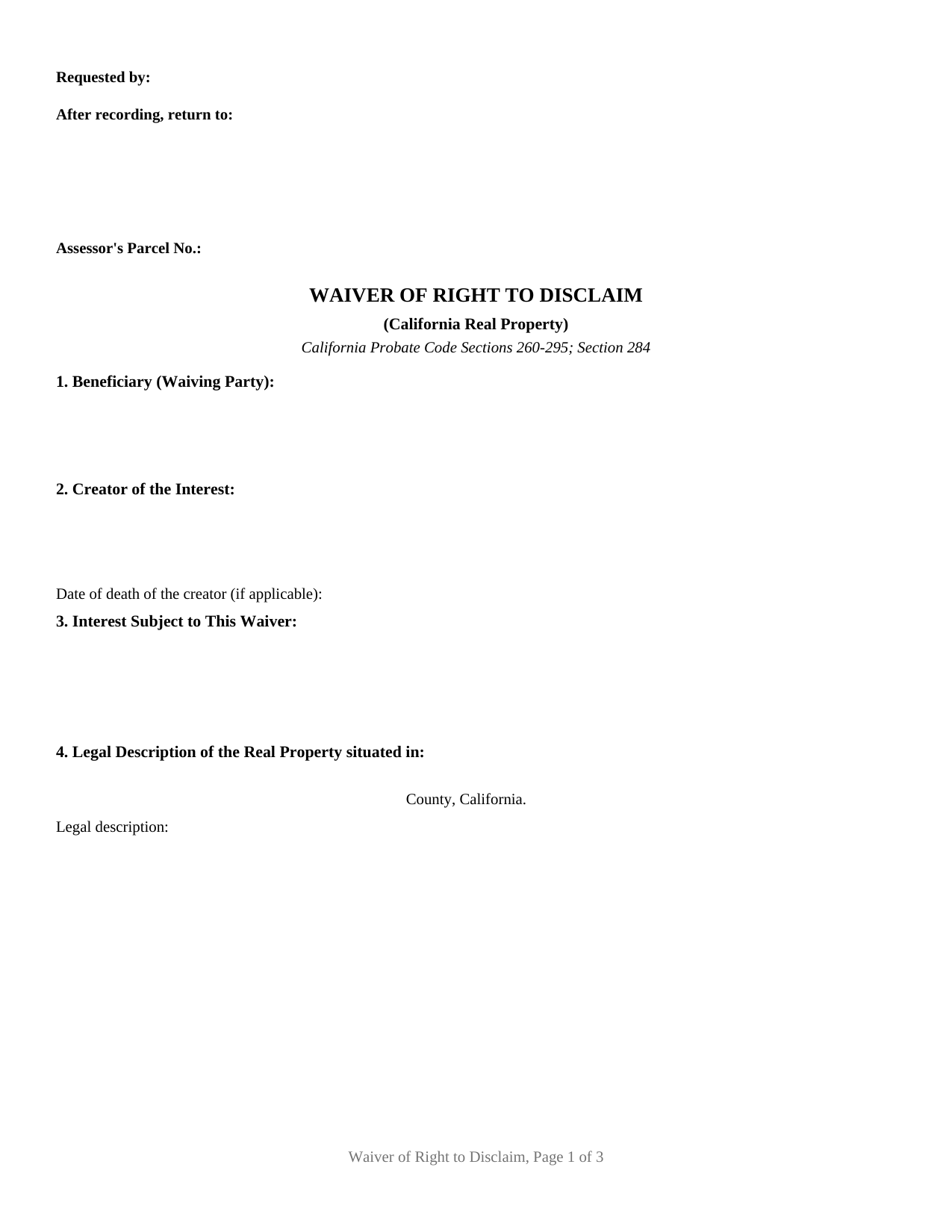
About the California Waiver of Right to Disclaim
How to Use This Form
- Select your county from the list
- Download the county-specific form
- Fill in the required information
- Have the document notarized if required
- Record with your county recorder's office
What Others Like You Are Saying
"very happy so far. Haven't gone to record deeds yet so am in good hopes everything will be in good o…"
"Good organization and guidance."
"A great service, making it fast and easy to prepare warranty deeds for property transfer sales. I re…"
"Thumbs up. Very pleased with service. Easy process."
"Very easy to find my documents, download and print them!"
4.8/5 from 4,818 reviews. Read all
A California waiver of the right to disclaim is the recorded counterpart to a disclaimer of interest: instead of refusing an inheritance, the beneficiary places on record that the inheritance will be kept. Probate Code Section 284 authorizes a person who could file a disclaimer to file, instead, a written waiver of the right to disclaim, and this fillable form prepares that waiver for one beneficiary and a specified interest in California real property.
The mirror image of a disclaimer
Part 8 of Division 2 of the Probate Code, Sections 260 through 295, gives a beneficiary two opposite instruments. A disclaimer declines, refuses, or renounces an interest that would otherwise pass to the beneficiary, so the property moves on as if the beneficiary had predeceased the person who created the interest. The Section 284 waiver runs the other way: it names an interest and gives up the statutory right to refuse it. The chapter reaches interests created under a will, by intestate succession, under a trust, by surviving a joint tenant, and under a transfer on death deed designation, among the categories listed in Section 267, and the waiver form is built for the real property setting, where the county records carry the answer.
Irrevocable once filed, binding on successors
Section 284 attaches hard consequences to a short instrument. Upon being filed as provided in Section 280, the waiver is irrevocable, and it binds the beneficiary and all persons claiming by, through, or under the beneficiary. Section 285(b)(2) adds a third: executing a written waiver under Section 284 counts as acceptance of the interest, and a disclaimer may not be made after the beneficiary has accepted the interest. The record gains certainty. Co-heirs dividing an estate, fiduciaries fixing distributive shares, and title examiners reading the chain all learn that the named interest cannot later be redirected by a disclaimer. That certainty is the instrument's work in settings such as negotiated family settlements, estate administrations closing with fixed distributees, and transactions that price an expected inheritance into the deal.
Specifying the interest
The statute's one content command is that the waiver specify the interest to which it applies, and the form is organized around that command. Its sections collect the beneficiary's name and mailing address, the creator of the interest (the testator, decedent, trustor, deceased joint tenant, or transfer on death transferor, following the definitions in Section 263), a description of the interest and how it arises, and the county, legal description, and street address of the real property, with the assessor's parcel number in the recording block. The operative section then states the waiver in the statute's own terms, states that the instrument is not a disclaimer and conveys nothing, and prints the Section 285 acceptance consequence as a capitalized warning, so the instrument reads complete on its face.
Notarization and the county records
California records acknowledged instruments, and Government Code Section 27287 makes the acknowledgment the gateway to recording. The form ends with the Civil Code Section 1189 certificate of acknowledgment, including the boxed identity notice that statute places at the top of every certificate for an acknowledgment taken in California. The first page reserves the statutory two and one half inch recording space, with the requester, return address, and parcel number lines in its left portion under Government Code Section 27361.6. The completed instrument goes to the county recorder of the county where the property is located. Section 284 also keys irrevocability to filing as provided in Section 280, which lists the superior court handling the estate, the distributing fiduciary, a custodian of the interest, and the creator of the interest as filing places, so a recorded waiver of a probate interest commonly has a counterpart filing in the estate file.
This product delivers the California waiver of right to disclaim as a fillable PDF, a completed example showing a Sonoma County fact pattern, and a guide that walks through each section, the statutes behind it, and the filing and recording steps. Nothing else is included, and the materials are informational only, not legal advice; a California attorney can address how a waiver or a disclaimer operates in a particular estate.
Important: County-Specific Forms
Our waiver of right to disclaim forms are specifically formatted for each of the 58 counties in California.
After selecting your county, you'll receive forms that meet all local recording requirements, ensuring your documents will be accepted without delays or rejection fees.