Mesa County Beneficiary Deed (Tenant in Commons Undivided Interest) Form
Last validated November 8, 2026 by our Forms Development TeamFormatted for recording in Mesa County, for property anywhere in the county: rural and unincorporated areas as well as Clifton, Collbran, De Beque, Fruita, Gateway, Glade Park, Grand Junction, Loma and 5 more.
- 3 documents included
- Immediate PDF download
- Formatting guarantee
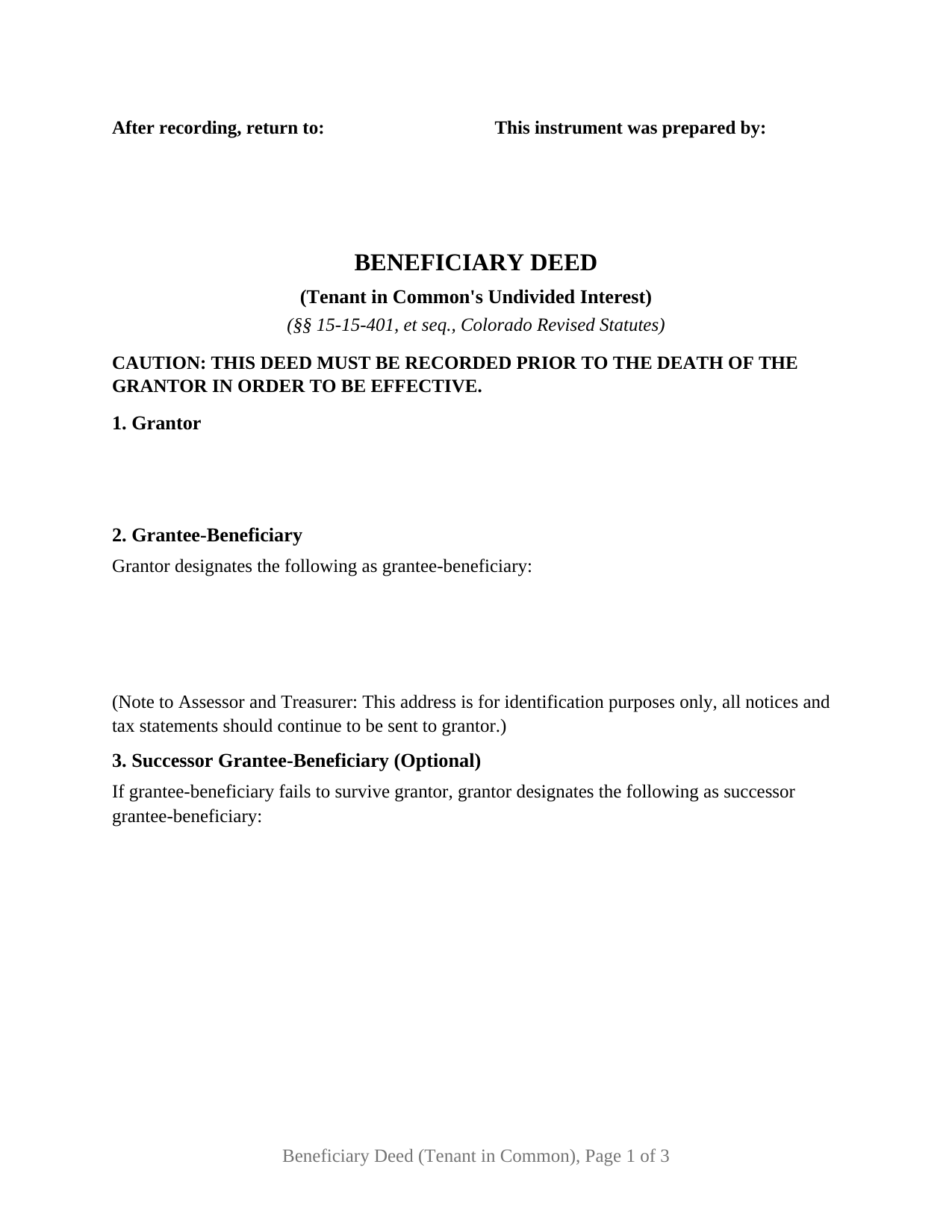
Mesa County Beneficiary Deed (Tenant in Commons Undivided Interest) Form
Fill in the blank Beneficiary Deed (Tenant in Commons Undivided Interest) form formatted to comply with all Colorado recording and content requirements.
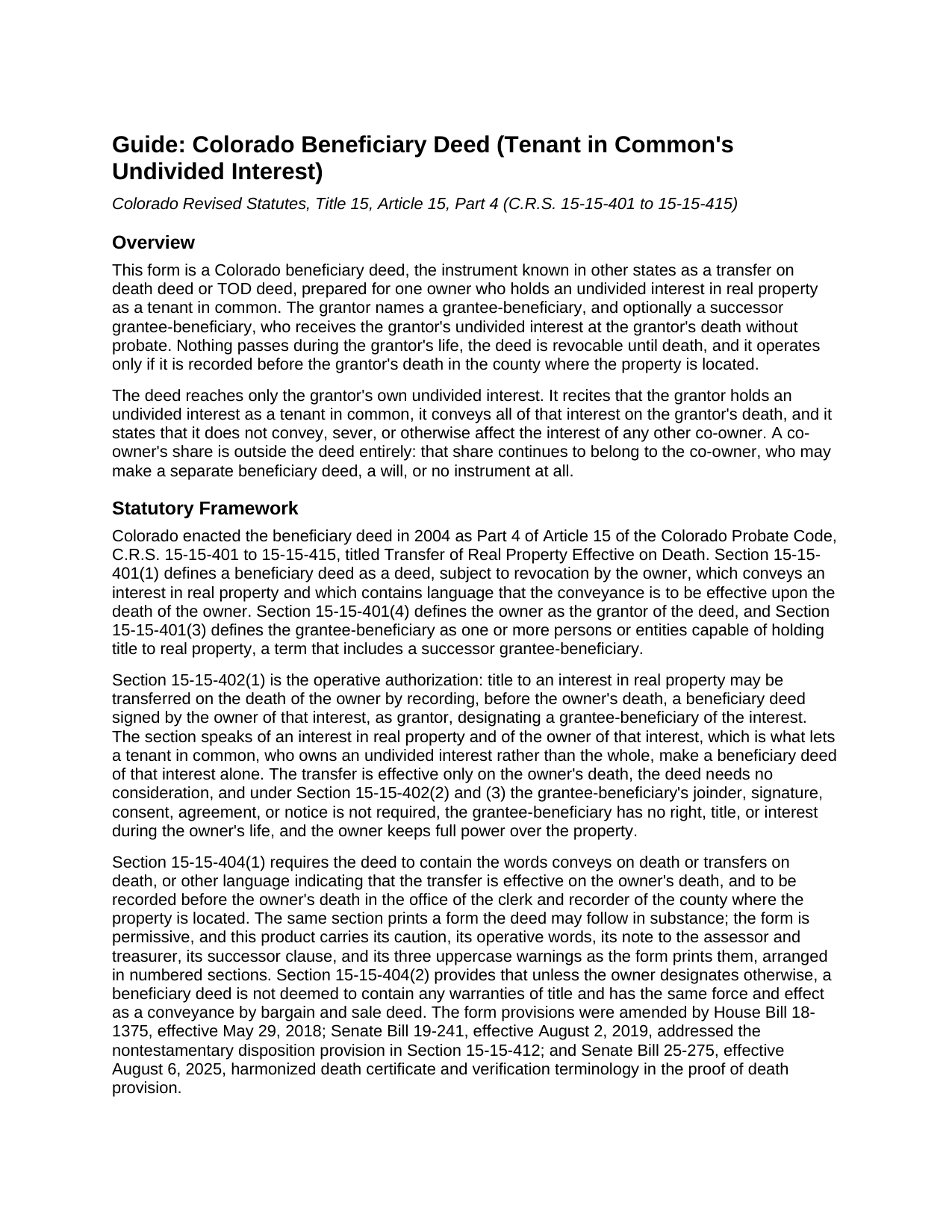
Mesa County Beneficiary Deed (Tenant in Commons Undivided Interest) Guide
Line by line guide explaining every blank on the Beneficiary Deed (Tenant in Commons Undivided Interest) form.
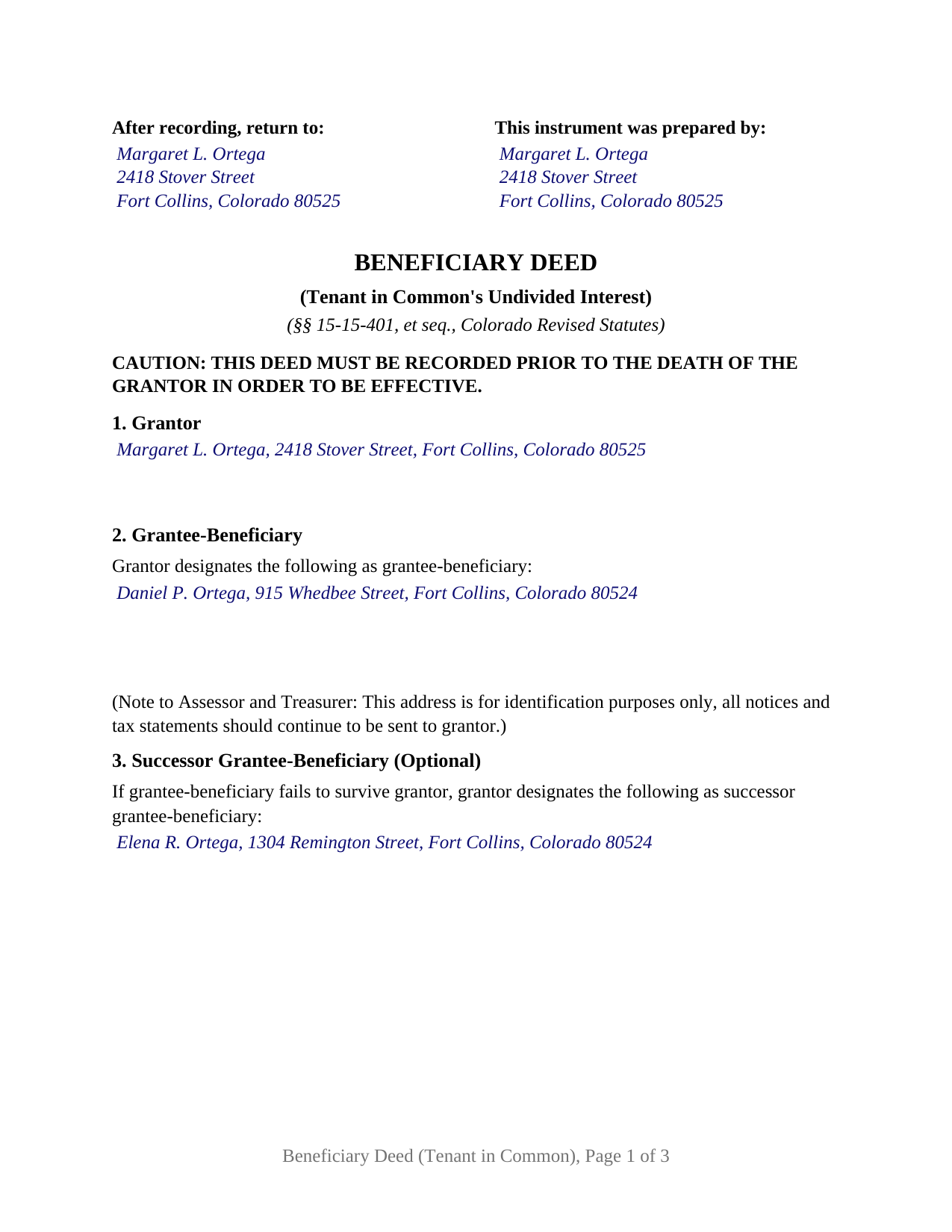
Mesa County Completed Example of the Beneficiary Deed (Tenant in Commons Undivided Interest) Document
Example of a properly completed Colorado Beneficiary Deed (Tenant in Commons Undivided Interest) document for reference.
All 3 documents above included • One-time purchase • No recurring fees
Immediate Download • Secure Checkout
Additional Colorado and Mesa County documents included at no extra charge:
Where to Record Your Documents
Mesa County Clerk & Recorder
Grand Junction, Colorado 81501
Hours: 8:00 to 4:30 Monday - Friday
Phone: (970) 244-1679
Mailing Address: Dept. 5007
Grand Junction, Colorado 81502-5001
Hours:
Phone:
Recording Tips for Mesa County:
- Bring your driver's license or state-issued photo ID
- Ensure all signatures are in blue or black ink
- Leave recording info boxes blank - the office fills these
- Make copies of your documents before recording - keep originals safe
- Recorded documents become public record - avoid including SSNs
Cities and Jurisdictions in Mesa County
Properties in any of these areas use Mesa County forms:
- Clifton
- Collbran
- De Beque
- Fruita
- Gateway
- Glade Park
- Grand Junction
- Loma
- Mack
- Mesa
- Molina
- Palisade
- Whitewater
Hours, fees, requirements, and more for Mesa County
How do I get my forms?
Forms are available for immediate download after payment. The Mesa County forms will be in your account ready to download to your computer. An account is created for you during checkout if you don't have one. Forms are NOT emailed.
Are these forms guaranteed to be recordable in Mesa County?
Yes. Our form blanks are guaranteed to meet or exceed the applicable formatting requirements used for recording in Mesa County, including margin requirements, font requirements, and other layout standards. This guarantee applies to formatting, not to the legal sufficiency of information entered by the user or the suitability of a form for a particular transaction.
Can I reuse these forms?
Yes. You can reuse the forms for your personal use. For example, if you have multiple properties in Mesa County you only need to order once.
What do I need to use these forms?
The forms are PDFs that you fill out on your computer. The free Adobe Acrobat Reader is recommended, and most PDF apps also work. You do NOT enter your property information online - you download the blank forms and complete them privately on your own computer.
Are there any recurring fees?
No. This is a one-time purchase. Nothing to cancel, no memberships, no recurring fees.
How much does it cost to record in Mesa County?
Recording fees in Mesa County vary. Contact the recorder's office at (970) 244-1679 for current fees.
Questions answered? Let's get started!
A Colorado beneficiary deed, the instrument many people search for as a Colorado transfer on death deed or TOD deed, lets an owner name who receives real property at death without probate. This version of the deed recites one specific owner: a tenant in common, who holds an undivided interest in the property alongside one or more co-owners, and it conveys that undivided interest, and nothing more, to a named grantee-beneficiary at death. The deed recites the tenancy in common, conveys all of the grantor's undivided interest on the grantor's death, and states on its face that it does not convey, sever, or otherwise affect the interest of any other co-owner.
One owner, one undivided share
Colorado's beneficiary deed chapter, C.R.S. 15-15-401 to 15-15-415, is written around an interest in real property rather than a parcel. Section 15-15-402(1) allows title to an interest in real property to be transferred on the owner's death by recording, before that death, a beneficiary deed signed by the owner of the interest as grantor. A tenant in common owns exactly such an interest: an undivided share of the whole, with no right of survivorship between co-owners, so that each co-owner's share passes at that co-owner's death through that co-owner's own estate or nonprobate arrangement. Colorado presumes a tenancy in common whenever a deed names two or more grantees without declaring a joint tenancy, which is why siblings who inherited a family home, friends who bought together, and co-owners whose deed reads as tenants in common hold title this way more often than they realize.
The deed does not ask for the size of the share. It conveys all of the grantor's undivided interest, whatever fraction that turns out to be at death, which matches the statute's own measure: the owner's interest. The recorded vesting deed shows the fraction, and the beneficiary deed leaves that record undisturbed.
What the deed leaves alone
The point of a tenant in common configuration is the line it draws. A co-owner is not a party to the deed, signs nothing, and keeps the co-owner's own undivided interest exactly as before. The deed creates no survivorship between the grantor and the co-owner, so the co-owner takes nothing under it, and the grantee-beneficiary who takes the grantor's share at death steps into the tenancy in common beside the surviving co-owner. The chapter's special rule for joint tenants, Section 15-15-408, under which a joint tenant's beneficiary deed is effective only if that joint tenant is the last joint tenant to die, has no counterpart for a tenant in common; the undivided interest passes at the grantor's own death under the general rule.
The grantee-beneficiary and a successor
Section 2 of the deed designates the grantee-beneficiary by name and legal address, in the words the statutory form in Section 15-15-404(1) uses, and carries that form's note to the assessor and treasurer, which keeps tax statements and notices flowing to the grantor during life. The address is more than a courtesy: Section 38-35-109(2) sends a deed back unrecorded when it omits the grantee's legal address, and Section 15-15-406 applies that rule to beneficiary deeds. One or more persons or entities capable of holding title may be named, and a trust may be named as the trust. Where more than one grantee-beneficiary is named and one does not survive the grantor, Section 15-15-407(5) adds that share proportionately to the survivors unless the deed says otherwise, and Colorado's anti-lapse statute does not apply.
Section 3 is the statutory form's optional successor clause, a fixed sentence with the successor grantee-beneficiary's name and address as its blank: if the grantee-beneficiary fails to survive the grantor, the successor takes. An unused Section 3 reads None designated.
Revocable until death, effective only when recorded
During the grantor's life the deed changes nothing. Section 15-15-402(3) leaves the owner with full power over the property, without the grantee-beneficiary's joinder, consent, or notice, and the grantee-beneficiary has no right, title, or interest until death. The deed is revocable under Section 15-15-405 by a recorded revocation or by a later recorded beneficiary deed for the same property, and a will cannot revoke it. The one condition that cannot be cured later is recording: under Sections 15-15-402(1) and 15-15-404(1) the deed must be recorded before the grantor's death in the office of the clerk and recorder of the county where the property is located, and the deed prints the statutory caution to that effect directly beneath its title. The deed also prints the statutory form's three uppercase warnings, that it is revocable and transfers no ownership until death, that executing it may affect Medicaid eligibility, and that it may not avoid probate.
What the grantee-beneficiary takes
Under Section 15-15-407, title to the undivided interest vests in the grantee-beneficiary only at the grantor's death, subject to every mortgage, lien, contract, easement, and other interest affecting title, whether recorded before or after the beneficiary deed, and subject to the state's claim for recovery of medical assistance payments. A person holding an unrecorded interest records notice of it within four months after the death or is barred against persons without notice. Section 15-15-404(2) makes the deed a conveyance without warranties of title, with the force of a bargain and sale deed, unless the owner designates otherwise, and this deed designates none.
Recording in Colorado
Because a beneficiary deed needs no consideration, no state documentary fee is due and no Real Property Transfer Declaration (TD-1000) accompanies it; Section 39-14-101(2) defines the document that needs a declaration as one on which the documentary fee is imposed. The deed is formatted to the margin rule of Section 30-10-406(3)(a), a one inch top margin on every page and half inch side and bottom margins, with the first page's top inch left clear for the recording information, and it carries the grantor's acknowledgment certificate in the short form Colorado's notarial law supplies. Recording fees are set by statute and appear on each county's fee schedule.
The package includes the fillable beneficiary deed, a completed example filled in for a realistic Larimer County fact pattern, and the guide that walks through every numbered section, the signing and notarization rules, and the recording process. This description and the guide describe the form and the governing Colorado statutes in general terms; they are not legal advice.
Important: Your property must be located in Mesa County to use these forms. Documents should be recorded at the county recording office listed above.
This Beneficiary Deed (Tenant in Commons Undivided Interest) meets all recording requirements specific to Mesa County.
Our Promise
The documents you receive here are guaranteed to meet or exceed the applicable Mesa County recording format requirements. If there is a rejection caused by our formatting, we will correct the issue or refund your payment. This guarantee applies to document formatting only and does not extend to information entered by the user, the selection of the form, or the legal effect of the completed document.
Save Time and Money
Get your Mesa County Beneficiary Deed (Tenant in Commons Undivided Interest) form done right the first time with Deeds.com Uniform Conveyancing Blanks. At Deeds.com, we understand that your time and money are valuable resources, and we don't want you to face a penalty fee or rejection imposed by a county recorder for submitting nonstandard documents. We constantly review and update our forms to meet rapidly changing state and county recording requirements for roughly 3,500 counties and local jurisdictions.
4.8 out of 5 - ( 4,847 Reviews )
Paula V. 5 out of 5 stars
Fast, easy, helpful instructions. I’ll use them again!
Thank you for your feedback. We really appreciate it. Have a great day!
Cindy A. 5 out of 5 stars
Needed a deed and the form provided with example and guide were of the most help. Thank you
Thank you, Cindy! We’re so glad the form, example, and guide were helpful in getting your deed taken care of. We appreciate your feedback!
Barry B. 5 out of 5 stars
Convenient and easy.
Thank you!
Debora E. 5 out of 5 stars
I was amazed! This company is so incredibly fast! They promised 10 minutes, it was actually less and I had the exact info I was needing! Definitely worth the cost!
We appreciate your business and value your feedback. Thank you. Have a wonderful day!
carol g. 5 out of 5 stars
very good. got my info in minuetes. thank you
Thank you for your feedback Carol, have a great day!
Gertrude M. 5 out of 5 stars
Rating 5 stars
Thank you!
Kimberly B. 5 out of 5 stars
Absolutely recommend Deeds.com! The process to recording your document is explained step by step. If you have any questions, you just send a message and almost instantly a staff member will reply. Super quick processing. I uploaded my document late Friday afternoon, it was reviewed by Deeds.com staff and sent to the county for recording on Monday. By Tuesday, my document was successfully recorded by the County Recorder's Office and a copy of my recorded document was available for me, as well!
We appreciate your business and value your feedback. Thank you. Have a wonderful day!
Jim L. 5 out of 5 stars
Very easy to use - the completed sample was super useful
We appreciate your business and value your feedback. Thank you. Have a wonderful day!
STEPHEN C. 5 out of 5 stars
Excellent service. Easy to use. Thank you.
We appreciate your business and value your feedback. Thank you. Have a wonderful day!
Daniel D. 5 out of 5 stars
Easier than I expected. I followed the downloaded examples step by step, and before I knew it, the form was completed correctly and good to go. Thank you, Daniel D.
We appreciate your business and value your feedback. Thank you. Have a wonderful day!
Johnnie G. 3 out of 5 stars
We had hoped, as this was direct through our State recorder's office, State-specific data would be pre-filled in. Also there is no help when transferring the home title from a Revocable Trust to the living Trustee and new spouse (no example given, no help for which code to use). And the example doesn't match the prior deed revision format submitted by our attorney. So, not the best experience. We may have to get an attorney involved...what we were hoping to avoid
Thank you for your feedback. We really appreciate it. Have a great day!
Douglas C. 5 out of 5 stars
Even for a novice like me, this site was easy to use, with very clear & simple options and instructions. I wish every web site was as good!
Thank you for your feedback. We really appreciate it. Have a great day!
Lori A. 5 out of 5 stars
It was quick and easy. A little expensive but convient
We appreciate your business and value your feedback. Thank you. Have a wonderful day!
Michael V. 5 out of 5 stars
Exactly what I needed and VERY fair price. I paid $19.97 for what a local attorney wanted $200 to do. I filled out the form using the line by line guide and filed it at the court house today. Absolutely no problems.
We appreciate your business and value your feedback. Thank you. Have a wonderful day!
Frank H. 4 out of 5 stars
Form and instructions were useful. But I suggest creating a form for transferring a deed pursuant to a trust. The existing form is based on a will going through probate so it doesn't fit the trust situation in some respects.
Thank you for your feedback. We really appreciate it. Have a great day!