Colorado Beneficiary Deed (Tenant in Commons Undivided Interest)
County Specific Legal Forms Validated as recently as November 8, 2026 by our Forms Development Team
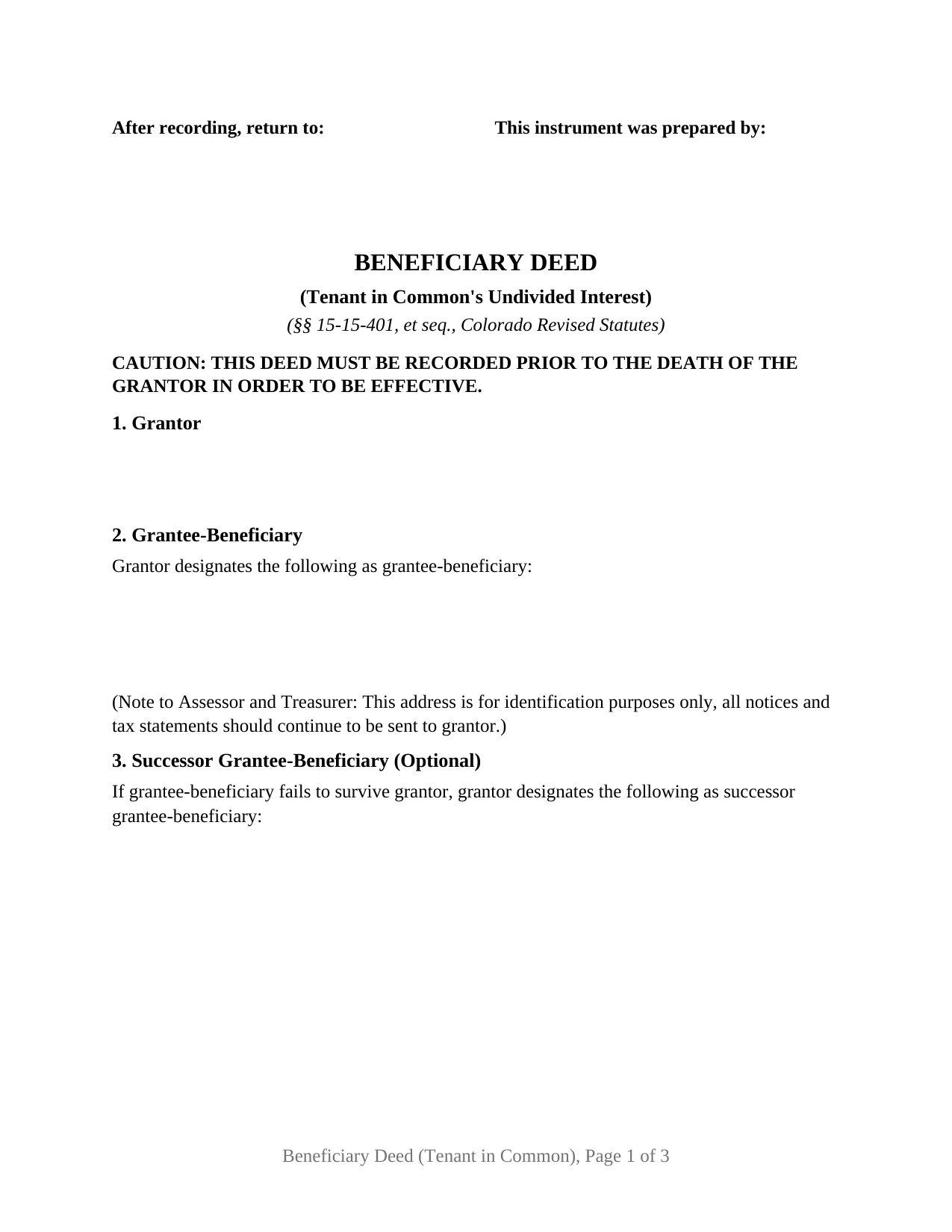
About the Colorado Beneficiary Deed (Tenant in Commons Undivided Interest)
How to Use This Form
- Select your county from the list
- Download the county-specific form
- Fill in the required information
- Have the document notarized if required
- Record with your county recorder's office
What Others Like You Are Saying
"The whole experience was amazing. Your site was easy to work with and the staff was supper responsiv…"
"Your service was easy to use and fee was reasonable. I would recommend to other lawyers who are in p…"
"we are hoping this is what we need. Thanks"
"Prompt, accurate and professional response. Thank you. Kelin F."
"Deeds.com made it so easy to file my paper work with the county. It saved me half a days travel and …"
4.8/5 from 4,847 reviews. Read all
A Colorado beneficiary deed, the instrument many people search for as a Colorado transfer on death deed or TOD deed, lets an owner name who receives real property at death without probate. This version of the deed recites one specific owner: a tenant in common, who holds an undivided interest in the property alongside one or more co-owners, and it conveys that undivided interest, and nothing more, to a named grantee-beneficiary at death. The deed recites the tenancy in common, conveys all of the grantor's undivided interest on the grantor's death, and states on its face that it does not convey, sever, or otherwise affect the interest of any other co-owner.
One owner, one undivided share
Colorado's beneficiary deed chapter, C.R.S. 15-15-401 to 15-15-415, is written around an interest in real property rather than a parcel. Section 15-15-402(1) allows title to an interest in real property to be transferred on the owner's death by recording, before that death, a beneficiary deed signed by the owner of the interest as grantor. A tenant in common owns exactly such an interest: an undivided share of the whole, with no right of survivorship between co-owners, so that each co-owner's share passes at that co-owner's death through that co-owner's own estate or nonprobate arrangement. Colorado presumes a tenancy in common whenever a deed names two or more grantees without declaring a joint tenancy, which is why siblings who inherited a family home, friends who bought together, and co-owners whose deed reads as tenants in common hold title this way more often than they realize.
The deed does not ask for the size of the share. It conveys all of the grantor's undivided interest, whatever fraction that turns out to be at death, which matches the statute's own measure: the owner's interest. The recorded vesting deed shows the fraction, and the beneficiary deed leaves that record undisturbed.
What the deed leaves alone
The point of a tenant in common configuration is the line it draws. A co-owner is not a party to the deed, signs nothing, and keeps the co-owner's own undivided interest exactly as before. The deed creates no survivorship between the grantor and the co-owner, so the co-owner takes nothing under it, and the grantee-beneficiary who takes the grantor's share at death steps into the tenancy in common beside the surviving co-owner. The chapter's special rule for joint tenants, Section 15-15-408, under which a joint tenant's beneficiary deed is effective only if that joint tenant is the last joint tenant to die, has no counterpart for a tenant in common; the undivided interest passes at the grantor's own death under the general rule.
The grantee-beneficiary and a successor
Section 2 of the deed designates the grantee-beneficiary by name and legal address, in the words the statutory form in Section 15-15-404(1) uses, and carries that form's note to the assessor and treasurer, which keeps tax statements and notices flowing to the grantor during life. The address is more than a courtesy: Section 38-35-109(2) sends a deed back unrecorded when it omits the grantee's legal address, and Section 15-15-406 applies that rule to beneficiary deeds. One or more persons or entities capable of holding title may be named, and a trust may be named as the trust. Where more than one grantee-beneficiary is named and one does not survive the grantor, Section 15-15-407(5) adds that share proportionately to the survivors unless the deed says otherwise, and Colorado's anti-lapse statute does not apply.
Section 3 is the statutory form's optional successor clause, a fixed sentence with the successor grantee-beneficiary's name and address as its blank: if the grantee-beneficiary fails to survive the grantor, the successor takes. An unused Section 3 reads None designated.
Revocable until death, effective only when recorded
During the grantor's life the deed changes nothing. Section 15-15-402(3) leaves the owner with full power over the property, without the grantee-beneficiary's joinder, consent, or notice, and the grantee-beneficiary has no right, title, or interest until death. The deed is revocable under Section 15-15-405 by a recorded revocation or by a later recorded beneficiary deed for the same property, and a will cannot revoke it. The one condition that cannot be cured later is recording: under Sections 15-15-402(1) and 15-15-404(1) the deed must be recorded before the grantor's death in the office of the clerk and recorder of the county where the property is located, and the deed prints the statutory caution to that effect directly beneath its title. The deed also prints the statutory form's three uppercase warnings, that it is revocable and transfers no ownership until death, that executing it may affect Medicaid eligibility, and that it may not avoid probate.
What the grantee-beneficiary takes
Under Section 15-15-407, title to the undivided interest vests in the grantee-beneficiary only at the grantor's death, subject to every mortgage, lien, contract, easement, and other interest affecting title, whether recorded before or after the beneficiary deed, and subject to the state's claim for recovery of medical assistance payments. A person holding an unrecorded interest records notice of it within four months after the death or is barred against persons without notice. Section 15-15-404(2) makes the deed a conveyance without warranties of title, with the force of a bargain and sale deed, unless the owner designates otherwise, and this deed designates none.
Recording in Colorado
Because a beneficiary deed needs no consideration, no state documentary fee is due and no Real Property Transfer Declaration (TD-1000) accompanies it; Section 39-14-101(2) defines the document that needs a declaration as one on which the documentary fee is imposed. The deed is formatted to the margin rule of Section 30-10-406(3)(a), a one inch top margin on every page and half inch side and bottom margins, with the first page's top inch left clear for the recording information, and it carries the grantor's acknowledgment certificate in the short form Colorado's notarial law supplies. Recording fees are set by statute and appear on each county's fee schedule.
The package includes the fillable beneficiary deed, a completed example filled in for a realistic Larimer County fact pattern, and the guide that walks through every numbered section, the signing and notarization rules, and the recording process. This description and the guide describe the form and the governing Colorado statutes in general terms; they are not legal advice.
Important: County-Specific Forms
Our beneficiary deed (tenant in commons undivided interest) forms are specifically formatted for each of the 64 counties in Colorado.
After selecting your county, you'll receive forms that meet all local recording requirements, ensuring your documents will be accepted without delays or rejection fees.