Rio Blanco County Beneficiary Deed (Trust Beneficiary) Form
Last validated November 8, 2026 by our Forms Development TeamFormatted for recording in Rio Blanco County, for property anywhere in the county: rural and unincorporated areas as well as Meeker, Rangely.
- 3 documents included
- Immediate PDF download
- Formatting guarantee
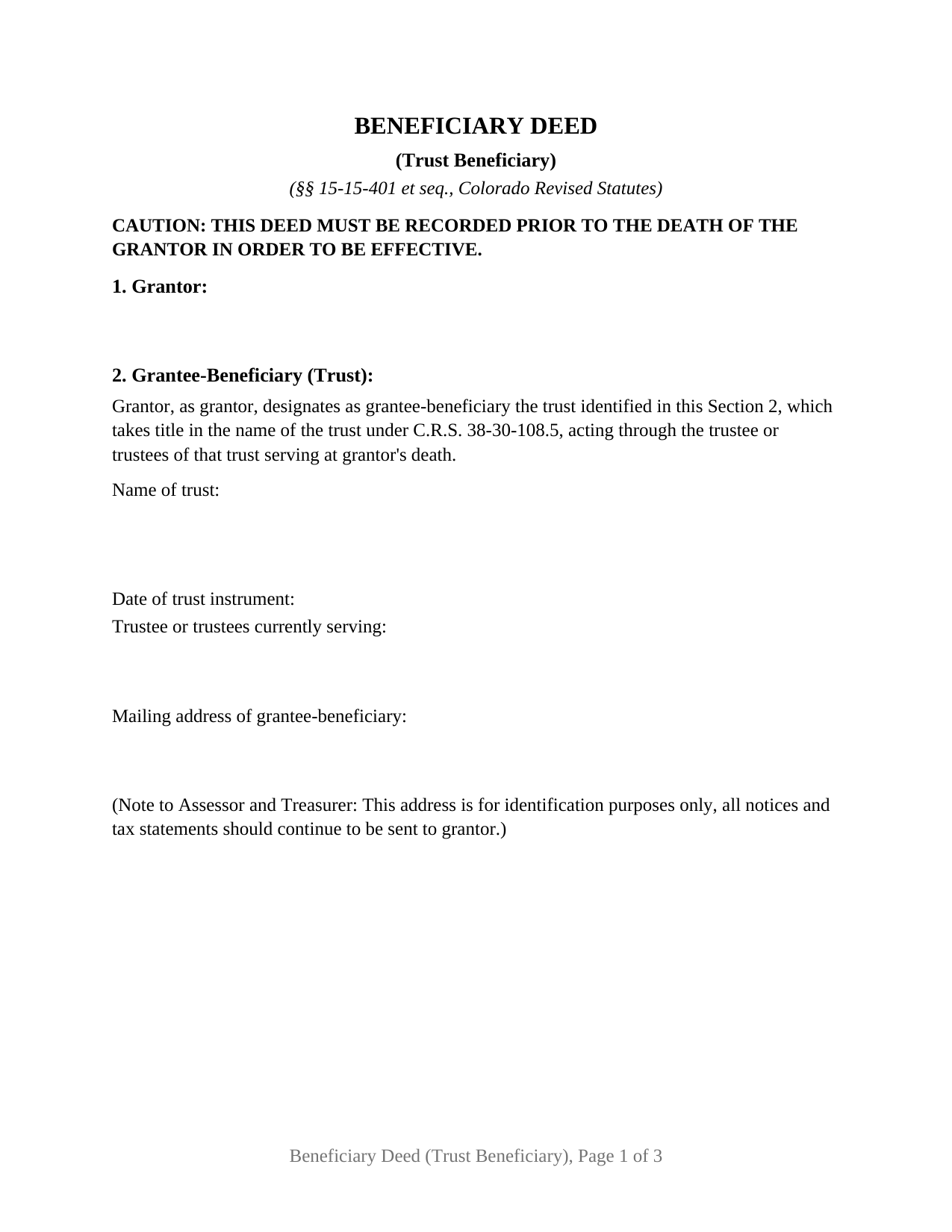
Rio Blanco County Beneficiary Deed (Trust Beneficiary) Form
Fill in the blank Beneficiary Deed (Trust Beneficiary) form formatted to comply with all Colorado recording and content requirements.
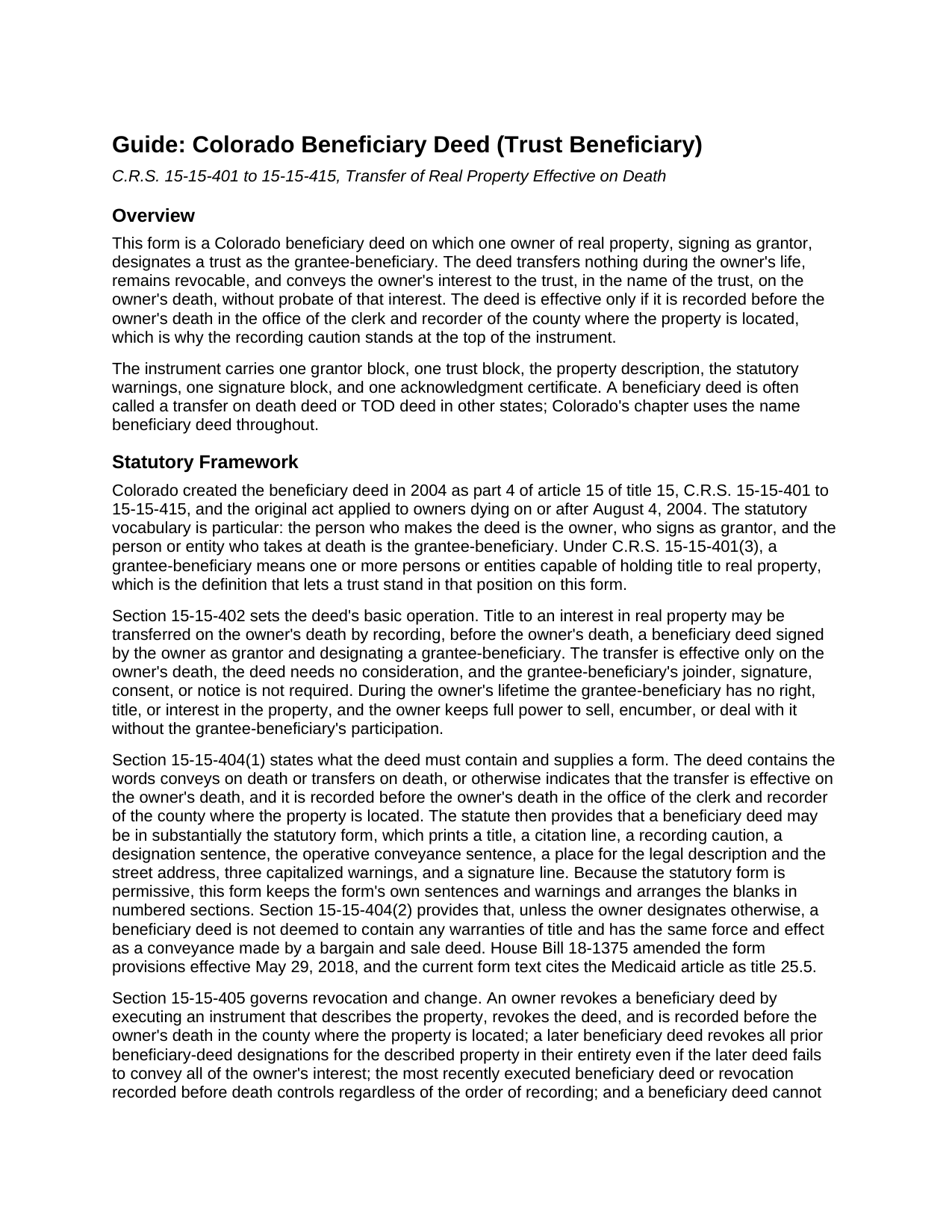
Rio Blanco County Beneficiary Deed (Trust Beneficiary) Guide
Line by line guide explaining every blank on the Beneficiary Deed (Trust Beneficiary) form.
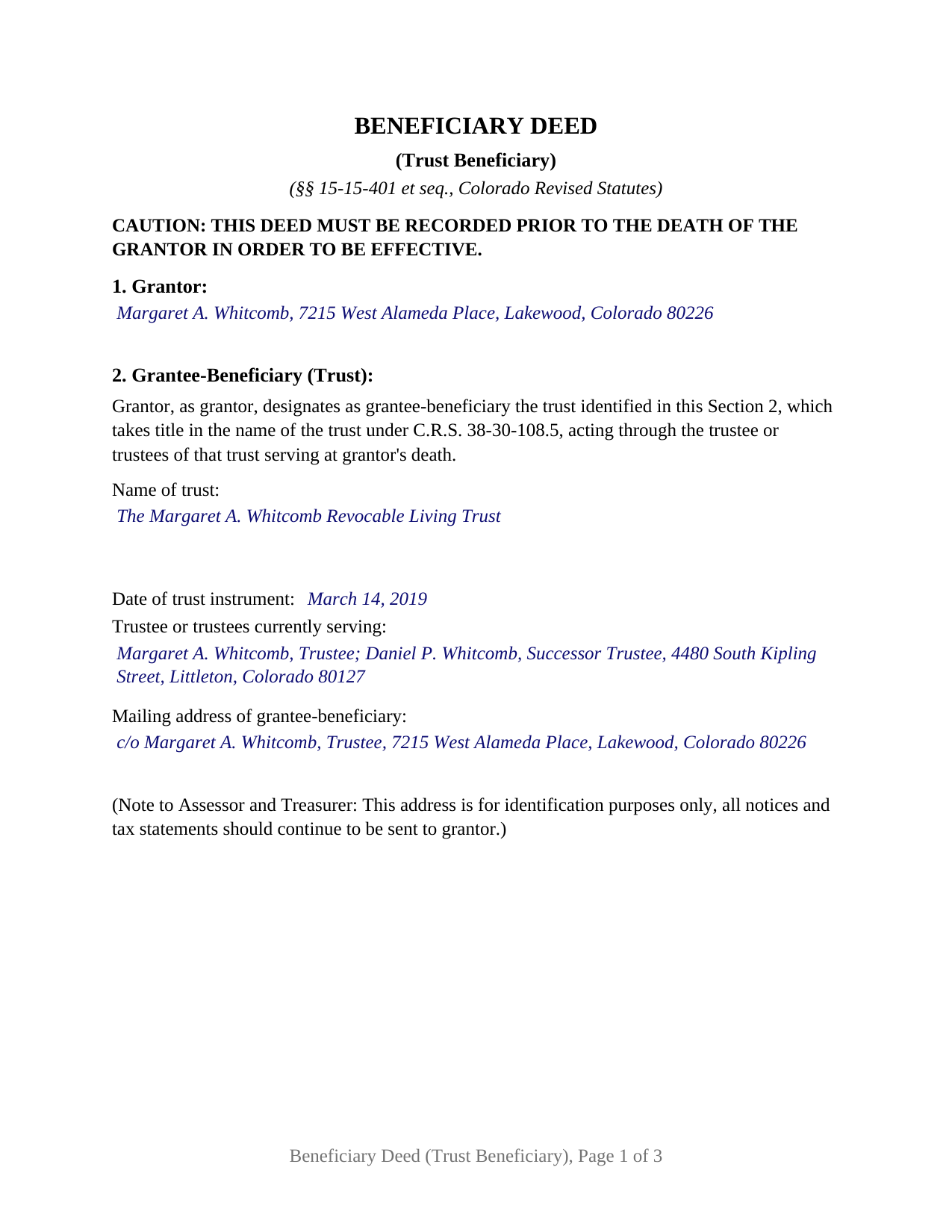
Rio Blanco County Completed Example of the Beneficiary Deed (Trust Beneficiary) Document
Example of a properly completed Colorado Beneficiary Deed (Trust Beneficiary) document for reference.
All 3 documents above included • One-time purchase • No recurring fees
Immediate Download • Secure Checkout
Additional Colorado and Rio Blanco County documents included at no extra charge:
Where to Record Your Documents
Rio Blanco Clerk and Recorder
Meeker, Colorado 81641
Hours: 8:30 to 4:30 Monday through Friday
Phone: (970) 878-9460
Rangely Branch Office
Rangely, Colorado 81648
Hours: 8:30 to 4:30 M-F
Phone: (970) 878-9465
Recording Tips for Rio Blanco County:
- Bring your driver's license or state-issued photo ID
- Ensure all signatures are in blue or black ink
- Documents must be on 8.5 x 11 inch white paper
- Double-check legal descriptions match your existing deed
- Verify all names are spelled correctly before recording
Cities and Jurisdictions in Rio Blanco County
Properties in any of these areas use Rio Blanco County forms:
- Meeker
- Rangely
Hours, fees, requirements, and more for Rio Blanco County
How do I get my forms?
Forms are available for immediate download after payment. The Rio Blanco County forms will be in your account ready to download to your computer. An account is created for you during checkout if you don't have one. Forms are NOT emailed.
Are these forms guaranteed to be recordable in Rio Blanco County?
Yes. Our form blanks are guaranteed to meet or exceed the applicable formatting requirements used for recording in Rio Blanco County, including margin requirements, font requirements, and other layout standards. This guarantee applies to formatting, not to the legal sufficiency of information entered by the user or the suitability of a form for a particular transaction.
Can I reuse these forms?
Yes. You can reuse the forms for your personal use. For example, if you have multiple properties in Rio Blanco County you only need to order once.
What do I need to use these forms?
The forms are PDFs that you fill out on your computer. The free Adobe Acrobat Reader is recommended, and most PDF apps also work. You do NOT enter your property information online - you download the blank forms and complete them privately on your own computer.
Are there any recurring fees?
No. This is a one-time purchase. Nothing to cancel, no memberships, no recurring fees.
How much does it cost to record in Rio Blanco County?
Recording fees in Rio Blanco County vary. Contact the recorder's office at (970) 878-9460 for current fees.
Questions answered? Let's get started!
A Colorado beneficiary deed can name a trust, rather than a person, to receive real property when the owner dies. This form prepares that deed under C.R.S. 15-15-401 to 15-15-415: one owner signs as grantor, designates a trust as the grantee-beneficiary, and the owner's interest in the property passes to the trust, in the name of the trust, on the owner's death and outside probate. Colorado calls the instrument a beneficiary deed; the same device is known elsewhere as a transfer on death deed or TOD deed.
A designation the trust never signs
The Colorado chapter builds the beneficiary deed around the owner alone. Under C.R.S. 15-15-402, the deed is signed by the owner of the interest as grantor, the transfer is effective only on the owner's death, no consideration is required, and the joinder, signature, consent, or notice of the grantee-beneficiary is not required. During the owner's lifetime the trust named in the deed has no right, title, or interest in the property, and the owner keeps full power to sell, mortgage, lease, or deal with it without the trustee's participation. The deed is revocable at any time by a recorded revocation or by a later recorded beneficiary deed, which under C.R.S. 15-15-405(2) revokes every earlier grantee-beneficiary designation for the same property. A will cannot revoke, alter, or amend it; C.R.S. 15-15-405(4) says so in terms.
The form carries the sentences the statutory form in C.R.S. 15-15-404(1) prints: the recording caution at the top, the operative words by which the grantor transfers, sells, and conveys on grantor's death to the grantee-beneficiary, and the three capitalized warnings on revocability, Medicaid eligibility, and probate. The statutory form is permissive, so the house arranges its blanks in numbered sections while keeping the statute's own words where they do legal work.
Title that vests in the name of the trust
Colorado lets a trust hold real property in its own name. C.R.S. 38-30-108.5(1) provides that a trust may acquire, convey, encumber, lease, or otherwise deal with any interest in real property in the name of the trust, and subsection (2) lets any trustee record a statement of authority under C.R.S. 38-30-172 to evidence the trust's existence and the trustee's authority. A companion statute, C.R.S. 38-30-108, governs an instrument whose grantee is described as trustee: the instrument also identifies the trust or the person represented, or the description is presumed to be of the person only. This form answers both statutes at once. Its trust section collects the trust's name, the date of its trust instrument, the trustee or trustees currently serving, and a mailing address for the trust, and its fixed text designates the trust as grantee-beneficiary taking title in the name of the trust and acting through the trustees serving at the grantor's death.
The address line matters for recording as well as identification. C.R.S. 38-35-109(2) requires every recorded deed to include the grantee's legal address and directs the clerk to return a deed that lacks one, and C.R.S. 15-15-406 applies that rule to beneficiary deeds expressly. The statutory form's own note to the assessor and treasurer follows the address, stating that it is for identification only and that notices and tax statements continue to go to the grantor.
Why the deed reaches the clerk before the owner dies
Recording is not a formality here; it is the condition on which the deed works. C.R.S. 15-15-404(1) requires the beneficiary deed to be recorded before the owner's death in the office of the clerk and recorder of the county where the property is located, and a deed left unrecorded at death transfers nothing, however carefully it was signed and notarized. The same timing governs any later revocation, and the most recently executed deed or revocation recorded before death controls under C.R.S. 15-15-405(3). The recording fee is a flat per-document charge under C.R.S. 30-1-103 as amended in 2025, quoted on most county schedules at forty-three dollars with the C.R.S. 30-10-421 surcharges. Colorado's documentary fee under C.R.S. 39-13-102 is imposed where consideration exceeds five hundred dollars, and a beneficiary deed needs no consideration at all, so the deed is ordinarily presented with no documentary fee due.
What the trust takes at the owner's death
Under C.R.S. 15-15-407(1), title vests in the grantee-beneficiary only on the owner's death. The trust takes the owner's interest subject to every conveyance, encumbrance, mortgage, lien, contract, and other interest affecting title at that moment, whether created before or after the deed was recorded, under C.R.S. 15-15-407(2), and subject to the state's Medicaid recovery claim under subsection (4). The deed carries no warranties of title and has the effect of a bargain and sale deed under C.R.S. 15-15-404(2). After the death, the trustee records proof of death in the manner used for a deceased joint tenant under C.R.S. 15-15-413 and 38-31-102, and a holder of an unrecorded interest has four months after the death to record notice of it under C.R.S. 15-15-407(3). The trust instrument, not the deed, then says what the trustee does with the property.
The one-grantor, one-trust configuration
The form recites exactly one grantor, a natural person signing in his or her own name, and exactly one grantee-beneficiary, a trust. It prints no marital status and no term of the trust; the grantor may be married or unmarried, and the trust may be the grantor's own revocable living trust, an irrevocable trust, or a trust someone else created. It carries one signature block and one acknowledgment certificate. An owner who holds property in his or her own name and wants it to reach an existing revocable trust at death without retitling it during life, and a parent whose estate plan routes real property into a trust for descendants, present the pattern this deed recites. The form is not set up for two owners signing one deed, for a trustee or an entity as grantor, for a designation of individual beneficiaries, or for a successor grantee-beneficiary; the statutory form's optional successor clause is written for a beneficiary who fails to survive the grantor, and this form omits it.
Signing and the Colorado certificate
The grantor signs before a notarial officer, who completes the acknowledgment certificate; no witness is required on a Colorado deed. The certificate on the form uses the Colorado short form of C.R.S. 24-21-516(1)(a), This record was acknowledged before me on, with the venue left for the officer to complete, since the venue is where the act is performed rather than where the property lies. An owner who signs outside Colorado appears before an officer of that state, and C.R.S. 24-21-511 gives that act the same effect as a Colorado officer's. C.R.S. 24-21-525(7) bars a notary from acting on a record with unfilled blanks in its text, so the deed's entries are complete before the acknowledgment is taken. Dower and curtesy do not exist in Colorado under C.R.S. 15-11-112, and C.R.S. 38-41-202(3) lets the owner of an automatically homesteaded property convey or encumber it without any other signature, so a non-owner spouse has no signature line on this deed; the guide describes the recorded homestead declaration under C.R.S. 38-41-202(4) as the one setting that changes the analysis.
The package includes the fillable Colorado Beneficiary Deed (Trust Beneficiary) form, a completed example filled in for a realistic Jefferson County fact pattern, and the guide that walks through each numbered section, the Colorado title statutes that govern a trust as grantee, and the recording process. This description and the guide describe the form and the governing statutes in general terms; they are not legal advice.
Important: Your property must be located in Rio Blanco County to use these forms. Documents should be recorded at the county recording office listed above.
This Beneficiary Deed (Trust Beneficiary) meets all recording requirements specific to Rio Blanco County.
Our Promise
The documents you receive here are guaranteed to meet or exceed the applicable Rio Blanco County recording format requirements. If there is a rejection caused by our formatting, we will correct the issue or refund your payment. This guarantee applies to document formatting only and does not extend to information entered by the user, the selection of the form, or the legal effect of the completed document.
Save Time and Money
Get your Rio Blanco County Beneficiary Deed (Trust Beneficiary) form done right the first time with Deeds.com Uniform Conveyancing Blanks. At Deeds.com, we understand that your time and money are valuable resources, and we don't want you to face a penalty fee or rejection imposed by a county recorder for submitting nonstandard documents. We constantly review and update our forms to meet rapidly changing state and county recording requirements for roughly 3,500 counties and local jurisdictions.
4.8 out of 5 - ( 4,847 Reviews )
Jane D. 5 out of 5 stars
Very easy to navigate and we get exactly what we need, when we need it! Also, they keep Tra k of previous purchases, so you don't have to repurchase! It's great!
We appreciate your business and value your feedback. Thank you. Have a wonderful day!
Randall M. 5 out of 5 stars
These forms worked fantastic!
We appreciate your business and value your feedback. Thank you. Have a wonderful day!
Timothy N. 5 out of 5 stars
Extremely easy and fast recording of real estate records. I was impressed that it was less than 6 hours from the time I uploaded the document to Deeds.com to receiving confirmation that it was recorded by the county clerk. I would highly recommend this service to save you time and quickly get documents recorded!
Thank you for your feedback. We really appreciate it. Have a great day!
Kimberly G. 3 out of 5 stars
It would be helpful if there were a specific example of putting a deed into a trust. Also, the limitation of characters on the description of the property was not enough.
Thank you for your feedback. We really appreciate it. Have a great day!
Marilyn C. 5 out of 5 stars
A great service, making it fast and easy to prepare warranty deeds for property transfer sales. I recommend this to everyone who needs this help.
Thank you!
Eugenia T. 5 out of 5 stars
I am the Kent County Recorder of Deeds in Central Delaware. I am impressed by the accuracy of your website. All data you post is correct regarding forms, fees, etc. We have just spent several months researching Property Theft, using many cites from various sources. I just discovered your white paper on this subject, and it is excellent. It also covers a few things we did not, such as house flipping and immigrants. Congratulations!
Thank you for your kind words and thoughtful review! It's an honor to know that our resources have been valuable to the Kent County Recorder of Deeds. Your feedback is particularly meaningful to us, and we are glad that our white paper contributed to your research on Property Theft. We fully support your vital efforts to combat property theft and deed fraud, and if there's anything else we can assist you with or any further insights you'd like to share, please don't hesitate to reach out. Keep up the outstanding work!
Susan M. 5 out of 5 stars
Simple and straightforward
Thank you for your feedback. We really appreciate it. Have a great day!
Edward E. 5 out of 5 stars
Easy to use.
Your feedback is valuable to us and helps us improve. Thank you for sharing your thoughts!
Garrison T. 5 out of 5 stars
Excellent service & very easy to use.
Thank you!
Steve W. 5 out of 5 stars
Perfect
Thank you!
Shannon R. 5 out of 5 stars
Good forms, served the purpose. would not hesitate to use again if needed.
We appreciate your business and value your feedback. Thank you. Have a wonderful day!
Annette A. 5 out of 5 stars
I requested a property report and it was completed fast and accurately. I would highly recommend this service.
We appreciate your business and value your feedback. Thank you. Have a wonderful day!
Fernando V. 5 out of 5 stars
Excellent!
Thank you!
Nancy E. 3 out of 5 stars
Took me awhile to figure out and get the information printed so I can use it later. Thank you.
Your insights are invaluable to us and help us strive for better service. Thank you for taking the time to share your thoughts.
Fred B. 5 out of 5 stars
Great site and very easy to use. I will be using this for all of my search and form requirements.
Thank you for your feedback. We really appreciate it. Have a great day!