Colorado Beneficiary Deed (Trust Beneficiary)
County Specific Legal Forms Validated as recently as November 8, 2026 by our Forms Development Team
About the Colorado Beneficiary Deed (Trust Beneficiary)
How to Use This Form
- Select your county from the list
- Download the county-specific form
- Fill in the required information
- Have the document notarized if required
- Record with your county recorder's office
What Others Like You Are Saying
"Loved the ease of use, the very helpful instructions, and samples to go along with the documents I n…"
"Easy to use and it is very user friendly."
"It was easy to download, but you need to open an account before doing so. That was not clear."
"This is an extremely user friendly site! I had been searching the internet for days for the proper G…"
"It works"
4.8/5 from 4,847 reviews. Read all
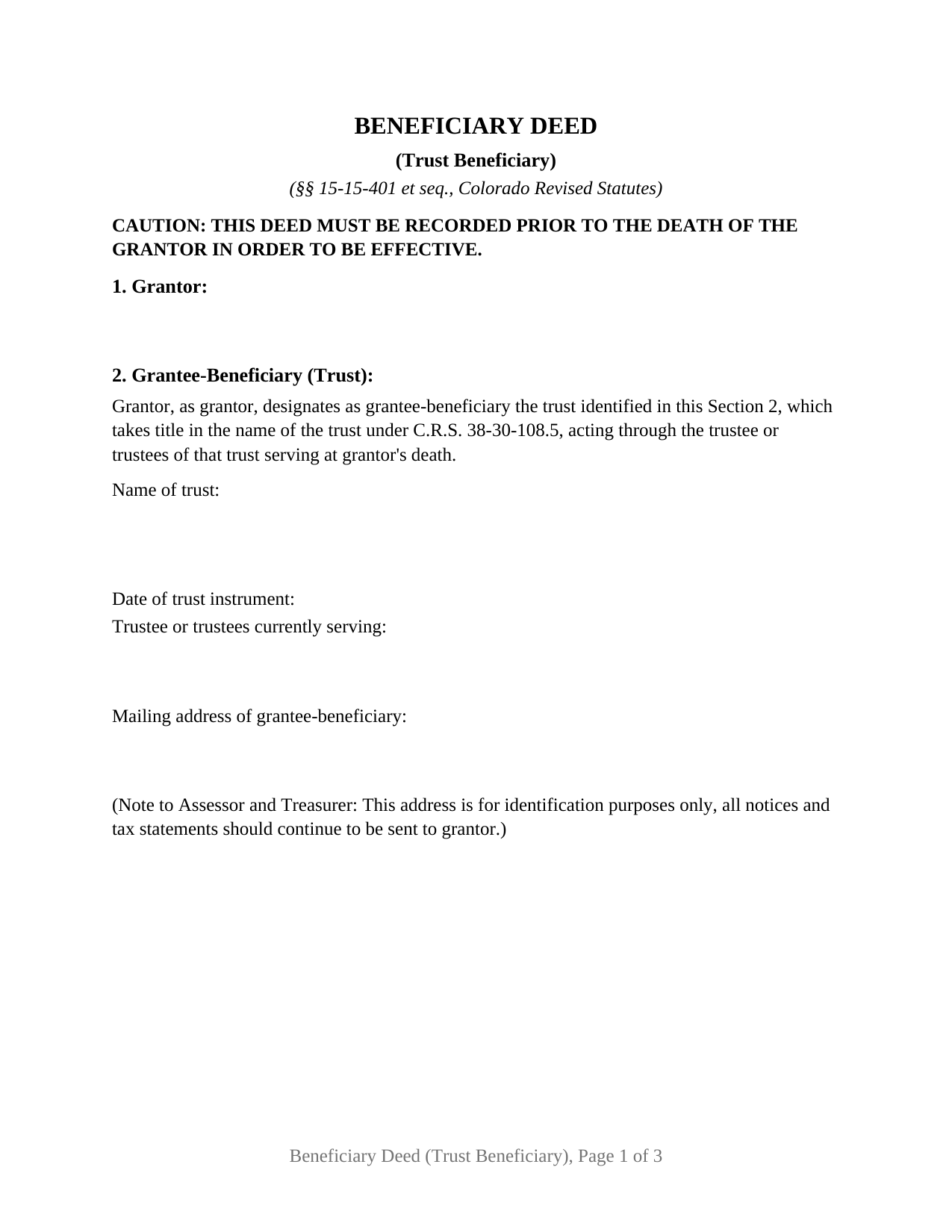
A Colorado beneficiary deed can name a trust, rather than a person, to receive real property when the owner dies. This form prepares that deed under C.R.S. 15-15-401 to 15-15-415: one owner signs as grantor, designates a trust as the grantee-beneficiary, and the owner's interest in the property passes to the trust, in the name of the trust, on the owner's death and outside probate. Colorado calls the instrument a beneficiary deed; the same device is known elsewhere as a transfer on death deed or TOD deed.
A designation the trust never signs
The Colorado chapter builds the beneficiary deed around the owner alone. Under C.R.S. 15-15-402, the deed is signed by the owner of the interest as grantor, the transfer is effective only on the owner's death, no consideration is required, and the joinder, signature, consent, or notice of the grantee-beneficiary is not required. During the owner's lifetime the trust named in the deed has no right, title, or interest in the property, and the owner keeps full power to sell, mortgage, lease, or deal with it without the trustee's participation. The deed is revocable at any time by a recorded revocation or by a later recorded beneficiary deed, which under C.R.S. 15-15-405(2) revokes every earlier grantee-beneficiary designation for the same property. A will cannot revoke, alter, or amend it; C.R.S. 15-15-405(4) says so in terms.
The form carries the sentences the statutory form in C.R.S. 15-15-404(1) prints: the recording caution at the top, the operative words by which the grantor transfers, sells, and conveys on grantor's death to the grantee-beneficiary, and the three capitalized warnings on revocability, Medicaid eligibility, and probate. The statutory form is permissive, so the house arranges its blanks in numbered sections while keeping the statute's own words where they do legal work.
Title that vests in the name of the trust
Colorado lets a trust hold real property in its own name. C.R.S. 38-30-108.5(1) provides that a trust may acquire, convey, encumber, lease, or otherwise deal with any interest in real property in the name of the trust, and subsection (2) lets any trustee record a statement of authority under C.R.S. 38-30-172 to evidence the trust's existence and the trustee's authority. A companion statute, C.R.S. 38-30-108, governs an instrument whose grantee is described as trustee: the instrument also identifies the trust or the person represented, or the description is presumed to be of the person only. This form answers both statutes at once. Its trust section collects the trust's name, the date of its trust instrument, the trustee or trustees currently serving, and a mailing address for the trust, and its fixed text designates the trust as grantee-beneficiary taking title in the name of the trust and acting through the trustees serving at the grantor's death.
The address line matters for recording as well as identification. C.R.S. 38-35-109(2) requires every recorded deed to include the grantee's legal address and directs the clerk to return a deed that lacks one, and C.R.S. 15-15-406 applies that rule to beneficiary deeds expressly. The statutory form's own note to the assessor and treasurer follows the address, stating that it is for identification only and that notices and tax statements continue to go to the grantor.
Why the deed reaches the clerk before the owner dies
Recording is not a formality here; it is the condition on which the deed works. C.R.S. 15-15-404(1) requires the beneficiary deed to be recorded before the owner's death in the office of the clerk and recorder of the county where the property is located, and a deed left unrecorded at death transfers nothing, however carefully it was signed and notarized. The same timing governs any later revocation, and the most recently executed deed or revocation recorded before death controls under C.R.S. 15-15-405(3). The recording fee is a flat per-document charge under C.R.S. 30-1-103 as amended in 2025, quoted on most county schedules at forty-three dollars with the C.R.S. 30-10-421 surcharges. Colorado's documentary fee under C.R.S. 39-13-102 is imposed where consideration exceeds five hundred dollars, and a beneficiary deed needs no consideration at all, so the deed is ordinarily presented with no documentary fee due.
What the trust takes at the owner's death
Under C.R.S. 15-15-407(1), title vests in the grantee-beneficiary only on the owner's death. The trust takes the owner's interest subject to every conveyance, encumbrance, mortgage, lien, contract, and other interest affecting title at that moment, whether created before or after the deed was recorded, under C.R.S. 15-15-407(2), and subject to the state's Medicaid recovery claim under subsection (4). The deed carries no warranties of title and has the effect of a bargain and sale deed under C.R.S. 15-15-404(2). After the death, the trustee records proof of death in the manner used for a deceased joint tenant under C.R.S. 15-15-413 and 38-31-102, and a holder of an unrecorded interest has four months after the death to record notice of it under C.R.S. 15-15-407(3). The trust instrument, not the deed, then says what the trustee does with the property.
The one-grantor, one-trust configuration
The form recites exactly one grantor, a natural person signing in his or her own name, and exactly one grantee-beneficiary, a trust. It prints no marital status and no term of the trust; the grantor may be married or unmarried, and the trust may be the grantor's own revocable living trust, an irrevocable trust, or a trust someone else created. It carries one signature block and one acknowledgment certificate. An owner who holds property in his or her own name and wants it to reach an existing revocable trust at death without retitling it during life, and a parent whose estate plan routes real property into a trust for descendants, present the pattern this deed recites. The form is not set up for two owners signing one deed, for a trustee or an entity as grantor, for a designation of individual beneficiaries, or for a successor grantee-beneficiary; the statutory form's optional successor clause is written for a beneficiary who fails to survive the grantor, and this form omits it.
Signing and the Colorado certificate
The grantor signs before a notarial officer, who completes the acknowledgment certificate; no witness is required on a Colorado deed. The certificate on the form uses the Colorado short form of C.R.S. 24-21-516(1)(a), This record was acknowledged before me on, with the venue left for the officer to complete, since the venue is where the act is performed rather than where the property lies. An owner who signs outside Colorado appears before an officer of that state, and C.R.S. 24-21-511 gives that act the same effect as a Colorado officer's. C.R.S. 24-21-525(7) bars a notary from acting on a record with unfilled blanks in its text, so the deed's entries are complete before the acknowledgment is taken. Dower and curtesy do not exist in Colorado under C.R.S. 15-11-112, and C.R.S. 38-41-202(3) lets the owner of an automatically homesteaded property convey or encumber it without any other signature, so a non-owner spouse has no signature line on this deed; the guide describes the recorded homestead declaration under C.R.S. 38-41-202(4) as the one setting that changes the analysis.
The package includes the fillable Colorado Beneficiary Deed (Trust Beneficiary) form, a completed example filled in for a realistic Jefferson County fact pattern, and the guide that walks through each numbered section, the Colorado title statutes that govern a trust as grantee, and the recording process. This description and the guide describe the form and the governing statutes in general terms; they are not legal advice.
Important: County-Specific Forms
Our beneficiary deed (trust beneficiary) forms are specifically formatted for each of the 64 counties in Colorado.
After selecting your county, you'll receive forms that meet all local recording requirements, ensuring your documents will be accepted without delays or rejection fees.