Colorado Warranty Deed (Two Grantors)
County Specific Legal Forms Validated as recently as October 7, 2026 by our Forms Development Team
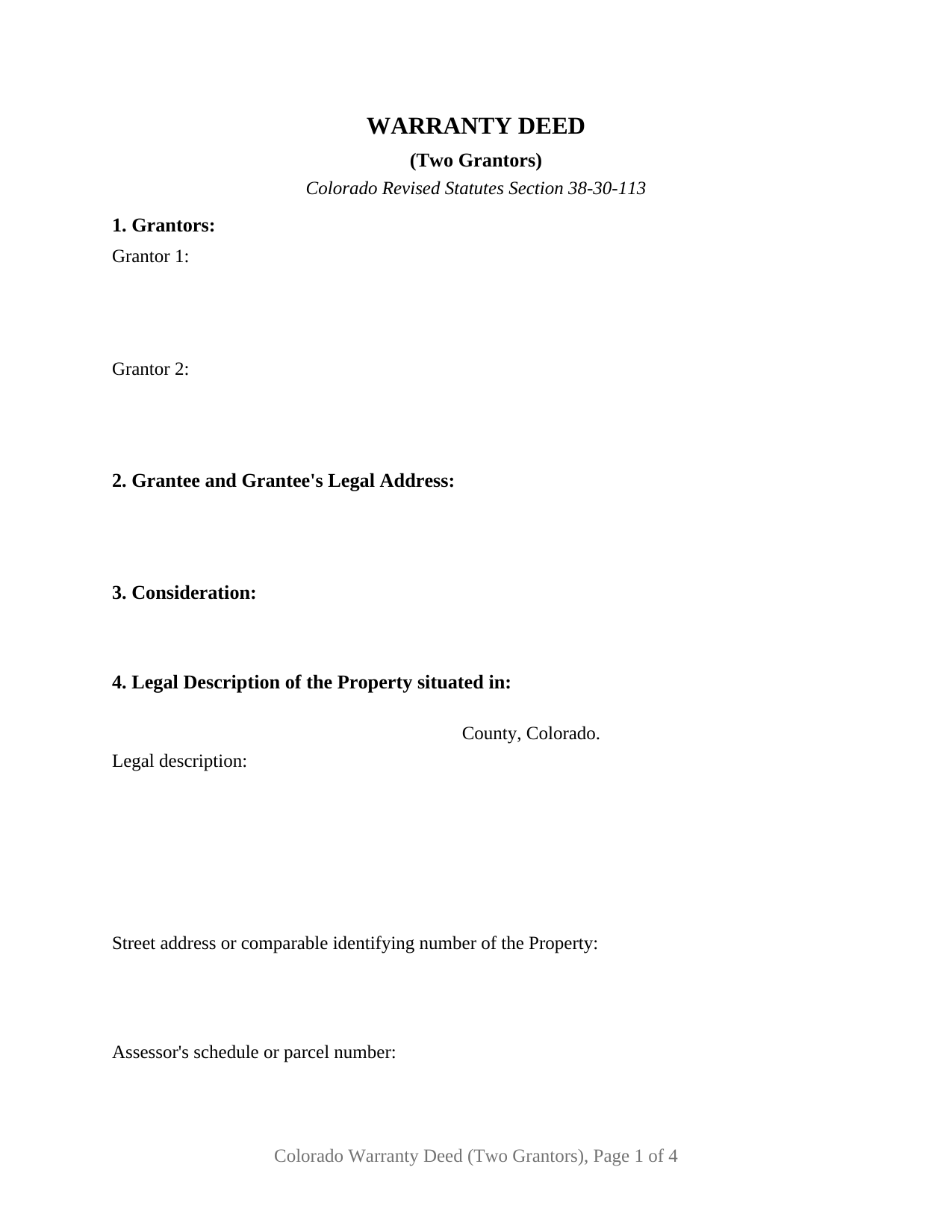
About the Colorado Warranty Deed (Two Grantors)
How to Use This Form
- Select your county from the list
- Download the county-specific form
- Fill in the required information
- Have the document notarized if required
- Record with your county recorder's office
What Others Like You Are Saying
"The web cite is very easy to navigate through making a document process simple to obtain."
"Great Service! Thank you"
"No complaints"
"Excellent website, thanks so much."
"After purchasing the Quit Claim Deed, I felt I had purchased something I could have gotten free some…"
4.8/5 from 4,828 reviews. Read all
Two record owners join in this deed, and both of them stand behind the title. The Colorado Warranty Deed (Two Grantors) prepares a single conveyance signed by exactly two individual grantors, built on the statutory short form in Section 38-30-113(1)(a) of the Colorado Revised Statutes, so a pair of co-owners sell and convey together and warrant the title in the same statutory words.
The whole estate moves in one instrument
A deed signed by one co-owner reaches only that owner's undivided share. When both record owners execute the same warranty deed, the grantee takes everything the two of them hold, and the statutory covenants attach to the full conveyance: ownership in fee simple with power to convey, freedom from encumbrances beyond those the deed states, quiet possession, and a duty to defend the title, the meaning Section 38-30-113(4)(a) assigns to the warranty words. Because the grantors join in one instrument, one recording, one documentary-fee computation, and one set of exceptions govern the entire transfer, instead of parallel deeds each moving a fractional share.
Two signatures, a certificate for each
The form recites two grantors from start to finish: two party blocks in the opening section, two signature lines with printed names and dates, and a separate acknowledgment certificate for each grantor in the wording of Colorado's notarial short form, stating that the record was acknowledged before the officer on a stated date by the named person. Separate certificates let the two owners sign on different days, in different counties, or in different states, with each certificate recording one clean acknowledgment. Colorado's short form is written for one or more names, so the law does not demand this layout; the form carries it because two co-owners rarely stand in front of the same notary at the same moment.
Married couples who both hold record title, siblings who inherited land together, and two investors who took title in their individual names present the two-owner record this deed recites. A sole owner's conveyance, a deed from three or more co-owners, and execution by an entity, a trustee, or an agent under a power of attorney each call for recitals this deed does not carry, and the form is not set up as any of those configurations.
Co-ownership words that matter twice
Colorado's co-ownership rules touch this deed on both sides. On the grantor side, the form the two owners held in makes little difference to conveying out: whether the pair were tenants in common or joint tenants, a deed executed by both passes the complete estate and closes out the co-tenancy. On the grantee side, the deed's vesting words decide what the record shows next. A deed to two grantees creates a tenancy in common by default under Section 38-31-101, survivorship arises only from an express declaration of joint tenancy, and entirety language has no home in Colorado, where a post-2006 attempt at tenancy by the entirety becomes a joint tenancy by statute. The guide walks through each vesting Colorado recognizes and the words that create it.
What the recorder checks before stamping
Colorado recording runs through the clerk and recorder of the county where the land lies, and two numbers meet the deed at the counter. The flat recording charge is $40 per document under the 2024 fee legislation, and statutory surcharges bring the quoted figure to $43 in many counties. The documentary fee then rides the price: ten cents per thousand dollars of consideration once the total passes the $500 threshold, noted by the clerk on the record before the deed is accepted. The transfer declaration that reports sale terms to the county assessor travels alongside the deed without entering the record, and the deed itself carries the grantee's legal address because a Colorado deed lacking it comes back unrecorded. The completed example in this package works a realistic Mesa County sale through each of those checkpoints.
The download delivers three pieces: the blank two-grantor warranty deed as a fillable PDF, a completed example prepared on the Mesa County fact pattern, and a plain-language guide covering each numbered section, the statutory covenants, grantee vesting options, and the recording steps. The materials describe Colorado law in general terms and are not legal advice.
Important: County-Specific Forms
Our warranty deed (two grantors) forms are specifically formatted for each of the 64 counties in Colorado.
After selecting your county, you'll receive forms that meet all local recording requirements, ensuring your documents will be accepted without delays or rejection fees.