District Of Columbia Transfer on Death Deed (Two Owners, Tenants by the Entirety)
County Specific Legal Forms Validated as recently as October 21, 2026 by our Forms Development Team
About the District Of Columbia Transfer on Death Deed (Two Owners, Tenants by the Entirety)
How to Use This Form
- Select your county from the list
- Download the county-specific form
- Fill in the required information
- Have the document notarized if required
- Record with your county recorder's office
What Others Like You Are Saying
"fast and easy"
"I downloaded your Transfer on Death Deed Forms on Monday and registered the deed on Wednesday. Thank…"
"Easy to use , so far"
"I liked the information I download. Just what I was looking for."
"Thank you for your patience and help with filing the documents needed. You were helpful, prompt, cou…"
4.8/5 from 4,842 reviews. Read all
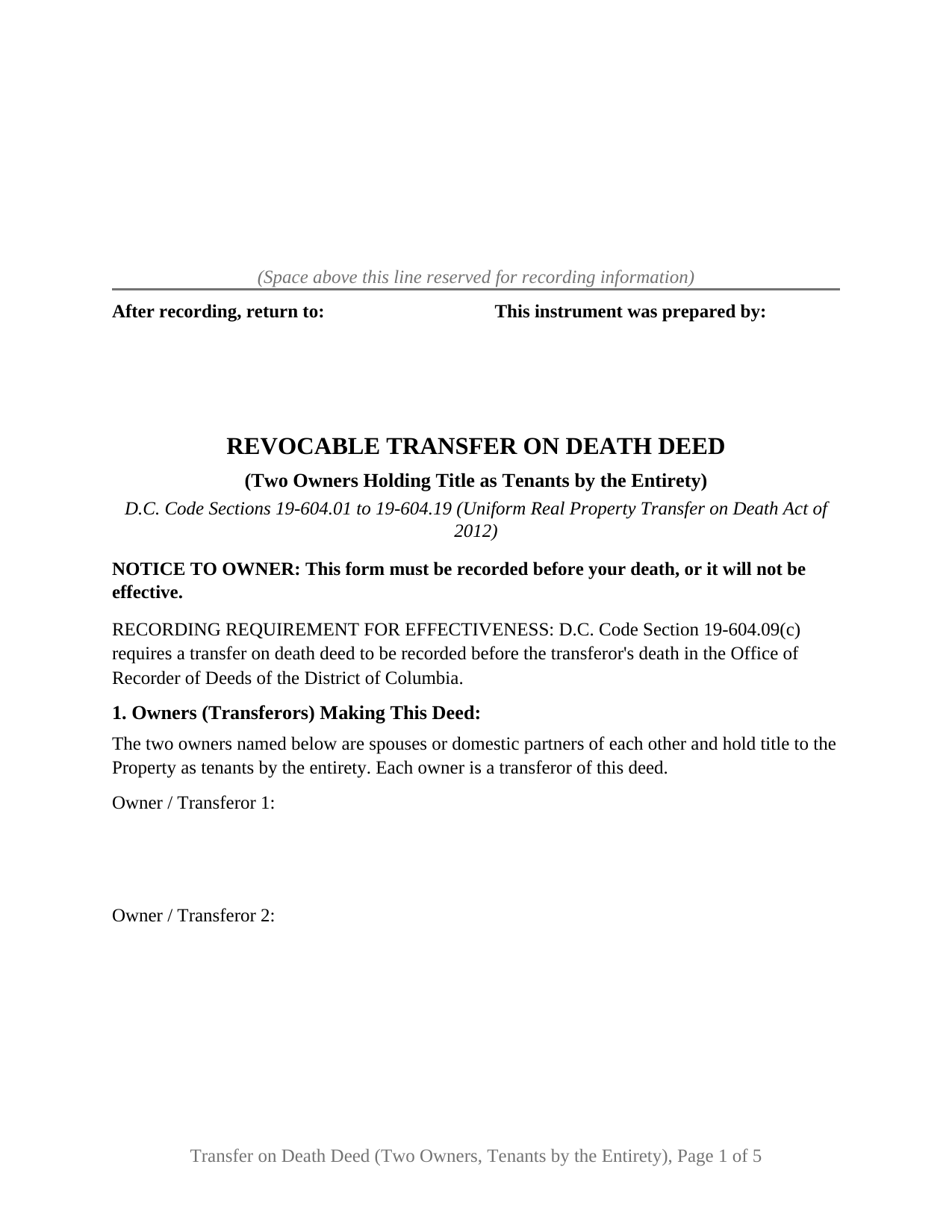
Spouses or domestic partners who hold a District of Columbia home as tenants by the entirety can settle, in one recorded instrument, who takes the property after both of them have died. This form prepares that revocable transfer on death deed under the District's Uniform Real Property Transfer on Death Act (D.C. Code Title 19, Chapter 6, Subchapter IV) for exactly two owners whose title already carries the entireties survivorship, and both owners sign it.
A deed that waits for the second death
The entireties estate does the work at the first death, and the deed does the work at the second. Section 19-604.02(3) counts a tenant by the entirety as a joint owner, and section 19-604.13(c) and (d) supply the timing for a joint owner's deed: when one owner dies survived by the other, the property belongs to the surviving owner with right of survivorship and the deed transfers nothing; when the last surviving owner dies, the deed is effective and the named beneficiaries take without probate. The form states that timing in its transfer section, and its designation sentences measure a beneficiary's survival from the death of the last surviving owner.
Why the couple's vesting deed decides the question
The District does not presume that a married couple holds with survivorship. Section 42-516(a) makes every grant to two or more persons, spouses and domestic partners included, a tenancy in common unless the deed expressly declares otherwise, and section 42-516(c) allows a tenancy by the entirety only in a conveyance to spouses or to domestic partners as defined in section 32-701(3). A tenancy in common sits outside the joint-owner definition. The words in the couple's own vesting deed, as tenants by the entirety, are what place a household inside the configuration this form recites.
The estate also exists only between spouses or domestic partners, so an absolute divorce ends it, and section 19-604.13(a) makes the deed's operation at death subject to the Superior Court's property disposition under section 16-910; the guide describes both points with their statutes.
Two signatures, two seals, two certificates
The form carries exactly two owner blocks, under a fixed recital that the two owners are spouses or domestic partners of each other and hold title to the Property as tenants by the entirety; two signature blocks, each ending in the printed [(SEAL)] scroll the District's statutory form prints and section 42-306(b) calls for; and two acknowledgment certificates built on the statutory short form sentence of section 1-1231.15, each with a reserved area for the officer's official seal. The certificates are separate so the owners may appear on different dates or in different places; the completed example shows one owner acknowledging in the District and the other in Maryland. No block is left unused, because a deed of joint owners is revoked only by all of the living joint owners under section 19-604.11(b) and the transfer the form recites depends on both owners joining in it. The form is not set up as an instrument for a sole owner, for tenants in common, for a trustee or an entity, or for a signer acting under a power of attorney, and it carries no room for a third owner.
Recording while both owners are living
Section 19-604.09(c) makes recording before the transferor's death a condition of the deed's effect, and the form carries the statutory form's warning to that effect above its first section. For a deed made by two transferors, recording promptly after both have acknowledged places it of record before either death. The District's single Recorder of Deeds records every parcel in the District; its published requirements call for the square, suffix, and lot legal description, a legible return address, and a completed Form FP-7/C with every deed. After the second death, the beneficiary's confirmatory deed is exempt from the District's recordation and transfer taxes under sections 42-1102(34) and 47-902(26); that deed, with the death certificate and tax form, is prepared and recorded separately at that time and is not included in this package.
Three items make up the package: the fillable deed behind its non-recorded instructions page, a completed example built on a realistic District of Columbia fact pattern, and a guide covering each section of the form, the signing and sealing formalities, and recording. The description and the guide explain the form and its statutes in general terms and are not legal advice.
Important: County-Specific Forms
Our transfer on death deed (two owners, tenants by the entirety) forms are specifically formatted for each of the 1 counties in District Of Columbia.
After selecting your county, you'll receive forms that meet all local recording requirements, ensuring your documents will be accepted without delays or rejection fees.