Florida Enhanced Life Estate Deed (Remainder to Charitable Organization (Individual Grantor))
County Specific Legal Forms Validated as recently as October 11, 2026 by our Forms Development Team
About the Florida Enhanced Life Estate Deed (Remainder to Charitable Organization (Individual Grantor))
How to Use This Form
- Select your county from the list
- Download the county-specific form
- Fill in the required information
- Have the document notarized if required
- Record with your county recorder's office
What Others Like You Are Saying
"very easy make sense instructions. Thank you."
"Appreciate the help with DC's non-intuitive forms. Superb service."
"I could not be happier with the service afforded by Deeds.com. After having been directed to two oth…"
"They didn't have what I was looking for so they refunded my money immediately. Very easy to work wit…"
"An excellent service that I would be happy to use again."
4.8/5 from 4,823 reviews. Read all
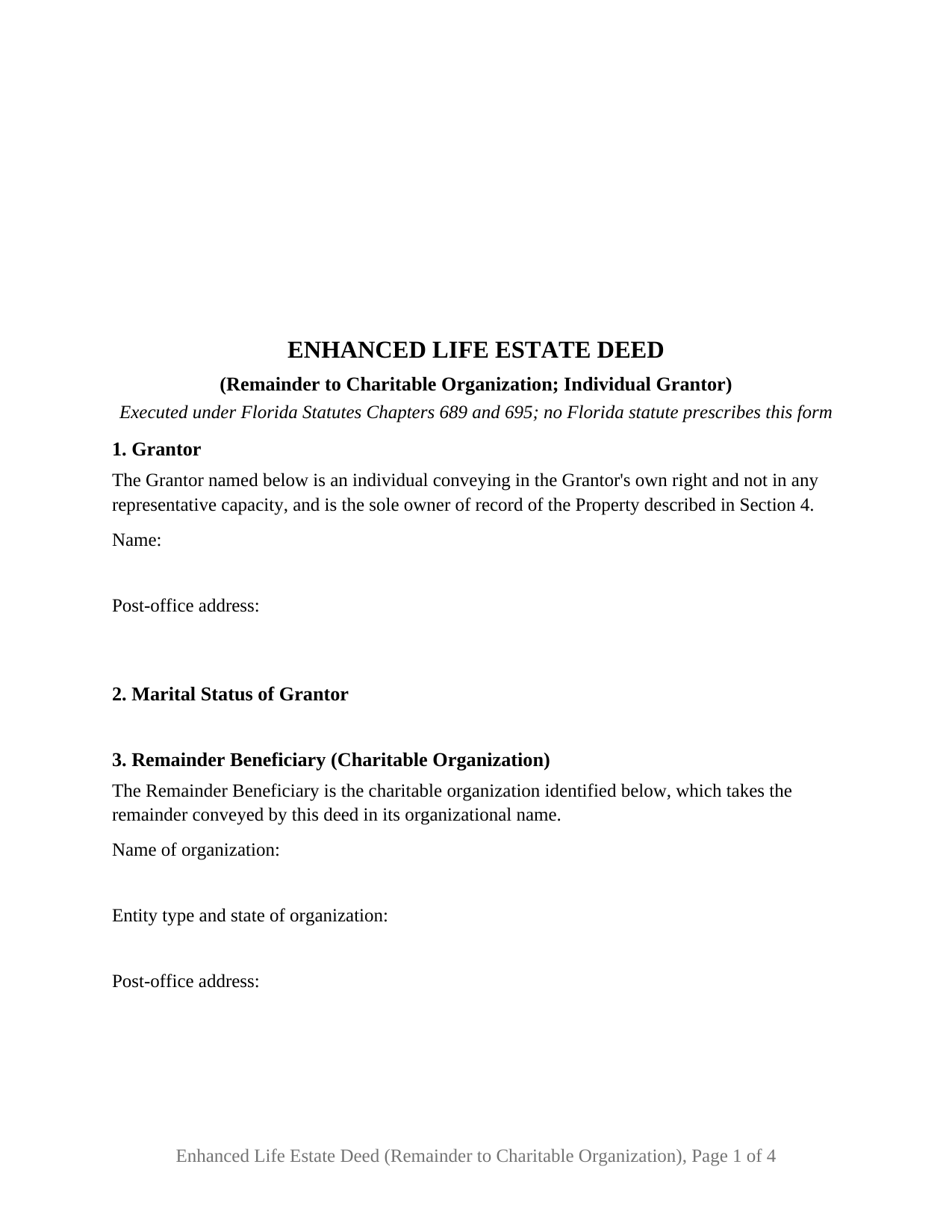
This Florida Enhanced Life Estate Deed names a charitable organization, not a person, as the party that takes the property at the owner's death. One individual grantor reserves a lady bird life estate, keeps every lifetime power over the property, and conveys the remainder to a nonprofit identified by its organizational name, entity type, state of organization, and post-office address. The remainder is written for an organization from the start: it vests in possession only if the organization, or its successor by merger or conversion, exists and has not been dissolved at the grantor's death, and otherwise it fails and the property passes as though the deed had never been made.
A remainder written for an organization
An organization can merge, convert, or dissolve, so a remainder to a charity says what happens in each case. Section 3 collects the organization's legal name, its entity type and state of organization, and the post-office address section 695.26(1)(f) requires for every grantee. Section 8 conveys the remainder to the organization and its successors, so that a surviving corporation in a merger takes under section 617.1106(2), which vests a merged corporation's real property in the survivor without reversion or impairment, and it conditions the remainder on existence at the grantor's death. Section 617.0302(9) gives a Florida corporation not for profit the power to take real property by gift.
What the grantor keeps until death
Section 7 reserves to the grantor a life estate with exclusive possession and all proceeds, together with full power, without liability for waste and without the joinder, consent, or notice of the organization, to sell, convey, mortgage, lease, gift, encumber, or otherwise dispose of the property in fee simple and to keep the proceeds. The reserved powers expressly include the power to divest the organization of the remainder by a later recorded instrument, the element Florida Uniform Title Standards 6.10 and 6.11 (June 2019) describe. Nothing passes to the organization during the grantor's life.
Quitclaim words and no warranty
No Florida statute creates the enhanced life estate deed; its components are statutory. The remainder is conveyed with the operative words of Florida's statutory quitclaim form in section 689.025, remise, release, and quitclaim, and the deed states that the grantor makes no covenant or warranty of title and conveys only the interest the grantor holds. Section 4 carries the parcel identification number blank section 689.025(3) requires.
The configuration this deed prints
The deed recites exactly one grantor, an individual conveying in the grantor's own right and the sole owner of record, with one signature block, the two subscribing witness blocks section 689.01 requires, each carrying the witness's printed name and post-office address under section 695.26(1)(c), and one acknowledgment certificate on the section 695.25(1) short form with a reserved area for the notary's seal. The deed prints no joinder line for a spouse, so the pattern it recites is a grantor whose conveyance calls for none under article X, section 4(c) of the Florida Constitution: an unmarried owner, or a married owner conveying property that is not constitutional homestead. An owner without close family who means a church, a land conservancy, or a college foundation to have the house, and a donor who intends to live in a promised residence and keep the option of selling it, present the pattern this deed recites. Two owners, an attorney in fact signing for the owner, a remainder to natural persons, and a gift in trust each present a different configuration.
Recording in the county of the property
The deed is recorded with the clerk of the circuit court in the county where the land lies, at the section 28.24 charges of $10 for the first page and $8.50 for each additional page; the completed example runs four pages. The first page reserves the 3-inch by 3-inch clerk space section 695.26(1)(e) sets aside, the preparer block names the natural person who prepared the deed under section 695.26(1)(b), and the Department of Revenue's published ruling TAA 20B4-004 (2020) treated a deed of this kind, on unencumbered property with no other consideration, as outside the documentary stamp tax of section 201.02, a ruling binding only as to the taxpayer who requested it.
The download contains the fillable deed, a completed example on a Pinellas County fact pattern in which a widow names a Florida not-for-profit conservation corporation as the remainder beneficiary, and a guide to every blank, the witness and notary mechanics, the homestead rules, and the recording process. The materials are not legal advice.
Important: County-Specific Forms
Our enhanced life estate deed (remainder to charitable organization (individual grantor)) forms are specifically formatted for each of the 67 counties in Florida.
After selecting your county, you'll receive forms that meet all local recording requirements, ensuring your documents will be accepted without delays or rejection fees.