Florida Gift Deed (Trustee Grantee)
County Specific Legal Forms Validated as recently as October 11, 2026 by our Forms Development Team
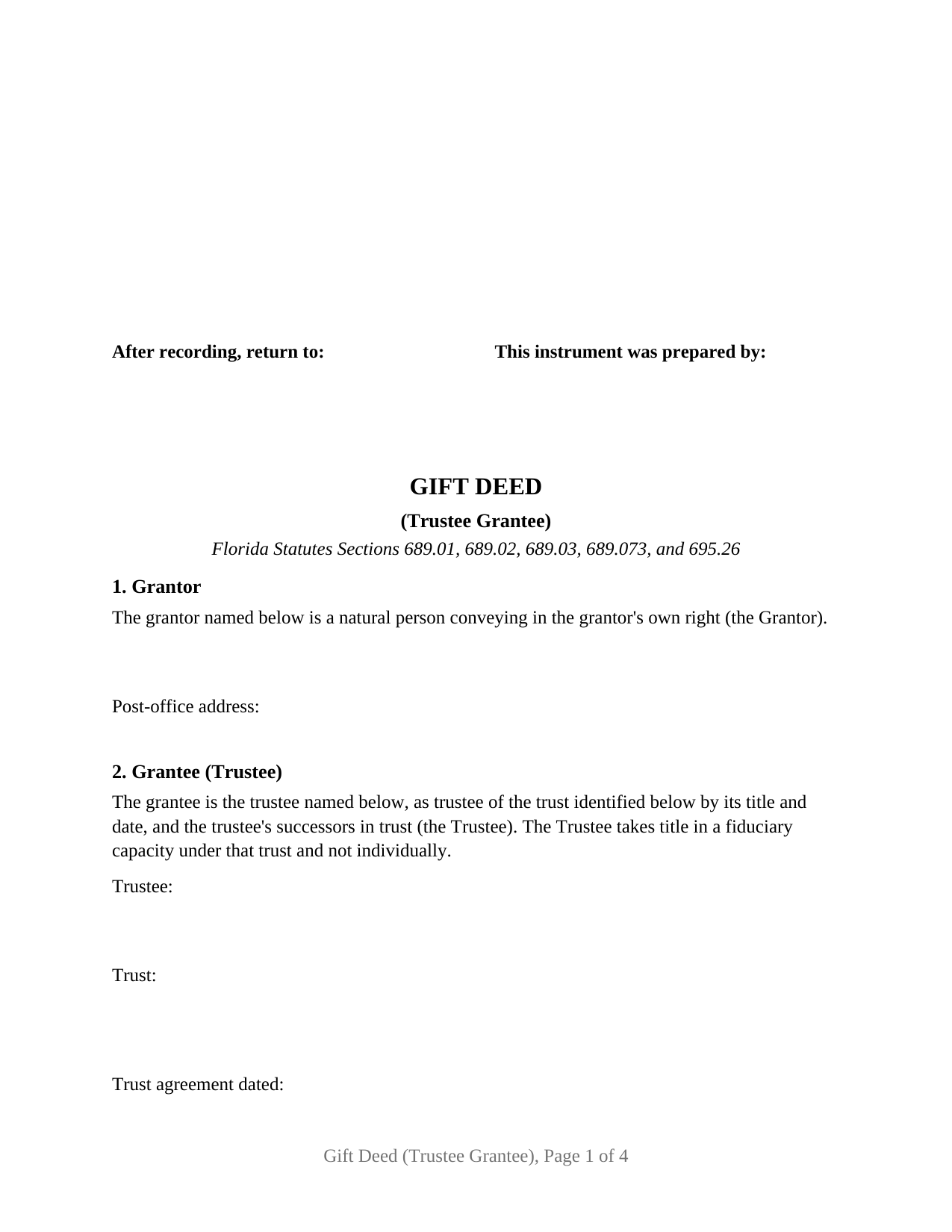
About the Florida Gift Deed (Trustee Grantee)
How to Use This Form
- Select your county from the list
- Download the county-specific form
- Fill in the required information
- Have the document notarized if required
- Record with your county recorder's office
What Others Like You Are Saying
"I found the process of downloading and completing the documents very user friendly. Thank you for th…"
"Deeds.com is a godsend! Being able to download the pertinent state and county specific forms reassur…"
"Very convenient & easy to use this website. Information was helpful."
"The site was easy to navigate...all the information needed to fill in the forms was included, which …"
"Wow absolutely amazing service. So quick and easy and makes what would be such a hassel a piece of c…"
4.8/5 from 4,823 reviews. Read all
A Florida gift deed to a trustee puts real property into a trust by name: the grantee is the trustee of a trust identified by its title and trust agreement date, and the deed itself confers the recorded powers that let the trustee deal with the land. This Florida Gift Deed (Trustee Grantee) is built for one grantor, a natural person conveying in the grantor's own right, giving the property to that trustee for love and affection alone, with no money or other valuable consideration.
Why the trust is named by title and date
Florida treats a bare trustee designation as no trust at all. Under Section 689.07, Florida Statutes, a deed that adds only the word trustee to the grantee's name, naming no beneficiaries, setting forth no trust purposes, and identifying no trust by title or date, grants that person a fee simple estate individually. This deed closes that gap on its face: its grantee section recites that the grantee is the trustee of the trust identified by its title and date, together with the trustee's successors in trust, and that the trustee takes title in a fiduciary capacity and not individually, with entries for the trustee's name, the trust's title, the trust agreement date, and the trustee's post-office address.
Recorded powers under Section 689.073
A trust agreement stays private, so a later buyer or lender cannot read the trustee's authority from the public record. Section 689.073, Florida Statutes, answers that for a recorded instrument conferring on the trustee the power to protect, to conserve, to sell, to lease, to encumber, or otherwise to manage and dispose of the property: the statute vests those powers in the trustee and relieves anyone dealing with the trustee of any obligation to inquire into the beneficiaries or the trustee's authority. The deed's powers section confers those powers in the statute's own words.
A gift with the statutory warranty behind it
The conveyance uses the granting and warranty words of the statutory warranty deed in Section 689.02, Florida Statutes: the grantor has granted, bargained, sold, and conveyed the property to the trustee and the trustee's successors in trust and assigns forever, in trust, and does hereby fully warrant the title against the lawful claims of all persons whomsoever. A permitted exceptions entry holds current taxes, recorded easements and restrictions, and any mortgage that remains. The consideration recital names no dollar figure, because the Department of Revenue's rules treat a gift of unencumbered realty as not taxable while a recital of love and affection with one dollar draws at least the minimum documentary stamp tax; a mortgage left on the property is consideration taxed on its unpaid balance.
One grantor, one trustee
The form recites exactly one grantor, a natural person signing in the grantor's own right, and exactly one grantee, the trustee of the named trust. A parent conveying a rental house to the trustee of an irrevocable trust for grandchildren and a donor conveying land to the trustee of a charitable trust present the pattern this deed recites. The form carries one signature block, two subscribing witness blocks with the printed names and post-office addresses Section 695.26 requires, and one acknowledgment certificate in the short form of Section 695.25(1) with a reserved area for the notary's rubber-stamp seal. It is not set up as a deed by two grantors, by an entity or fiduciary grantor, or by an attorney in fact; a married owner's gift of homestead calls for the spouse's joinder under Article X, Section 4(c) of the Florida Constitution, a signature this form does not carry.
Recording in the county where the land lies
The deed is recorded with the clerk of the circuit court, its first page leaving the 3 inch by 3 inch clerk space at the top right. The guide explains the trust provisions of the Department of Revenue's Rule 12B-4.013, including the rule that a deed to the trustee of the grantor's own revocable trust is not a transfer of ownership for stamp tax purposes, and the just-value reassessment Section 193.155 applies after a change of ownership of homestead property.
The package contains the fillable deed form, the completed example filled in for a Pinellas County conveyance to the trustee of a family trust, and the guide that explains each section, the two-witness signing, and the recording and stamp tax treatment. This description and the guide describe the form and the governing law in general terms; they are not legal advice.
Important: County-Specific Forms
Our gift deed (trustee grantee) forms are specifically formatted for each of the 67 counties in Florida.
After selecting your county, you'll receive forms that meet all local recording requirements, ensuring your documents will be accepted without delays or rejection fees.