Florida Trustees Deed
County Specific Legal Forms Validated as recently as October 1, 2026 by our Forms Development Team
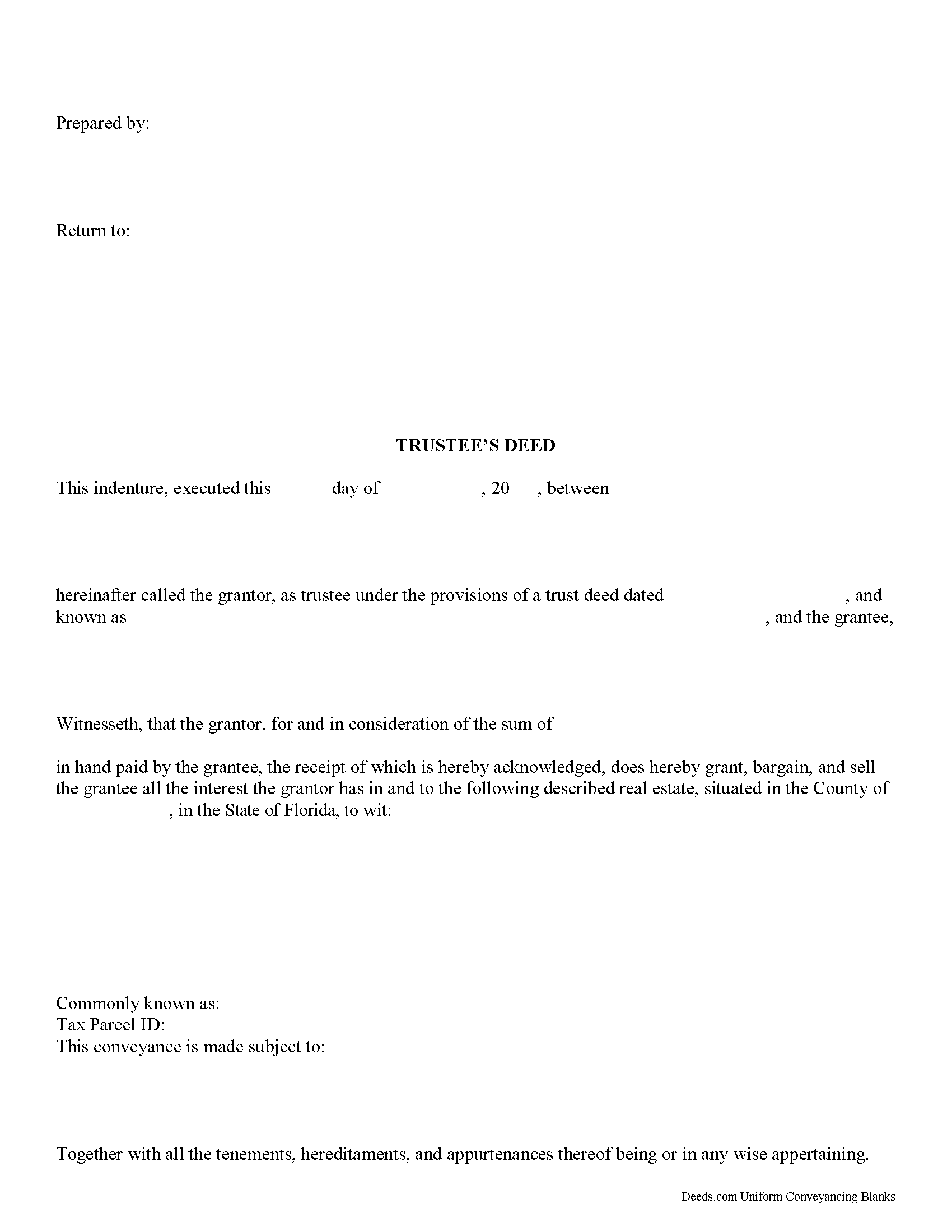
About the Florida Trustees Deed
How to Use This Form
- Select your county from the list
- Download the county-specific form
- Fill in the required information
- Have the document notarized if required
- Record with your county recorder's office
What Others Like You Are Saying
"So easy and fast. Since covid-19 is here, this option is perfect."
"Quick and Easy"
"We were very pleased at how quickly the forms showed up and the guide and copy of a sample filled in…"
"Deeds was very easy to use. I thought it might take weeks to complete, but the whole process was com…"
"Very fast, efficient, and convenient - thanks Deeds.com! I would recommend this service to everyone …"
4.8/5 from 4,825 reviews. Read all
A Florida trustees deed sits at the intersection of three bodies of law that don't play nicely together: the Florida Trust Code (Chapter 736), the conveyancing and recording statutes in Chapters 689 and 695, and the constitutional homestead protections in Article X, Section 4. Unlike most states that treat a transfer out of trust as administrative paperwork, Florida requires two subscribing witnesses on the deed, imposes documentary stamp tax even when the trustee receives no money, and may demand that a non-titled spouse join in the conveyance if the property is homestead. Florida also recognizes two distinct trust vehicles that hold real estate — the ordinary living trust under Chapter 736 and the land trust under the Florida Land Trust Act (Fla. Stat. § 689.071) — and the trustees deed has to be drafted with the right one in mind.
When a Trustees Deed Is Used in Florida
Trustees use this deed to convey real property out of a Florida trust — commonly a revocable living trust at the death or resignation of the trustor, distribution to a trust beneficiary, sale to a third party, or transfer out of a Florida land trust at the direction of the beneficiaries or holder of the power of direction. Trustees of mortgage-related trusts also use the form for non-judicial transfers in foreclosure contexts. The deed serves the same recording and notice function as a warranty or quitclaim deed, but it identifies the grantor as a trustee acting under a named trust dated a specific date, and it recites the trustee's authority to convey.
Florida Statutory Requirements
The deed must meet the standard Florida content requirements that apply to any conveyance of real property. Under Fla. Stat. § 695.26, an instrument is not eligible for recording in the Official Records unless it includes:
- The name and post office address of the natural person who prepared the instrument or under whose supervision it was prepared
- The names of grantor and grantee legibly typed or printed beneath each signature
- The post office addresses of each grantee
- The names of witnesses legibly typed or printed beneath their signatures
- A 3-inch by 3-inch space in the upper right-hand corner of the first page reserved for recording information, and a 1-inch by 3-inch space on each subsequent page
The deed must also identify the property by legal description, name the grantor in the trustee capacity (for example, "Jane Doe, as Trustee of the Doe Family Revocable Trust dated January 1, 2020"), and recite the consideration. For land trusts, Fla. Stat. § 689.071 vests both legal and equitable title in the trustee, so the trustee conveys directly without joinder of the beneficiaries when the recorded instrument creating the trust gives the trustee that power.
Execution: Two Witnesses Plus Notary
This is the requirement that catches out-of-state trustees most often. Fla. Stat. § 689.01 requires that any deed conveying an estate or interest in Florida real property be signed in the presence of two subscribing witnesses. The acknowledgment before a notary under Fla. Stat. § 695.03 is separate and additional — not a substitute. A trustees deed signed only before a notary, with no witnesses or only one, will be rejected at recording or, worse, recorded but later challenged as defective. The notary may serve as one of the two witnesses, but a second independent witness is still required. Witnesses must sign with their printed names beneath, per § 695.26.
Florida-Specific Traps
Several Florida rules cause more rejected recordings and title defects on trustees deeds than any other category of error:
- Documentary stamp tax. Fla. Stat. § 201.02 imposes documentary stamp tax on deeds at the rate of 70 cents per $100 of consideration (60 cents per $100 in Miami-Dade for single-family residences, with a surtax on other transfers). A transfer from a trust to a beneficiary as a distribution may qualify for minimum tax treatment, but a transfer that pays off a mortgage or otherwise involves consideration is taxed on that consideration. The clerk will not record the deed without the tax paid or a documented exemption.
- Homestead and spousal joinder. Article X, Section 4 of the Florida Constitution restricts the alienation of homestead property. If the property held in trust is homestead and the trustor (or trustor's surviving spouse) is married, the non-titled spouse may need to join in the deed to make the transfer effective — even though title sits in the trust. This is a recurring problem on transfers out of revocable living trusts after the death of the first spouse.
- Certification of trust. Recorders and title underwriters frequently require evidence of the trustee's authority. Fla. Stat. § 736.1017 lets the trustee provide a certification of trust — a sworn summary of the trust's existence, the trustee's identity, and the trustee's powers — rather than recording the entire trust agreement. Recording the full trust instrument is rarely advisable; it makes the dispositive terms of the trust public.
- Preparer block. The "Prepared by" block at the top of the first page is a statutory requirement under § 695.26, not a courtesy. Missing or incomplete preparer information is a common rejection reason.
- Trustee identification. The grantor block must show the trustee's name, the words "as Trustee" or equivalent, the full name of the trust, and the date of the trust instrument. A deed that names only the individual without the trustee capacity creates a chain-of-title break.
- Land trust vs. living trust. Florida land trusts under § 689.071 operate differently from ordinary trusts under Chapter 736. The deed should reflect which type of trust holds title and reference the recorded instrument that vested title in the trustee where applicable.
Recording the Deed
Record the executed deed in the Official Records of the county where the property is located — Florida has 67 counties, each with its own clerk of the circuit court or comptroller handling recordings. Under Fla. Stat. § 695.01, an unrecorded conveyance is not effective against creditors or subsequent purchasers for value without notice. Prompt recording also protects against intervening liens and double-conveyance claims. Recording fees are set by Fla. Stat. § 28.24 and run $10 for the first page and $8.50 for each additional page, plus the documentary stamp tax. Some counties charge an additional indexing fee per name beyond the first four.
Vesting in the Grantee
The trustees deed transfers title to the grantee in whatever vesting the grantee chooses to take — sole ownership, tenancy in common, joint tenancy with right of survivorship, or tenancy by the entireties for a married couple taking title together. Florida does not presume survivorship between joint owners; survivorship language must be expressly stated in the deed. Tenancy by the entireties is presumed for property conveyed to a married couple unless the deed states otherwise, and it carries automatic survivorship plus protection from creditors of one spouse alone.
Download Package
The Florida Trustees Deed package includes the form, line-by-line completion guidelines, and a completed example. Files are provided as fillable PDFs for immediate download after purchase, suitable for use in any Florida county.
Important: County-Specific Forms
Our trustees deed forms are specifically formatted for each of the 67 counties in Florida.
After selecting your county, you'll receive forms that meet all local recording requirements, ensuring your documents will be accepted without delays or rejection fees.