Florida Grant Deed
County Specific Legal Forms Validated as recently as October 11, 2026 by our Forms Development Team
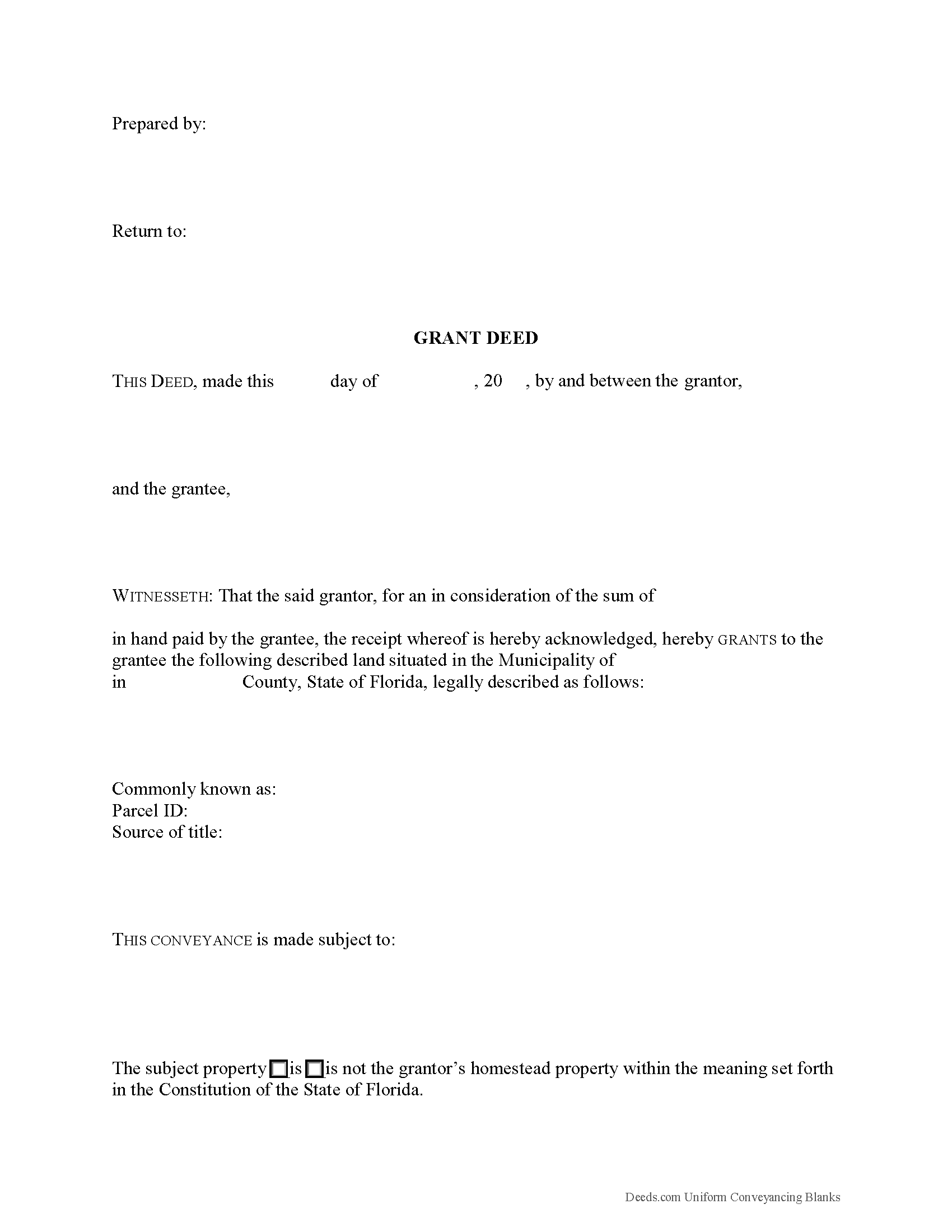
About the Florida Grant Deed
How to Use This Form
- Select your county from the list
- Download the county-specific form
- Fill in the required information
- Have the document notarized if required
- Record with your county recorder's office
What Others Like You Are Saying
"You Guys are Fantastic and the service you all provide. Is PRICELESS!"
"Your customer service person was very professional and polite and helpful."
"Easy to use but can't seem to find LOGOUT control????"
"Great service got everything I needed with a click of a tab. Thank You..."
"Great to find this makes for easy work when you need to secure your ownership of a property!!Thanks …"
4.8/5 from 4,825 reviews. Read all
A Florida grant deed conveys real property with two promises written into the deed itself: that the grantor has not already conveyed the property, or any interest in it, to someone else, and that the grantor has not encumbered it beyond the matters the deed lists. Florida has no grant deed statute, so those covenants exist only because the deed states them. This package prepares that deed for one or two natural persons conveying Florida real estate in their own right.
Two promises, written out
Florida's conveyancing chapter prescribes two deed forms and attaches covenants to only one of them. A deed executed substantially in the warranty deed form of Florida Statutes Section 689.02 is treated by Section 689.03 as a warranty deed with full common-law covenants. The quitclaim form in Section 689.025 conveys whatever interest the grantor has and promises nothing. Nothing in the chapter gives the word grant a covenant of its own, so a Florida grant deed spells out its covenants and states that they are its only covenants of title.
The result is a middle posture. The grantor answers for the grantor's own conveyances and encumbrances, and for those of anyone claiming under the grantor, but does not warrant the title against the world or undertake to defend it against a claim that arose before the grantor owned the property. The deed's exceptions section gives the covenant against encumbrances its edges: current-year taxes, recorded easements and restrictions, and a mortgage the buyer takes subject to are listed there, and a listed matter sits outside the covenant.
One or two grantors, written in by hand
This is the general configuration of the Florida grant deed. The grantor block and the grantee block are open text: each receives one or two names with the status recital Florida practice places after a name, a married man, a single woman, husband and wife, and the grantee block receives the vesting words where two grantees take together, as tenants in common, as joint tenants with right of survivorship, or as spouses holding by the entirety. Nothing about marital status, vesting, or capacity is preprinted, so the same form carries a sole owner's sale, a married couple's conveyance of their jointly held home, and two siblings passing an inherited parcel to one buyer. The guide describes each Florida vesting form with its governing statute or decision.
The deed carries two grantor signature blocks, each with its own pair of subscribing-witness blocks and its own acknowledgment certificate, so two grantors may sign on different days, in different places, or in different states. A single grantor uses the first block and leaves the second blank. The form is not set up for a corporation, limited liability company, or trustee as grantor, for an agent signing under a power of attorney, or for three or more persons on either side; each of those patterns recites different authority and acknowledges under a different certificate.
Witnesses, the notary, and the clerk's list
Section 689.01 requires a Florida deed to be signed in the presence of two subscribing witnesses, and since January 1, 2024, Section 695.26 requires each witness's printed name and post-office address on the instrument. The acknowledgment certificate is the Section 695.25 short form word for word, including the box the notary marks for physical presence or online notarization, the identification line, and a reserved area for the rubber-stamp seal Section 117.05 places below or beside the notary's signature. The preparer's name and address, each grantee's post-office address, and the blank clerk's space at the top right of every page round out the Section 695.26 list the clerk checks before recording. A married grantor conveying homestead is joined by the grantor's spouse under Article X, Section 4 of the Florida Constitution; the second signature block and certificate carry that joinder.
Documentary stamp tax is due when the deed is recorded, at seventy cents per one hundred dollars of consideration statewide and under the separate Miami-Dade rate, and the clerk's recording charge runs by the page. The guide covers both, with the county variations that matter.
The package includes the fillable grant deed, a completed example filled in for a realistic Hillsborough County conveyance, and the guide that walks through every section, the signing and witnessing requirements, and the recording process. This description and the guide describe the form and the governing Florida statutes in general terms; they are not legal advice.
Important: County-Specific Forms
Our grant deed forms are specifically formatted for each of the 67 counties in Florida.
After selecting your county, you'll receive forms that meet all local recording requirements, ensuring your documents will be accepted without delays or rejection fees.